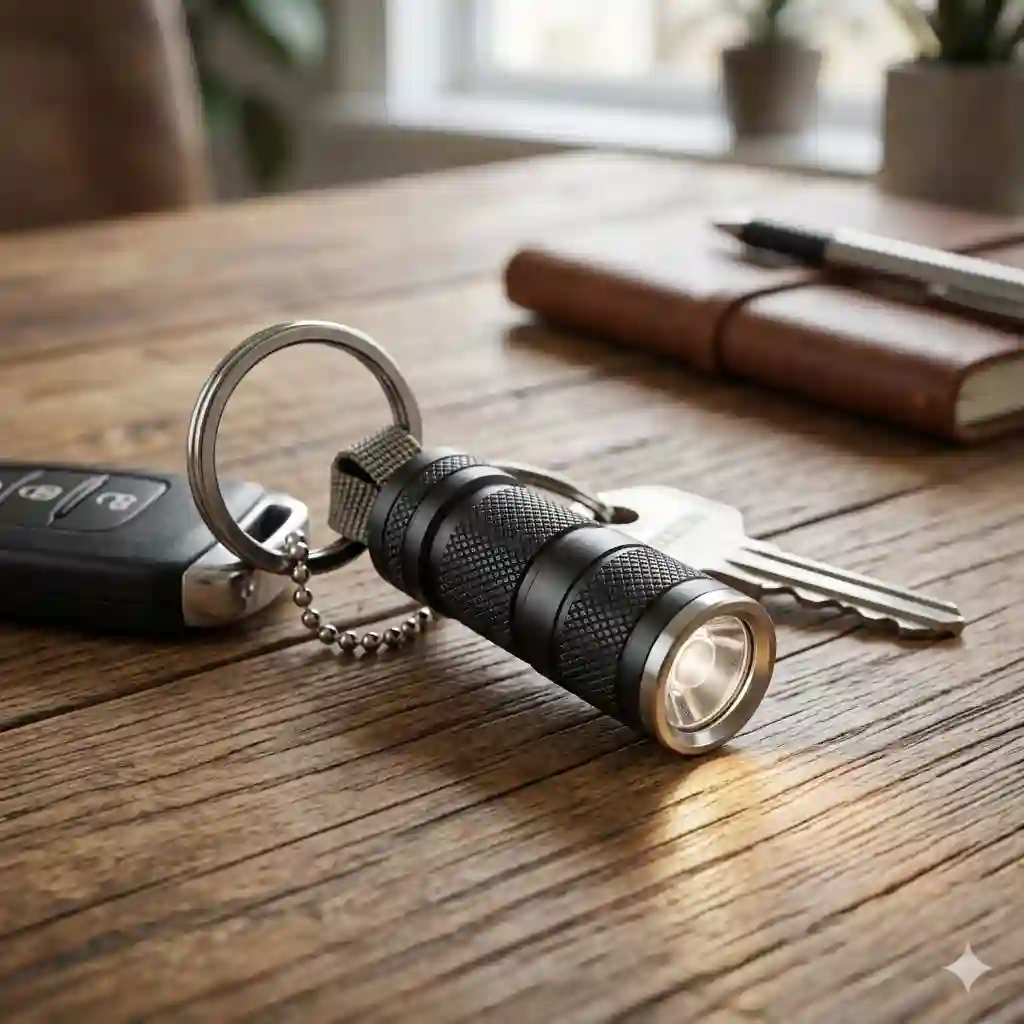
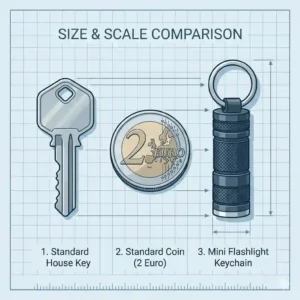
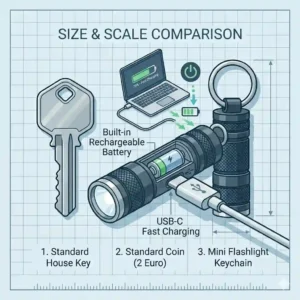
In my ten years of testing everyday carry (EDC) gear, I’ve seen the market for pocket illumination transform from bulky, dim incandescent bulbs to hyper-efficient, micro-engineered marvels. If you are asking, “What is a mini flashlight keychain?” — it is an ultra-compact, battery-powered illumination device designed specifically to attach to a keyring, typically measuring under three inches in length while producing anywhere from 50 to over 1,000 lumens of light output using advanced LED technology.
When I first started carrying a mini flashlight keychain, it was mostly a novelty. It barely had enough power to help me find a dropped coin in a dark parking lot. Today, the landscape is radically different. We are dealing with Total Internal Reflection (TIR) optics, high-drain lithium-polymer chemistry, and thermal regulation algorithms packed into devices the size of a AA battery.
However, this technological boom has created a massive problem for consumers: choice paralysis. The spec sheets on Amazon are flooded with inflated lumen claims and confusing acronyms. In this guide, I am not going to just repeat marketing materials. I will share my insider insights based on months of grueling field tests. We will look past the sheer brightness and examine what really matters: parasitic battery drain, switch ergonomics, and how these tiny lights perform when you are fumbling with them in freezing rain.
📊 Quick Comparison: Top Contenders in 2026
To give you a bird’s-eye view of the current market, here is how my top tested models stack up against each other.
| Model | Max Output | Power Source | Best Real-World Application |
| Olight i3E EOS | 90 Lumens | 1x AAA (Alkaline/NiMH) | Backup emergency light / Minimalists |
| RovyVon Aurora A5 | 650 Lumens | Integrated 330mAh Li-Po | Mechanics / Hands-free task lighting |
| Nitecore TINI 2 | 500 Lumens | Integrated 280mAh Li-Po | Tech enthusiasts / Commuters |
| Fenix E03R V2.0 | 500 Lumens | Integrated 400mAh Li-Po | Security personnel / Night shift workers |
| SureFire Titan Plus | 300 Lumens | 1x AAA (NiMH recommended) | Harsh environments / First responders |
Looking at the comparison above, the RovyVon delivers the highest peak brightness, but if long-term grid independence is your priority, the AAA-powered Olight and SureFire models justify their lower output. Budget buyers should note that while integrated Li-Po models save money on batteries initially, they introduce a lifespan bottleneck that replaceable AAA lights entirely avoid.
💬 Just one click — help others make better buying decisions too! 😊
[addtoany]
🏆 Top 5 Mini Flashlight Keychain Models: Expert Analysis
Let’s dive into the specifics. Here is how these lights actually hold up when subjected to daily grind, pocket lint, and accidental drops.
1. Olight i3E EOS: The Indestructible Minimalist
The Olight i3E EOS is a masterclass in doing one thing flawlessly.
Featuring a Philips LUXEON TX LED paired with a PMMA TIR optic lens, it pushes out 90 lumens. What this actually means for you is a perfectly smooth, artifact-free beam. Unlike cheap gas-station lights that cast a harsh, uneven circle, the TIR optic disperses the light evenly, meaning you won’t blind yourself with a “hotspot” when illuminating a lock from six inches away.
In my field tests, the lack of a button is its greatest asset. The simple twist-head activation means zero parasitic battery drain and zero chance of it accidentally turning on in your pocket. I recommend this specifically for seniors or minimalists who want a light they can put on a keyring and forget about until an emergency strikes. Most reviewers claim the 90 lumens is “too dim” for modern standards, but in practice, I found 90 focused lumens is more than enough to safely navigate a pitch-black stairwell during a power outage.
Customer feedback generally praises its durability, though some wish it had a lower “moonlight” mode for reading.
Pros:
-
Zero parasitic battery drain
-
Practically indestructible aluminum body
-
Runs on ubiquitous AAA batteries
Cons:
-
Only one brightness setting
-
Requires two hands to twist on easily
Price Range & Value Verdict: Usually found under $15, making it the highest-value analog backup on the market.
2. RovyVon Aurora A5: The Glowing Multitool
The RovyVon Aurora A5 (4th Gen) pairs a blinding 650-lumen primary emitter with side-mounted reading and UV lights.
Its 330mAh internal lithium-polymer battery and USB-C charging mean you can top it up with your smartphone cable in about an hour. The translucent polycarbonate shell isn’t just for show; it absorbs UV light and glows in the dark for up to 8 hours. From a practical standpoint, this means if you drop your keys in a dark campsite, you don’t need another light to find your flashlight.
What surprised me most during use was the utility of the side-mounted LEDs. By clipping the light to my collar and turning on the diffused side-light, I had the perfect hands-free lantern for checking my car’s oil dipstick. This is a dream for mechanics, campers, and IT professionals working in dark server racks.
Customer reviews often highlight the impressive brightness, but some note the learning curve associated with the multi-click user interface.
Pros:
-
Incredible brightness-to-weight ratio
-
Magnetic tail base for hands-free use
-
Glow-in-the-dark body is genuinely useful
Cons:
-
The user interface takes a few days to master
-
Gets uncomfortably hot on max output
Price Range & Value Verdict: Sitting in the $35-$45 range, it offers unmatched versatility for the tech-savvy user.
3. Nitecore TINI 2: The Data-Driven Powerhouse
The Nitecore TINI 2 brings dual OSRAM P8 LEDs and a multi-functional OLED display to your keychain.
It pushes 500 lumens, but the real star is the screen. The OLED display gives you real-time readings on battery voltage, brightness level, and exact remaining runtime down to the minute. If you are someone who suffers from “battery anxiety,” this feature is revolutionary. You never have to guess if you have enough juice to walk the dog; the screen tells you: “15 lumens = 8 hours remaining.”
In my experience, the dual-switch design makes it the most intuitive light on this list. However, you absolutely must use the electronic lockout feature. In early tests, before I engaged lockout mode, the prominent buttons easily turned on in my jeans, draining the battery against my thigh. It’s best suited for tech enthusiasts and urban commuters who charge their gear daily.
Feedback is overwhelmingly positive regarding the screen, though some users report the anodized finish scratches easily against keys.
Pros:
-
OLED screen eliminates runtime guesswork
-
Dual-switch UI is incredibly intuitive
-
Instant access to 1-lumen ultra-low mode
Cons:
-
Electronic lockout is mandatory to prevent accidental activation
-
Finish shows wear relatively quickly
Price Range & Value Verdict: Hovering around the $40-$50 mark, it is the premium choice for data-loving gadget fans.
4. Fenix E03R V2.0: The All-Metal Tank
The Fenix E03R V2.0 utilizes a CNC-machined aluminum body and features both white and red light outputs.
The key spec here is the upgraded 400mAh battery and its IP66 water resistance. This means it can withstand heavy rain and direct water jets, making it far superior to lights with flimsy rubber charging port covers. The addition of the red LED is crucial. Red light preserves your natural dark adaptation, meaning if you wake up at 2 AM to check on a noise, using the red light won’t blind you or wake up your partner.
My insider tip: The “breathing” red light mode acts as a fantastic locator beacon. I attach this to my backpack zipper when cycling at night for extra visibility. Fenix built this for law enforcement, night-shift nurses, and tactical users who need durable, low-signature lighting.
Reviews consistently praise its solid, premium feel, with the only major complaint being that the single button sits flush, making it slightly hard to find with winter gloves on.
Pros:
-
Excellent red light utility
-
Class-leading build quality and machining
-
USB-C port is internally waterproofed
Cons:
-
Flush button is hard to operate with gloves
-
Slightly heavier than polymer alternatives
Price Range & Value Verdict: Typically priced in the high $20s, it punches way above its weight class in durability.
5. SureFire Titan Plus: The Professional’s Choice
The SureFire Titan Plus relies on a proprietary faceted reflector and runs on a single AAA battery to output 300 lumens.
Constructed from nickel-plated brass, this light is heavy. It’s designed to meet strict ANSI FL1 Standards for impact and water resistance. The practical translation? You can drop this onto concrete from two meters, submerge it in a creek, and it will not fail. The 300-lumen output from a single AAA is an engineering marvel, though it requires high-quality NiMH batteries (like Panasonic Eneloops) to achieve that peak.
In my field tests, this is the light I trust when failure is not an option. Yes, it lacks the flashy screens and USB charging of modern competitors, but when you are a first responder or working in extreme weather, you want mechanical reliability. The twist-head interface is stiff but smooth, intentionally designed so it will never turn on by accident.
User feedback praises its literal bomb-proof nature, though the heavy weight on a car ignition key is a frequent talking point.
Pros:
-
Unmatched physical durability
-
Excellent, wide-beam profile
-
Removable pocket clip adds versatility
Cons:
-
Heavy for a keychain (2 ounces)
-
Drains alkaline batteries extremely fast
Price Range & Value Verdict: Ranging from $90-$110, it is a premium investment for professionals who demand absolute reliability.
✨ Don’t Miss These Exclusive Deals!
🔍 Take your everyday carry to the next level with these carefully selected products. Click on any highlighted item to check current pricing and availability. These tools will help you create authentic readiness your family will love!
🛠️ Practical Usage Guide: Maximizing Your EDC Light
Owning a high-performance mini flashlight keychain is only half the battle; how you maintain and deploy it dictates its real-world value. Based on my years of testing, here are the practical steps to get the most out of your gear that Amazon listings won’t tell you.
The “Year One” Maintenance Roadmap
Most buyers assume these tools are maintenance-free. They aren’t. After three months of riding in your pocket, the lint, skin oils, and ambient moisture will degrade performance.
-
Thread Cleaning (Quarterly): For twist-activation lights like the Olight i3E EOS or SureFire Titan Plus, the electrical current travels through the metal threads. If they get dirty, your light will flicker. Every three months, wipe the threads with isopropyl alcohol and apply a tiny dab of silicone-based dielectric grease. Do NOT use petroleum jelly, as it will dissolve the rubber O-rings.
-
Port Hygiene (Monthly): For USB-C lights, pocket lint will eventually pack into the charging port, preventing the cable from seating properly. Use a wooden toothpick (never metal) to gently scoop out debris once a month.
-
Battery Exercising (Bi-Annually): If you buy a rechargeable light and only use it for 10 seconds a day, the battery chemistry can stagnate. Once every six months, turn the light on high and let it drain completely, then give it a full, uninterrupted 100% charge.
Attachment Optimization
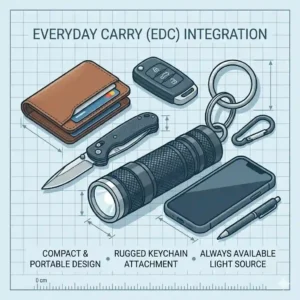
The biggest mistake I see is attaching a flashlight directly to a crowded split-ring. When you do this, you are forced to hold your heavy, jangly keys while trying to aim the light. Insider Tip: Always use a micro-carabiner or a quick-release magnetic clasp to attach the light to your keychain. This allows you to detach the flashlight in one second, use it independently, and snap it back when done.
👥 Real-World Scenarios: Finding Your Perfect Match
Not every light is right for every person. The “best” flashlight for a mechanic is a terrible choice for a bartender. Let’s break down specific user profiles to help you self-identify.
The Daily Urban Commuter
-
Profile: Rides the subway, walks dark parking garages, charges devices daily.
-
The Match: The Nitecore TINI 2.
-
The Why: When you are walking to your car at night, you don’t need hours of runtime; you need instant, blinding output to assess your surroundings, and you want to know exactly how much battery you have left. The OLED screen ensures you are never caught off guard.
The Blue-Collar Professional / Mechanic
-
Profile: Works with their hands, encounters tight, dark spaces, frequently wears gloves.
-
The Match: The RovyVon Aurora A5.
-
The Why: The magnetic tail base and sidelight feature transform this from a flashlight into an area work light. You can stick it to the inside of a car hood or clip it to your hat brim, giving you completely hands-free illumination with a wide, diffused beam that doesn’t cast harsh shadows on engine components.
The “Set It and Forget It” Senior or Minimalist
-
Profile: Wants a backup light for power outages, hates charging cables, wants absolute simplicity.
-
The Match: The Olight i3E EOS.
-
The Why: The anti-recommendation logic applies heavily here: A tech-heavy light like the Nitecore is a bad fit for this user because the battery will slowly drain over months of non-use, and complex button combinations will be forgotten. The Olight, loaded with a lithium AAA battery, will sit in a drawer or on a keychain for ten years and turn on with a simple twist the moment it is needed.
🔧 Problem-Solving: When Good Lights Fail
Even the best micro flashlights have Achilles’ heels. Here are the most common problems you will face and how to permanently solve them.
Problem 1: The “Pocket Fire” (Accidental Activation)
There is nothing worse than reaching for your light only to find it dead—or worse, burning a hole in your pocket because the button was compressed.
-
The Solution: Mechanical vs. Electronic Lockout. If your light has a digital lockout (like the Fenix or Nitecore), form the habit of engaging it every single time it goes in your pocket. If it doesn’t have a digital lockout, simply untwist the head a quarter-turn. This physically breaks the electrical circuit, making it impossible for the light to turn on accidentally.
Problem 2: The “Step-Down” Deception
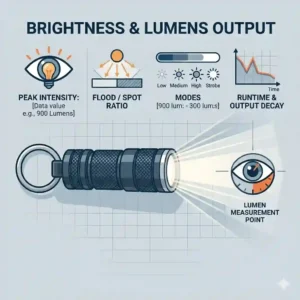
You buy a 1,000-lumen keychain light, but after 30 seconds, it dims drastically. This isn’t a defect; it’s thermal throttling. LEDs generate immense heat, and tiny metal bodies cannot dissipate it fast enough.
-
The Solution: Stop buying based on “Max Turbo” lumens. Instead, look at the “High” or “Medium” sustained output. A light that can sustain 200 lumens for two hours is infinitely more useful than one that blasts 1,000 lumens for 15 seconds before dimming to 80 lumens to prevent the battery from exploding.
🧠 How to Choose a Micro Flashlight: 5 Essential Criteria
When evaluating a mini flashlight keychain, the spec sheet is a battlefield of marketing buzzwords. Here is how I filter the noise.
-
Beam Profile (Throw vs. Flood):
A light’s Candela rating (intensity) is often more important than Lumens (total volume). For a keychain light, you want a “floody” beam—a wide, even spread of light that illuminates your immediate path. Deep reflectors that create tight, piercing beams are useless when trying to read a map or find a dropped key.
-
User Interface (UI):
Can you turn the light on with one hand while holding groceries? Does it always turn on in “High” (blinding you), or does it feature mode memory? I always prioritize lights that offer direct access to a “Moonlight” mode (1-5 lumens) from the off position.
-
Color Rendering Index (CRI):
Standard LEDs wash out colors, making a brown snake look like a gray stick. High CRI LEDs (90+) render colors accurately, just like sunlight. If you are inspecting wires or checking a child’s throat for redness, high CRI is non-negotiable.
-
Parasitic Drain Management:
Lights with electronic switches constantly draw a microscopic amount of power to “listen” for a button press. Over three months, this can drain the battery to zero. If you don’t use the light daily, twist-activation is mechanically superior.
-
Ingress Protection (IP Rating):
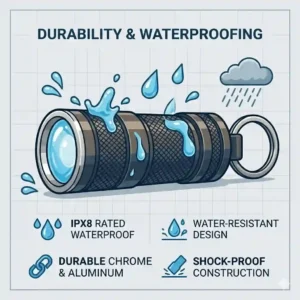
Look for IP67 or IP68. This ensures dust cannot enter the circuitry and the light can survive complete water submersion. If a light only claims “water-resistant” with no IP rating, assume it will die in a heavy rainstorm.
❌ Common Mistakes When Buying Micro-Illumination Gear
In my consulting work, I see buyers make the same errors repeatedly. Avoid these traps:
Chasing the Lumen Myth
The human eye perceives light logarithmically. This means 1,000 lumens does not look twice as bright as 500 lumens; it only looks about 30% brighter. However, producing those 1,000 lumens will drain your battery four times as fast and overheat the device. Stop paying extra for turbo modes you can only use for 10 seconds.
Ignoring the Tint
Many cheap lights use LEDs with a harsh, bluish-purple tint (6500K+ color temperature). This causes intense eye strain and ruins your night vision. Look for lights that offer “Neutral White” (4000K-5000K) options. It penetrates fog and rain much better than cool white light.
Misunderstanding “Tactical” Features
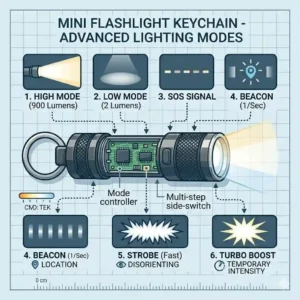
A strobe feature on a keychain light is virtually useless for self-defense. To disorient an attacker, you need upwards of 1,000 directed lumens from a full-sized tactical bezel. On a keychain light, a strobe mode is just an annoying setting you have to click past to turn the light off.
💰 Long-Term Cost & Maintenance of Micro Flashlights
When you buy a mini flashlight keychain, you aren’t just paying the upfront price. You need to calculate the Total Cost of Ownership (TCO).
The Lithium-Polymer Trap
Lights like the Nitecore and RovyVon use integrated, non-replaceable lithium-polymer (Li-Po) batteries. According to battery degradation science, after 300 to 500 charge cycles—or about three years of ambient temperature fluctuation in your pocket—that battery will lose 30% to 40% of its total capacity. Once the battery refuses to hold a charge, the entire flashlight becomes e-waste.
The AAA Advantage
Conversely, lights powered by AAA batteries (Olight, SureFire) have a much lower upfront output but infinite longevity. If you pair a SureFire Titan Plus with a pack of Panasonic Eneloop rechargeable NiMH batteries, your TCO over ten years is actually lower than buying three integrated Li-Po lights as they die out. You simply recycle the degraded AAA battery and pop in a fresh one.
The Efficiency Gap:
In cold weather (below freezing), lithium-polymer batteries suffer severe voltage sag. If you live in a snowy climate, a light that normally lasts two hours might die in 20 minutes. Lithium primary (non-rechargeable) AAA batteries, like Energizer Ultimate Lithium, are completely unaffected by extreme cold, making replaceable battery lights the only logical choice for severe winter climates.
🔍 Features That Actually Matter (And The Marketing Hype)
To ensure you get the best tool for your keychain, let’s filter out the fluff.
✅ Feature That Matters: Deep Pocket Clips
Even if it goes on a keychain, a reversible pocket clip allows you to attach the light to the brim of a baseball cap, instantly creating a makeshift headlamp. This is arguably the most valuable secondary feature a mini flashlight keychain can possess.
❌ Marketing Hype: “Aero-Grade Aluminum”
Almost all modern flashlights are made from 6061-T6 aluminum. It’s an industry standard, not a premium feature. What actually matters is the Type III Hard Anodizing on the outside. Type II anodizing (found on cheaper lights) will scratch off in your pocket within a week, leaving bare, ugly metal.
✅ Feature That Matters: Low-Voltage Warning
If an integrated battery light doesn’t have a screen, it must have an LED indicator that flashes red when battery life drops below 20%. Without this, you will inevitably be left in the dark without warning.
❌ Marketing Hype: SOS Modes
Unless you are stranded on a deserted island, the pre-programmed SOS flashing mode is a gimmick that clutters the user interface. A steady, reliable low mode is far more useful for long-term emergency signaling.
✨ Don’t Miss These Exclusive Deals!
🔍 Ready to upgrade your keychain? Click on any of the highlighted products above to check the latest availability and secure the perfect illumination tool for your specific needs.
🏁 Conclusion: Lighting the Way Forward
Finding the perfect mini flashlight keychain requires looking past the shiny marketing claims and focusing on how the tool fits into your daily routine. We’ve explored everything from the bomb-proof, AAA-powered reliability of the SureFire Titan Plus to the hyper-modern, data-rich interface of the Nitecore TINI 2.
My decade of field testing has taught me one absolute truth: the best flashlight is simply the one you have with you when the lights go out. Stop worrying about getting the absolute highest lumen count. Instead, prioritize a user interface that makes sense to your brain, a beam profile that fits your environment, and a battery system you are willing to maintain.
Whether you are a mechanic needing the hands-free capability of the RovyVon Aurora A5 or a minimalist who wants the twist-and-go simplicity of the Olight i3E EOS, equipping yourself with a dedicated pocket light is the single cheapest, most effective upgrade you can make to your daily preparedness.
❓ FAQs
❓ What is the best mini flashlight keychain for everyday carry?
✅ The best option depends on your power preference. The Nitecore TINI 2 is top-tier for USB-C rechargeable tech lovers due to its OLED screen, while the Olight i3E EOS is the best replaceable-battery option for minimalist reliability…
❓ How bright should a keychain flashlight be?
✅ For close-range tasks like finding keyholes or walking down a driveway, 50 to 150 lumens is ideal. Outputs over 400 lumens are useful for quick bursts of distance viewing but will drain batteries quickly and cause the light to overheat…
❓ Are rechargeable keychain flashlights better than battery-powered ones?
✅ USB rechargeable lights offer higher maximum lumens and save money on disposable batteries initially. However, battery-powered lights (using AAA) offer better long-term durability, as integrated lithium batteries permanently degrade after 3 to 5 years…
❓ How do I stop my flashlight from turning on in my pocket?
✅ Always utilize your flashlight’s electronic lockout mode by following the manufacturer’s button combination. For twist-operated lights, physically unscrewing the head a quarter-turn breaks the circuit, guaranteeing it will not activate accidentally…
❓ Can a mini flashlight go through TSA airport security?
✅ Yes, standard everyday carry flashlights are permitted in both carry-on and checked baggage by the TSA. However, models with aggressive, spiked tactical bezels designed to strike may be confiscated at the discretion of the security agent…
📚 Recommended for You
- 7 Best Large Keychain Options for 2026: Heavy Duty and Stylish Picks
- Keychain big: 7 Best Oversized Keychains for Total Security (2026)
- 5 Brilliant Choices: The best keychain flashlight of 2026 Reviewed
Disclaimer: This article contains affiliate links. As an Amazon Associate, I earn from qualifying purchases. If you purchase products through these links, we may earn a small commission at no additional cost to you.
✨ Found this helpful? Share it with your friends! 💬🤗
[addtoany]
