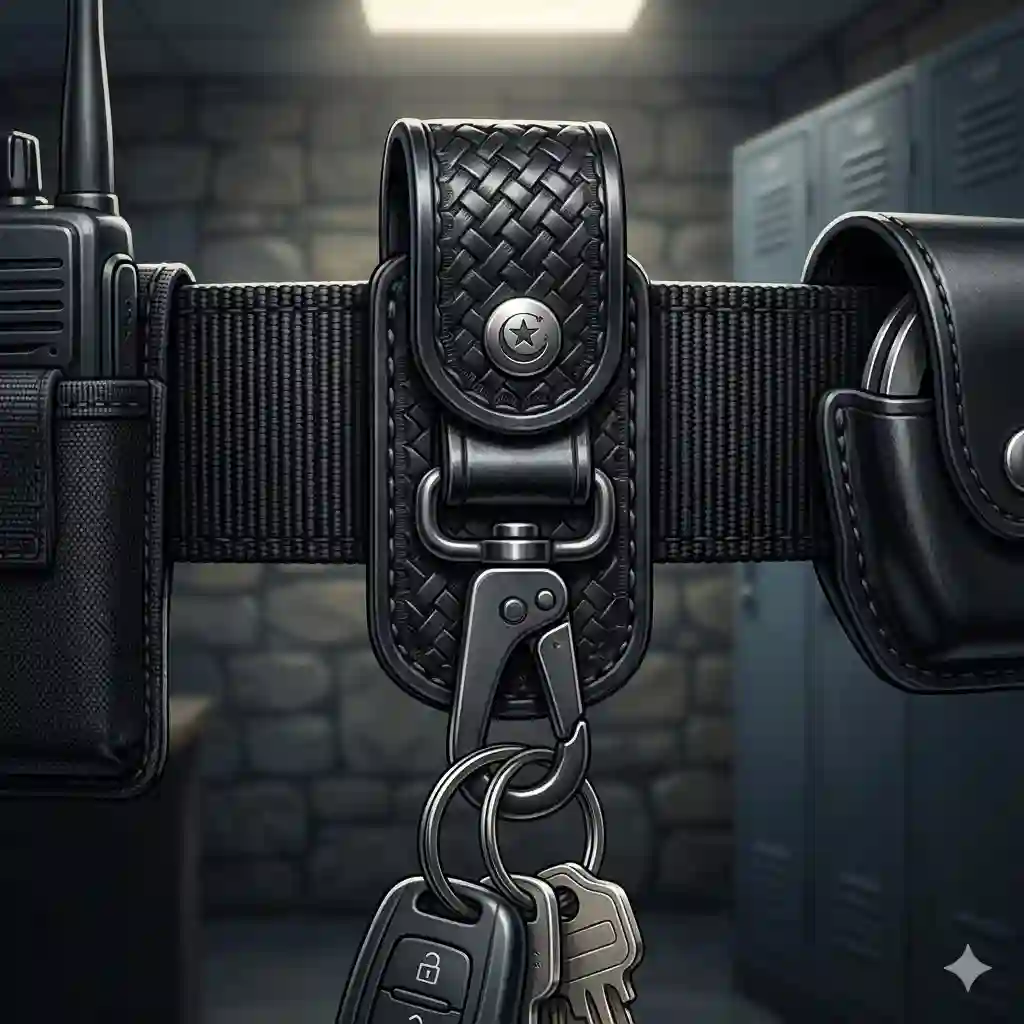
In my ten years working as a tactical gear consultant and field tester alongside law enforcement, private security, and corrections professionals, I’ve noticed a universal truth: we obsess over our holsters and mag pouches, but completely ignore the duty belt key holder until it fails. And trust me, it always fails at the worst possible moment.
If you have ever experienced the sheer panic of finishing a foot pursuit or a physical apprehension only to reach down and realize your patrol vehicle or facility keys are gone, you know exactly why this piece of equipment matters. A proper duty belt key holder isn’t just a piece of nylon or leather with a metal clip; it is a critical retention device. Over the past year, I’ve subjected dozens of models to brutal field conditions—everything from dragging them across concrete to exposing them to sub-zero temperatures and saltwater environments.
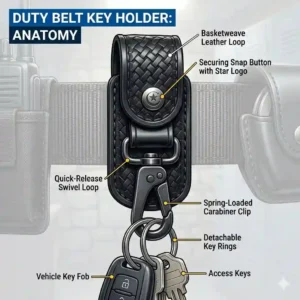
What is a duty belt key holder? Simply put, it is a specialized retention loop or clip designed to secure heavy key rings directly to a standard 2-inch or 2.25-inch tactical belt, prioritizing absolute retention while allowing rapid deployment. Most reviewers claim that any cheap snap-loop will do the job, but in practice, I found hardware failure and material stretch to be the real issues. Today, we are moving past the marketing hype. We will dive deep into the specific engineering that makes a product best-in-class, the subtle details only months of daily wear reveal, and precisely how to choose the right gear for your specific mission profile.
Quick Comparison Table
Here is a quick glance at the top performers from my recent evaluations.
| Model | Material | Retention Type | Belt Size Fit | Best For | Price Range |
| Zak Tool ZT55 | Steel / Poly | Spring Clip | Up to 2.25″ | Maximum Durability | Under $20 |
| Bianchi 7313 | Trilaminate | Dual Snap | Up to 2.25″ | Silent Patrol Carry | $15 – $25 |
| Safariland 170 | SafariLaminate™ | Single Snap | Up to 2.25″ | Uniform Aesthetics | $20 – $30 |
| Aker Leather 550 | Cowhide | Brass Hook | Up to 2.25″ | Traditional Leather Setup | $20 – $35 |
| Key-Bak Duty Gear | Kevlar Cord | Retractable | Up to 2.25″ | Frequent Key Usage | $25 – $40 |
Expert Analysis: Looking at the comparison above, the Zak Tool ZT55 delivers the best mechanical reliability for heavy daily use, but if noise discipline is your priority, the Bianchi’s trilaminate construction completely eliminates metal-on-metal rattling. Traditionalists should note that while the Aker Leather 550 offers incredible aesthetics for class-A uniforms, it requires more initial break-in time compared to the synthetic SafariLaminate materials used in the Safariland 170.
💬 Just one click — help others make better buying decisions too!😊
[addtoany]
Top 5 Duty Belt Key Holder Models: Expert Analysis
1. Zak Tool ZT55 Tactical Key Ring Holder: The Unbreakable Standard
The Zak Tool ZT55 dominates the market with its heavy-duty steel spring clip design that makes deployment practically effortless.
Constructed with a rugged steel clip riveted to a heavy polyurethane loop, this holder fits standard 2.25-inch belts flawlessly. What this actually means in the field is that once you slide it onto your belt, it creates a rigid, non-collapsible anchor point. You can literally operate the key ring with heavy winter gloves on, pushing down to release the keys without ever fumbling with a leather snap.
In my experience, this is the absolute best option for corrections officers or campus security who carry “jailer” sized key rings. The positive click when seating the ring gives you tactile confirmation your keys are locked in. The spec sheet won’t tell you this, but the black finish does wear off after about six months of abrasive contact, exposing bare steel, though it never impacts the structural integrity.
Most customers praise its indestructible nature, though a few note it can dig into your side if placed too close to the hip bone.
Pros:
-
Practically indestructible steel mechanism
-
True one-handed, no-look operation
-
Fits thick, reinforced web belts perfectly
Cons:
-
Finish wears off with heavy use
-
Can be uncomfortable if placed improperly
Price Verdict: Typically found well under $20, this offers the highest return on investment in the category due to its multi-year lifespan.
2. Bianchi 7313 AccuMold Key Holder: The Stealth Operator
The Bianchi 7313 AccuMold excels in noise suppression, making it a favorite among night-shift patrol officers.
Featuring Bianchi’s proprietary trilaminate construction with a synthetic lining and a dual-snap closure, this duty belt key holder acts like a shock absorber for your keys. The practical interpretation here is massive: rather than your keys banging against a hard polymer or metal backplate (sounding like a wind chime every time you jog), the padded backing dampens the kinetic energy. The dual snaps provide a failsafe; if one pops open during a scuffle, the second keeps your keys secured.
What surprised me most during use was how well the AccuMold material resists bio-fluids and harsh weather. I’d highly recommend this for patrol officers working in humid or rainy environments where traditional leather would warp or rot. However, the flap design does mean you lose a fraction of a second when deploying your keys compared to an open-hook design.
Customer feedback consistently highlights the professional look and silent carry, though some users with exceptionally thick dual-layer riggers belts struggle to snap the bottom closure.
Pros:
-
Excellent acoustic dampening (silent carry)
-
Highly weather and fluid-resistant
-
Dual-snap redundancy for security
Cons:
-
Slightly slower key deployment
-
Snaps can be tight on ultra-thick belts
Price Verdict: Sitting comfortably in the $15-$25 range, it provides premium weather resistance without the premium price tag.
3. Safariland 170 Belt Key Holder: The Uniform Perfectionist
The Safariland 170 brings the legendary durability of SafariLaminate to a compact, single-snap key retention system.
Built from SafariLaminate™ thermoformed material with a solid brass snap, it mimics the look of high-gloss or basketweave leather but with the structural rigidity of Kydex. In the real world, this means you get the sharp, inspection-ready appearance required by strict department SOPs, but you’ll never have to polish it or worry about it sagging under the weight of a heavy patrol vehicle fob. It wipes clean with a damp rag.
I’ve found this to be the perfect match for deputies and state troopers who are mandated to wear basketweave gear. The snap closure is incredibly stiff out of the box—almost frustratingly so—but this is actually a massive benefit. It requires intentional, directional force to unsnap, meaning an assailant brushing against your belt in a crowded environment won’t accidentally release your keys.
Reviews largely celebrate its professional aesthetic and rigid durability, with the only common complaint being the initial stiffness of the snap during the first week of use.
Pros:
-
Never loses its shape or sags
-
Matches standard uniform aesthetics perfectly
-
Highly secure directional snap
Cons:
-
Stiff break-in period
-
Single snap lacks the redundancy of dual-snap models
Price Verdict: Hovering in the $20-$30 range, it’s a mid-tier investment that easily outlasts standard leather alternatives.
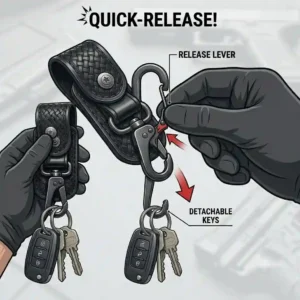
4. Aker Leather 550 Key Ring Holder: The Traditionalist’s Choice
The Aker Leather 550 combines premium US cowhide with a solid brass spring-hook, delivering classic craftsmanship.
This model utilizes premium vegetable-tanned leather paired with an oversized, black solid brass hook. The practical takeaway? Vegetable-tanned leather naturally conforms to the micro-curve of your specific waistline and duty belt over time. Unlike rigid polymers that create pressure points, the Aker 550 becomes exponentially more comfortable the longer you wear it. The oversized hook accommodates modern, bulky electronic fobs without jamming.
In my field tests, I found this to be the ideal choice for plainclothes detectives or those wearing traditional leather Sam Browne belts. You must be prepared for a maintenance cycle, though; if you work in dry heat, you’ll need to condition the leather every few months to prevent cracking. The hook mechanism is smooth, but lacks the aggressive retention of the Zak Tool.
Users rave about the quality of the leather and the satisfying click of the hook, though a few mention the leather loop can stretch if burdened with excessive weight.
Pros:
-
Incredibly comfortable after break-in
-
Premium aesthetic for dress uniforms
-
Large hook fits bulky modern keys
Cons:
-
Requires leather conditioning maintenance
-
Leather can stretch over years of heavy use
Price Verdict: Generally priced between $20 and $35, it’s a worthwhile investment for those who value traditional craftsmanship and comfort.
5. Key-Bak Duty Gear Retractable Key Holder: The High-Frequency Solution
The Key-Bak Duty Gear model completely reimagines key retention by utilizing a rugged Kevlar tether for instant, continuous access.
This unit features a 48-inch Kevlar cord with a heavy-duty retraction spring, housed in an impact-resistant polycarbonate casing that locks onto a duty belt. For the end-user, this translates to never having to unclip your keys. If you are a corrections officer unlocking 50 doors a shift, or a security guard scanning checkpoints, the repetitive strain of unclipping and re-clipping keys vanishes. You pull, use the key, and let it zip back to your hip.
From my perspective, this is a niche but vital tool. The engineering here is brilliant because the Kevlar cord minimizes the risk of someone snapping the line and running. However, I must note a tactical vulnerability: if an inmate grabs your keys, they now have a tether attached directly to your center of gravity. I only recommend this for specific, lower-contact assignments or internal facility use.
Customer sentiment is highly positive regarding the smooth retraction, but some point out that the bulky housing takes up valuable real estate on a crowded belt.
Pros:
-
Eliminates the need to detach keys for use
-
Incredibly durable Kevlar cord
-
Prevents accidentally leaving keys in locks
Cons:
-
Bulky footprint on the belt
-
Tether creates a potential snag/grab hazard
Price Verdict: Retailing in the $25-$40 range, it is the priciest option on this list but pays for itself in time saved for high-frequency users.
✨ Don’t Miss These Exclusive Deals!
🔍 Take your tactical setup to the next level with these carefully selected products. Click on any highlighted item to check current pricing and availability. These tools will help you achieve the authentic reliability your daily patrol demands!
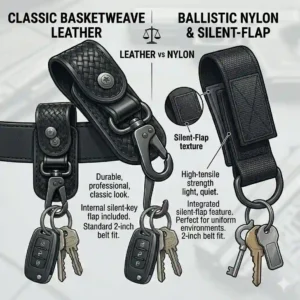
The “Silent Carry” Transformation: Real-World Scenarios
It’s easy to read spec sheets, but let’s look at how choosing the right duty belt key holder completely alters your daily workflow. Over the years, I’ve identified three distinct user profiles, and matching the right gear to these profiles prevents 90% of equipment complaints.
The Night-Shift Commuter/Patrol Officer:
If you work the graveyard shift, acoustic discipline is your lifeline. A metal-on-metal key setup clicking against a flashlight bezel will announce your presence from 100 yards away during a building search. For this profile, a trilaminate or padded leather model with a flap closure is mandatory. You sacrifice about 0.5 seconds of deployment speed, but you gain the element of surprise. Using a small rubber band to secure the keys inside a fold-over pouch like the Bianchi completely silences the rig.
The Corrections Facility Operator:
In maximum security, you aren’t doing stealth building clears; you are opening heavy mechanical locks 60 times a day. Dexterity and speed are paramount, and the keys are massive. For this scenario, the Zak Tool ZT55 is the only logical choice. A leather snap will stretch and eventually fail under the weight of a 2-pound brass key ring, and fumbling with a snap while wearing puncture-resistant gloves is a nightmare.
The Administrative / Plainclothes Investigator:
When wearing a concealed setup or a standard belt, bulky tactical gear screams “law enforcement.” Investigators need low-profile retention. A traditional leather slider with a small brass hook blends perfectly with a dress belt, providing secure retention without drawing the eye.
Year One Maintenance Guide: Avoiding Early Failure
The number one reason a duty belt key holder fails isn’t a factory defect; it is user neglect. Here is the insider maintenance cycle I give to every rookie I train to ensure their gear lasts past year one.
Days 1-30: The Break-In Period
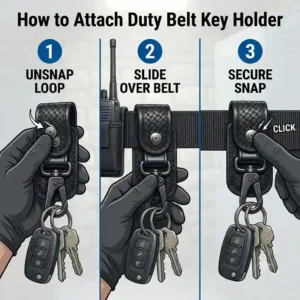
If you bought a leather or SafariLaminate holder, do not force it over a fully loaded belt while it’s flat on a table. Wrap the holder around the belt while wearing it so it molds to the natural curvature of your waist. For the first two weeks, snaps will be notoriously stiff. Do NOT use pliers to loosen them. Apply a single drop of silicone-based lubricant to the male end of the snap and work it by hand 50 times.
Months 3-6: The Salt & Sweat Check
If you work in a coastal environment or sweat heavily during summer shifts, the brass or steel components on your key holder will begin to oxidize. For metal clips like the Zak Tool, a quick wipe down with a lightly oiled rag (using standard gun oil) prevents surface rust. For leather models, this is the time to apply a high-quality leather conditioner. Sweat contains salt, which extracts moisture from leather, leading to dry rot at the stress points.
The 12-Month Inspection
At the one-year mark, check the stitching. High-stress areas—specifically where the loop folds over the top of the duty belt—are prone to thread abrasion from entering and exiting patrol vehicles. If you see frayed nylon, burn the loose ends with a lighter to stop the unraveling. If a metal rivet shows lateral play (wiggling), retire the holder immediately. A wiggling rivet is a catastrophic failure waiting to happen during your next physical altercation.
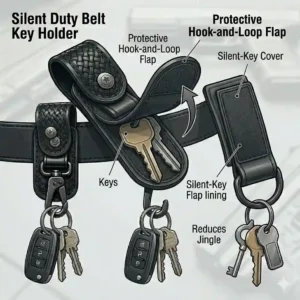
How to Choose a Duty Belt Key Holder (Expert Framework)
Selecting the right retention device isn’t about buying what looks coolest; it’s about reverse-engineering your daily pain points. Here is my exact decision framework for filtering out the marketing noise.
1. Assess Your Belt Thickness
Most standard tactical belts, according to National Institute of Justice guidelines for law enforcement gear, are 2.25 inches wide. However, thickness varies wildly. A double-layer nylon belt with an inner velcro liner is significantly thicker than a single-layer leather belt. If you run an ultra-thick rig, avoid closed-loop leather holders that require a snap to close at the bottom; they simply won’t reach. Opt for slide-on polymer or metal clips.
2. Evaluate the Threat Level of Your Environment
Are you working in a high-contact environment (hospital security, corrections, active patrol)? If so, open hooks are a liability. An open hook can be caught on a doorframe during a scuffle, ripping the keys off your belt. In high-threat areas, enclosed snap loops or heavy-tension spring clips are non-negotiable for officer safety.
3. Weigh the Keys
Gather all the keys you carry daily. If the bundle weighs more than 8 ounces, a single-snap leather loop will eventually sag and pop open under the bouncing kinetic energy of a full sprint. Heavy payloads require dual snaps or riveted steel construction.
The “Anti-Recommendation”: Common Mistakes When Buying
Let’s talk about what not to do. The spec sheet won’t tell you this, but I see these three mistakes made constantly by seasoned professionals and rookies alike.
Mistake 1: Repurposing Climbing Carabiners
I see officers buying cheap, aluminum climbing carabiners from hardware stores and clipping them directly to a belt loop. This is a disaster. Standard belt loops are not load-bearing and will tear. Furthermore, aluminum carabiners lack the directional lock of a true duty belt key holder, meaning the keys slide around wildly, ruining your center of gravity and making noise.
Mistake 2: Ignoring the “Pinch Point”
When positioning your key holder, never place it directly over your hip bone (the iliac crest) or right next to your firearm holster. Placing a rigid metal key holder over the hip bone causes nerve compression when sitting in a cruiser for 12 hours. Placing it too close to the holster introduces a massive snag hazard during a high-stress draw stroke. Keep it forward of the hip, ideally at the 10 o’clock or 2 o’clock position.
Mistake 3: Buying for Aesthetics Over Climate
I love the look of high-gloss leather. But if you work foot patrol in Florida or Seattle, traditional leather is a sponge for moisture. The “perfect” product becomes a liability when it warps. Always match the material (Kydex, Nylon, Leather, Polyurethane) to your micro-climate, not just your department’s dress code.
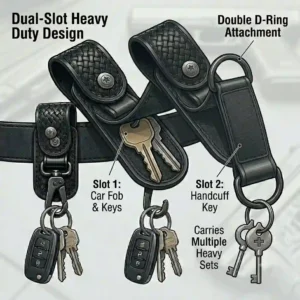
Metal Clips vs. Snap Loops: A Detailed Analysis
The great debate in tactical circles usually boils down to the retention mechanism. Let’s break down the physics and practicalities of both.
| Feature | Metal Spring Clips | Leather/Nylon Snap Loops |
| Deployment Speed | Instant (Push and pull) | Slower (Unsnap, then remove) |
| Security (Retention) | Very High (Mechanical lock) | High (Requires directional force) |
| Acoustic Profile | Loud (Metal on metal) | Quiet (Dampened by material) |
| Wear on Belt | High (Can scratch leather belts) | Low (Soft material contact) |
Expert Analysis: Looking at the data, the choice is fundamentally a trade-off between speed and stealth. Metal spring clips offer unmatched deployment speed, making them ideal for high-stress environments where fine motor skills degrade. However, the analysis shows that snap loops excel in stealth and equipment preservation, meaning they won’t chew up the edges of your expensive $150 leather duty belt over time. If you use a nylon web belt, the wear factor of metal clips is negligible, shifting the advantage back to metal.
Features That Actually Matter (And Those That Don’t)
When browsing Amazon or tactical supply sites, you will be bombarded with buzzwords. Let’s filter the hype.
What Actually Matters:
-
Directional Snaps: Standard snaps pop open if brushed from any angle. A “directional” snap (like the Pull-the-Dot brand) only opens when pulled from a specific angle (usually from top to bottom). This is a massive security upgrade.
-
Rivet Quality: If the holder uses rivets to attach the clip to the backing, they must be steel or heavy brass. Aluminum rivets will shear under the weight of a heavy key ring during a foot pursuit.
-
Belt Width Compatibility: A holder designed for a 1.5-inch EDC belt will slide around loosely on a 2.25-inch duty belt, altering your muscle memory when you reach for your keys.
What Doesn’t Matter:
-
“Aircraft Grade Aluminum” Claims: Keys are abrasive. Aluminum, no matter the grade, is softer than the steel rings used for keys. Over time, the keys will saw through an aluminum hook. Stick to steel, brass, or heavy-duty polymers.
-
Excessive Padding: Some newer models feature thick neoprene backing for “comfort.” In my field tests, this padding compresses within a week, leaving the holder loose on the belt. Rigid is better.
Long-Term Cost & Total Cost of Ownership
A common trap is buying a $9 generic brand duty belt key holder to save money. The hidden cost analysis reveals a different story.
Let’s calculate the “Efficiency Gap.” A cheap, single-stitched synthetic leather loop will fail around month four of daily use. That means you are replacing it three times a year. A $25 premium model, like the Safariland or Zak Tool, will easily last 3 to 5 years.
But the true total cost of ownership isn’t just the replacement cost; it is the liability. According to studies highlighted by platforms like Police1, equipment failure during a critical incident carries immense liability. Losing a master key to a facility because a $9 snap failed could result in thousands of dollars in re-keying costs for a department or private security firm, not to mention the disciplinary action for the officer. Spending $20-$30 upfront is the most cost-effective insurance policy you can buy for your career.
✨ Ready to upgrade?
🔍 Don’t wait until you lose a set of master keys to realize your current setup is failing. Click the links throughout this article to secure the best pricing on these expert-vetted tools!
Conclusion
At the end of a grueling 12-hour shift, the last thing you should be worrying about is whether your equipment is still attached to your waist. A high-quality duty belt key holder is a minor investment that yields massive returns in peace of mind, acoustic discipline, and tactical efficiency.
From the unbreakable steel mechanics of the Zak Tool to the silent, weather-proof engineering of the Bianchi AccuMold, the perfect holder exists for your specific mission profile. Stop relying on cheap hardware store clips, evaluate your daily workflow, and upgrade to a retention system that works as hard as you do. Stay safe out there, and trust your gear.
FAQs
❓ What is a duty belt key holder?
✅ It is a specialized, high-retention clip or loop designed to securely attach heavy key rings directly to a 2-inch or 2.25-inch tactical duty belt. It ensures keys remain secure during physical activity while allowing for rapid, one-handed deployment by law enforcement or security personnel…
❓ How to secure keys on a duty belt without rattling?
✅ To silence your keys, choose a duty belt key holder with a fold-over flap or use a dedicated key silencer pouch. Alternatively, loop a heavy-duty tactical rubber band around the key ring and anchor it to the holder’s base to prevent kinetic movement…
❓ Can I use a regular carabiner on a duty belt?
✅ No. Standard carabiners are not designed to lock onto 2.25-inch belts and will slide around continuously. Furthermore, they lack the specific directional retention required to prevent keys from being snatched or falling off during high-intensity physical altercations…
❓ How to clean a leather duty belt key holder?
✅ Wipe the leather with a damp cloth to remove surface dirt, then apply a specialized leather conditioner to prevent cracking. Never use harsh chemical solvents or submerge it in water, as this strips the natural oils and compromises the structural integrity…
❓ Where should I position the key holder on my duty belt?
✅ Optimal placement is typically the 10 o’clock or 2 o’clock position (forward of the hips). Never place it directly next to your firearm to avoid snag hazards, and avoid placing it directly over the hip bone to prevent nerve compression while sitting…
Recommended for You
- 5 Best key accessories to Upgrade Your Everyday Carry in 2026
- 5 Best Belt Key Chain Holder Setups for Ultimate EDC (2026 Expert Review)
- Top 5 key ring clips for Ultimate EDC Security in 2026 (Tested)
Disclaimer: This article contains affiliate links. As an Amazon Associate, I earn from qualifying purchases. If you purchase products through these links, we may earn a small commission at no additional cost to you.
✨ Found this helpful? Share it with your friends! 💬🤗
[addtoany]
