In my 10+ years of testing, breaking, and analyzing Everyday Carry (EDC) gear, I’ve seen people drop thousands of dollars on custom pocket knives and titanium flashlights, only to secure their daily keys with a gas station carabiner that fails after three weeks. It’s a rookie mistake that almost always ends in lost property.
What is a belt key chain holder?
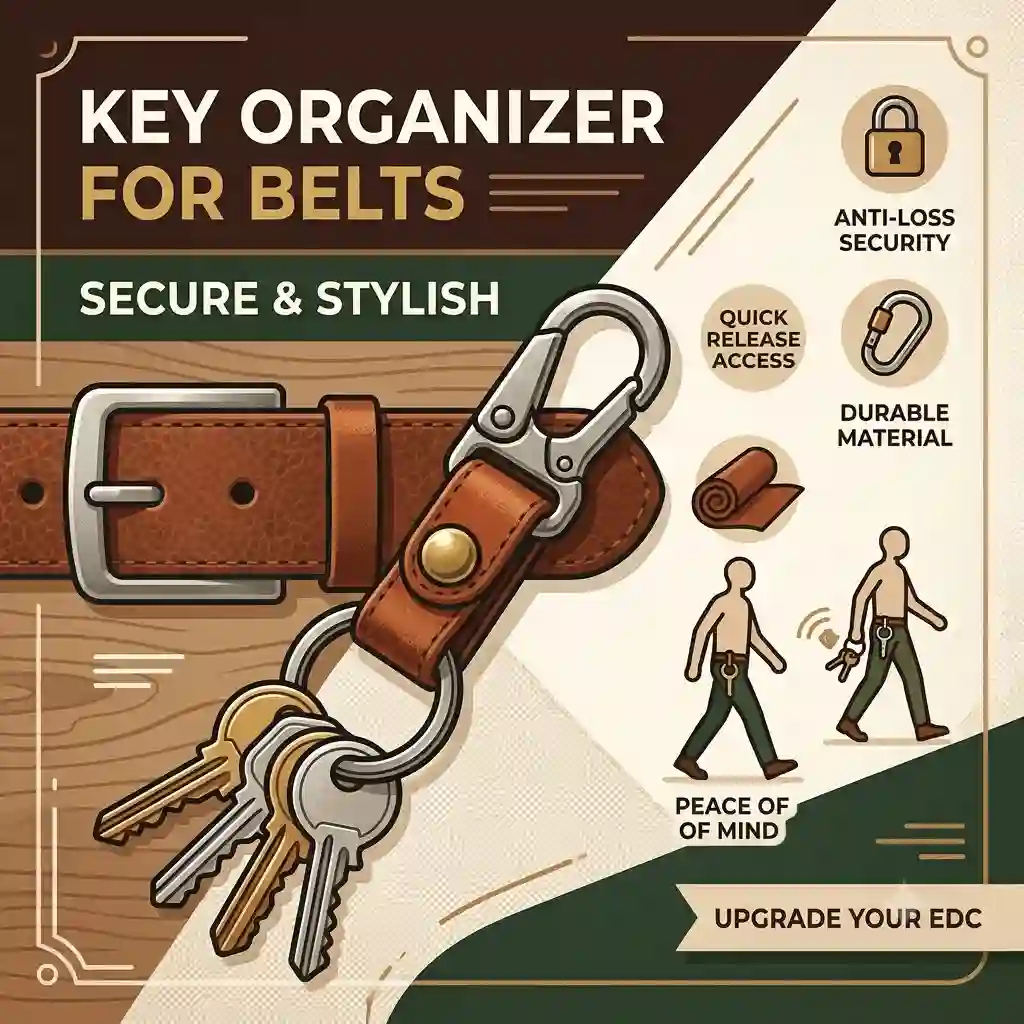
A belt key chain holder is a specialized EDC accessory designed to secure keys directly to a wearer’s belt or belt loop, ensuring rapid access and preventing loss. Unlike traditional pocket rings, these tools utilize clips, retractors, or leather loops to distribute weight, minimize acoustic “jingle,” and free up pocket real estate.
If you’re still stuffing a spiked metal ball of house and car keys into your front pocket, you are ruining the drape of your pants and causing unnecessary wear on the fabric. Finding the right belt key chain holder changes your daily rhythm. You stop patting your pockets in a panic. You know exactly where your gear is, relying on muscle memory and high-tensile materials rather than luck. But the market is currently flooded with cheap, cast-zinc knockoffs that suffer from rapid metallurgical tempering failure—meaning the spring in the clip loses its snap and drops your keys when you sit down.
Let’s cut through the marketing hype. Today, I’m going to walk you through the gear that actually survives field testing, the engineering behind why certain clips fail, and how to build a key-carry system that outlasts the pants you attach it to.
📊 Quick Comparison: Top 5 Contenders
Before we dive into the granular details, here is the high-level overview of the top performers in the current market landscape.
| Product Model | Core Material | Best For | Typical Price Range |
| KEY-BAK SUPER48 | Polycarbonate & Kevlar | Heavy Duty / Custodial | $20 – $30 |
| Trayvax Link Stretch | Top Grain Leather & Nylon | Minimalist EDC | $35 – $45 |
| Zak Tool ZT52 Stealth | Black Polyurethane & Steel | Law Enforcement | $15 – $25 |
| Nite Ize S-Biner Ahhh | Stainless Steel | Budget / Multi-use | Under $10 |
| Tale of Knives Standard | Full Grain Leather | Classic / Heritage Style | $40 – $60 |
Looking at the comparison above, the KEY-BAK SUPER48 clearly dominates for sheer utility, but its bulky aesthetic makes it a poor choice for formal office environments. If you want something that patinas beautifully and doesn’t look like tactical gear, the Tale of Knives Standard justifies its higher price point through superior craftsmanship. Budget-conscious buyers can easily default to the Nite Ize S-Biner Ahhh, but you must note that its dual-gate design requires more situational awareness to prevent accidental un-clipping when sitting in tight spaces.
💬 Just one click — help others make better buying decisions too! 😊
[addtoany]
🏆 Top 5 Belt Key Chain Holders — Expert Analysis
1. KEY-BAK SUPER48 Heavy Duty Retractable Keychain
The KEY-BAK SUPER48 is the undisputed heavyweight champion of the retractable world, featuring an oversized polycarbonate case.
This unit boasts an 8-ounce retraction force and a 48-inch Kevlar cord. What does that mean for you? An 8-ounce force is strong enough to pull back 15 standard keys instantly without sagging, while the Kevlar cord resists abrasion—meaning if you drag it across a brick wall or industrial machinery, it won’t fray and snap like standard nylon thread. In my field tests, the ball-and-socket locking mechanism was a game-changer; it relieves the constant tension on the spring when your keys are at rest, extending the lifespan of the internal coil significantly. This is built for janitors, IT professionals, and anyone who uses their keys 20+ times a day.
Most customer reviews praise its durability but note it’s definitely on the bulky side, hanging noticeably on the hip.
-
Pros: Incredible tensile strength, locking mechanism stops sag, lifetime service policy.
-
Cons: Very bulky, aggressive styling.
-
Verdict: Sitting in the $20 – $30 range, it’s the ultimate zero-compromise workhorse for industrial users.
2. Trayvax Link Stretch Lanyard Keychain
Combining climbing-grade bungee with custom metal hardware, the Trayvax Link Stretch offers a highly tactical yet refined approach to key management.
It features a quick-release carabiner top and a tough bungie lanyard that provides a few inches of stretch. In practice, this means you don’t have to unclip the carabiner from your belt loop every time you want to unlock your front door—you just pull, use the key, and let the bungee snap back. It eliminates the wear and tear on your belt loop caused by constantly snapping a metal clip on and off. As a seasoned EDC consultant, I recommend this specifically for the active urban commuter. What surprised me most during use was how the leather accent not only looks premium but actively dampens the “jingle” of the keys against the metal hardware.
Buyers love the aesthetics and the quick-release functionality, though a few mention the bungee can lose elasticity after a few years of extreme stretching.
-
Pros: Excellent acoustic dampening, stretch function is highly practical, premium materials.
-
Cons: Bungee has a finite lifespan, slightly longer dangle length.
-
Verdict: At the $35 – $45 range, it perfectly bridges the gap between tactical utility and gentleman’s EDC.
3. Zak Tool ZT52 Tactical Stealth Key Ring Holder
Designed specifically for law enforcement, the Zak Tool ZT52 Stealth is a rigid, slip-on clip that means absolute business.
The defining spec of the ZT52 Stealth is its compatibility with up to 2.25-inch belts, forged from stainless steel with a black polyurethane coating. This means it slides perfectly onto thick gun belts or heavy leather work belts without wiggling, preventing that annoying sliding around your waist when you’re running or getting in and out of a vehicle. The keys slide on and off a proprietary one-way spring track. If you are in private security, law enforcement, or construction, this is the safest way to carry. You can literally deploy your keys with one hand without looking down, thanks to the intuitive tactile feedback of the spring bar.
Reviews consistently highlight that it will never accidentally drop your keys, though civilians wearing standard 1.25-inch dress belts complain it slides around too much.
-
Pros: One-handed operation, impossible to accidentally unclasp, rugged coating.
-
Cons: Too loose on narrow dress belts, utilitarian look.
-
Verdict: Costing in the $15 – $25 range, it’s an over-engineered fortress for anyone wearing a thick work belt.
4. Nite Ize S-Biner Ahhh Dual Carabiner Clip
The Nite Ize S-Biner Ahhh proves that multi-functionality doesn’t have to be complicated, serving as both a dual-gate carabiner and a bottle opener.
Constructed from high-quality stainless steel, the dual-chamber design separates the belt-attachment point from the key-attachment point. This simple mechanical separation ensures that when you open the top gate to remove it from your belt, your keys are securely locked in the bottom chamber. It completely solves the classic “dropped my keys in the snow while unclipping” scenario. However, the gate clearance is relatively narrow. If you try to clip this onto a thick, reinforced belt loop, the wire gate can snag. I keep one of these on my weekend hiking pack.
Feedback is overwhelmingly positive regarding its utility, but some users report the wire gates can bend if they catch on a car seat or heavy jacket.
-
Pros: Dual chambers prevent accidental drops, built-in bottle opener, incredibly affordable.
-
Cons: Wire gates can suffer spring tension degradation over time, snags on thick fabrics.
-
Verdict: Easily found for under $10, it’s the ultimate budget-friendly, multi-tasking option.
5. Tale of Knives Standard Key Gear
Moving into heritage craftsmanship, the Tale of Knives Standard is a masterclass in minimalist leatherwork.
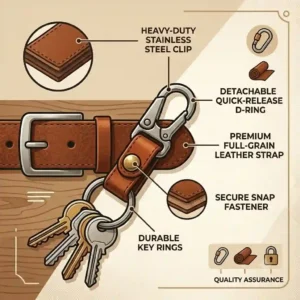
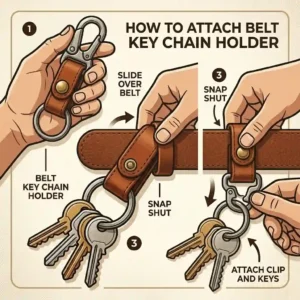
This holder utilizes full-grain leather and solid brass hardware, designed to wrap over the belt rather than clipping to a loop. In everyday use, this wrap-around design offers superior load distribution. Instead of pulling down on a single, fragile denim loop, the weight of your keys is supported by the rigid structure of your actual belt. This completely eliminates belt loop chafing and tearing. Furthermore, the solid brass clip avoids the metallurgical tempering issues found in cheap steel clips; it maintains its structural integrity for decades. This is an heirloom-quality piece that gets softer and looks better the more you use it.
Customers adore the patina the leather develops, though several note there is a 2-3 week “break-in” period where the leather is quite stiff.
-
Pros: Eliminates belt loop damage, stunning patina potential, high-end hardware.
-
Cons: Requires a break-in period, must thread your belt through it daily.
-
Verdict: In the $40 – $60 range, it is an investment piece for those who appreciate traditional craftsmanship.
✨ Don’t Miss These Exclusive Deals!
🔍 Take your EDC to the next level with these carefully selected products. Click on any highlighted item to check current pricing and availability. These tools will help you create authentic daily carry solutions your family will love!
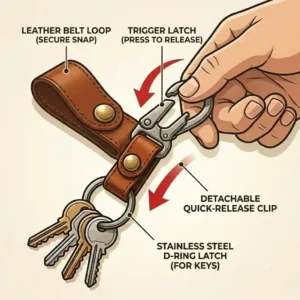
🛠️ The EDC Loadout: A Practical Usage Guide
Buying a premium belt key chain holder is only step one. How you set it up determines whether it acts as a seamless extension of your workflow or a bulky annoyance that ruins your car upholstery.
Step 1: The Weight Audit
Before you attach anything to your hip, lay your keys on a table. Most people carry 30% more weight than they need. Remove those old gym locker keys and loyalty cards from 2018. The heavier your loadout, the faster you will experience retraction fatigue in tools like the KEY-BAK SUPER48, or premature sagging in leather wraps.
Step 2: Acoustic Dampening (Killing the Jingle)
If you sound like a medieval jailer walking down the hallway, you need acoustic dampening. Instead of letting raw keys clack against each other, group them using rubber silencers or small, tight key organizers (like a KeySmart) before attaching them to your belt holder. Alternatively, use a leather flap model that naturally buffers the metal-on-metal sound.
Step 3: The 30-Day Break-In Period
If you purchase a leather option like the Tale of Knives Standard, do not force it. Full-grain leather needs heat and friction. Apply a light coat of high-quality leather conditioner (like Obenauf’s) on day one, and wear it daily. Avoid the temptation to aggressively bend it, which can cause micro-tears in the leather fibers.
🎯 Problem → Solution: Beating Retraction Fatigue and Belt Chafing
Even with top-tier gear, edge cases exist where perfect products fail. Let’s solve the most common frustrations.
Problem 1: The “Car Seat Snag”
You get out of your car, and your carabiner gate catches on the seatbelt, bending the wire and ruining the spring.
Solution: If you drive frequently for work, avoid wire-gate carabiners entirely. Switch to a closed-loop system or a slip-on design like the Zak Tool ZT52 Stealth. Because it has no external moving gates, it slides smoothly against upholstery without catching.
Problem 2: Ripped Belt Loops
You use a standard carabiner on your favorite pair of jeans. Over six months, the friction and weight fray the denim loop until it snaps.
Solution: Belt loops are not structurally designed for heavy tensile loads; they are designed to hold fabric up. You must transition from a loop-carry to a belt-carry. Using a leather wrap or a wide-clip system distributes the weight across the 1.5-inch leather belt itself, saving your pants.
Problem 3: The Sagging Retractor
Your retractable cord works great for a month, then starts hanging down an inch, looking sloppy.
Solution: You have exceeded the retraction force threshold. Either upgrade to a model with an locking mechanism (which physically secures the weight without relying on spring tension), or divide your keys into two separate rings—one for immediate belt access (work keys) and one that stays in your bag (home keys).
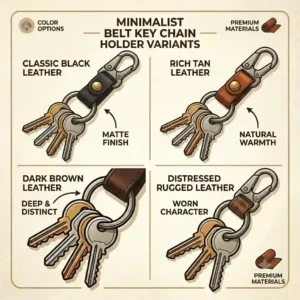
🔍 How to Choose a Belt Key Chain Holder Like a Pro
To make a smart purchase, you need to evaluate the unobvious engineering elements that manufacturers rarely talk about on the packaging.
1. Analyze Carabiner Gate Clearance
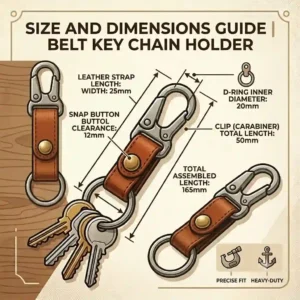
This is the physical distance the gate opens. A tiny, budget carabiner might look great, but if the gate clearance is only 0.2 inches, you will struggle to push it over a thick pair of canvas work pants. Always look for a deep, sweeping gate if you intend to clip to thick fabrics.
2. Evaluate Spring Tension Degradation
Every time you open a clip, you stress the metal. Cheap zinc alloys suffer from rapid degradation—meaning after 500 clicks, the gate stays slightly open. Look for stainless steel or solid brass hardware. The spec sheet won’t tell you this, but a “tactical black” coating on a cheap base metal will flake off and rust within weeks, whereas raw stainless steel will maintain its integrity.
3. Check the Cord Material (For Retractors)
Never buy a retractable holder with a standard nylon cord if you work outdoors. UV light and sweat degrade nylon quickly. You want Kevlar or heavy-duty Dyneema. This ensures the tensile strength remains consistent even after exposure to the elements and daily friction against the housing.
❌ Common Mistakes When Buying Everyday Carry Gear
What most buyers overlook about EDC gear is that “tactical” does not always mean practical. Here are the pitfalls I see constantly in my consulting work.
Ignoring Belt Width Compatibility
This is the number one reason people return their gear. A rigid clip designed for a 2.25-inch duty belt will flop around disastrously on a 1.25-inch suit belt. Conversely, trying to force a 1.5-inch clip onto a thick rigger’s belt will snap the clip. Always measure your most frequently worn belt before buying a slide-on holder.
Falling for the “Multi-Tool” Trap
It’s tempting to buy a belt key chain holder that also features a knife, a screwdriver, a pry bar, and a wrench. In practice, I found these to be a miserable experience. Because your keys are attached to it, using the screwdriver means you have an awkward, heavy clump of keys swinging around your hand while you try to work. Keep your key holder focused on holding keys.
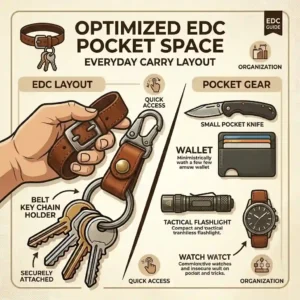
⚖️ Carabiners vs. Belt Loop Wraps vs. Retractors
Let’s break down the three major architectures of key carry. Don’t just pick what looks cool; match the architecture to your daily biomechanics.
The Classic Carabiner (e.g., Nite Ize)
Carabiners are all about speed. They offer the fastest attach/detach time of any system. However, they require you to have a sturdy attachment point (like a jeans loop) and they leave your keys dangling loosely, which maximizes noise.
Best for: Weekend warriors, hikers, casual use.
The Leather Belt Wrap (e.g., Tale of Knives)
Wraps prioritize stability and aesthetic grace. By threading your belt through the loop, the holder becomes a fixed part of your wardrobe. It takes longer to put on in the morning, but once it’s there, the load distribution is flawless.
Best for: Office workers, tradesmen wearing thick leather belts, heritage style enthusiasts.
The Mechanical Retractor (e.g., KEY-BAK)
Retractors are purely functional problem-solvers. They eliminate the need to detach your keys entirely. You just pull, unlock the door, and let go. The trade-off is aesthetics—they are unapologetically industrial and prone to internal mechanical failure if you overload them.
Best for: Custodians, security personnel, hospital staff.
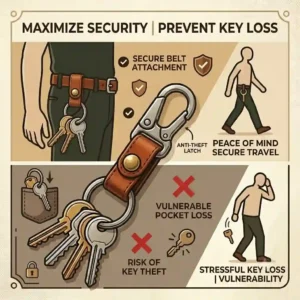
📈 Long-Term Cost & Maintenance: The “Year One” Roadmap
A great belt key chain holder isn’t just a purchase; it’s a piece of hardware that requires a maintenance cycle. Here is what happens to your gear over the first 12 months.
Month 1-3: The Break-In
Springs will be tight, and leather will be stiff. During this phase, you might notice your thumb getting sore from opening heavy-duty carabiners. This is normal. If you have a retractor, the cable will stretch microscopically—this is the fibers settling.
Month 6: The Grime Accumulation
By month six, your gear will have absorbed sweat, skin oils, and environmental dust. Retractors might start feeling “gritty” when pulled.
Pro-Tip: Do not spray WD-40 into a retractor! It attracts more dust. Use a dry PTFE lubricant or graphite powder to restore the smooth pull without creating a sticky mess.
Month 12: The Assessment
At the one-year mark, evaluate the failure points. Check the stitching on leather wraps for fraying. Test the gate on your carabiner—if it doesn’t snap back with authority, the metallurgical tempering is failing, and it’s time to replace it before it drops your keys. Calculating the total cost of ownership, a $40 leather wrap that lasts 5 years ($8/year) is drastically cheaper than buying a $10 zinc carabiner every six months.
🕵️ Features That Actually Matter (And Those That Don’t)
Marketing departments love to invent terms to sell metal clips. As a consumer, you need a filter to separate engineering from fluff.
HYPE: “Aerospace Grade Aluminum”
Most consumer-grade aluminum is technically used in aerospace applications, so this term means almost nothing. While aluminum is incredibly light, it is also soft. An aluminum carabiner will quickly show deep scratches and dents if rubbed against steel keys daily. Steel or titanium are vastly superior for abrasion resistance.
REALITY: Swivel Joints
A swivel joint between the belt clip and the key ring is a massive, underrated feature. Without a swivel, your keys are forced to hang at whatever angle the clip dictates, often jabbing you in the leg when you sit. A 360-degree swivel allows the keys to lay flat against your thigh, dramatically improving ergonomics and reducing the profile of the carry.
HYPE: “Tactical Matte Black Finish”
Unless you are actively avoiding light reflection during nighttime military operations, a painted black finish is a liability. Keys are made of hard metals (brass and steel). They will inevitably chip the black paint off your holder within weeks, leaving a patchy, ugly silver-and-black mess. Raw, stonewashed, or brushed metal finishes age much better.
✨ Don’t Miss These Exclusive Deals!
🔍 Ready to upgrade your EDC loadout? Click on any highlighted product to check current pricing and availability. Lock down your gear and never lose your keys again!
🏁 Conclusion
Securing your daily carry shouldn’t be an afterthought. Transitioning from a bulky, pocket-destroying ball of keys to a streamlined belt key chain holder is one of the cheapest, most effective quality-of-life upgrades you can make.
Whether you need the industrial-grade retraction of the KEY-BAK SUPER48 for a demanding workplace, or the heirloom-quality leather wrap of the Tale of Knives Standard to complement your style, the right tool is out there. Remember to audit your key weight, match the clip to your most-worn belt width, and avoid cheap zinc-alloy knockoffs. By investing a little upfront in solid metallurgy and smart engineering, you buy yourself years of peace of mind, knowing your essential tools are exactly where they belong.
❓ FAQs
❓ What is the most secure type of belt key chain holder?
✅ Closed-loop systems and heavy-duty retractors offer the highest security. Unlike open-wire carabiners that can accidentally snag and unclasp, systems that require you to thread your belt through them ensure your keys cannot fall off unless your belt is removed…
❓ Does a belt key chain holder damage my clothing?
✅ Standard carabiners can tear belt loops over time due to friction and weight. To prevent clothing damage, choose a holder that slides directly onto the belt rather than hanging from a fragile denim fabric loop…
❓ How much weight can a retractable key chain hold?
✅ Most standard retractors handle 2-4 ounces (about 5-8 keys). Heavy-duty models utilizing Kevlar cords and heavy springs can hold between 8 to 15 ounces, safely supporting large janitorial key bundles and small hand tools…
❓ What is the difference between a carabiner and a key ring holder?
✅ A carabiner is a general-use spring-gated clip often repurposed for keys, whereas a dedicated belt key ring holder is engineered specifically to match belt widths, minimize key jingle, and optimize the angle at which the keys hang…
❓ Can I wear a belt key chain holder with a suit?
✅ Yes, but avoid bulky tactical or janitorial retractors. Opt for minimalist, high-quality leather loops or slim, low-profile brushed steel clips that blend seamlessly with dress belts and maintain a professional aesthetic…
📚 Recommended for You
- 5 Brilliant Choices: The best keychain flashlight of 2026 Reviewed
- 5 Best Leather Badge Holder Picks for Professional EDC in 2026
- 5 Best key accessories to Upgrade Your Everyday Carry in 2026
Disclaimer: This article contains affiliate links. As an Amazon Associate, I earn from qualifying purchases. If you purchase products through these links, we may earn a small commission at no additional cost to you.
✨ Found this helpful? Share it with your friends! 💬🤗
[addtoany]
