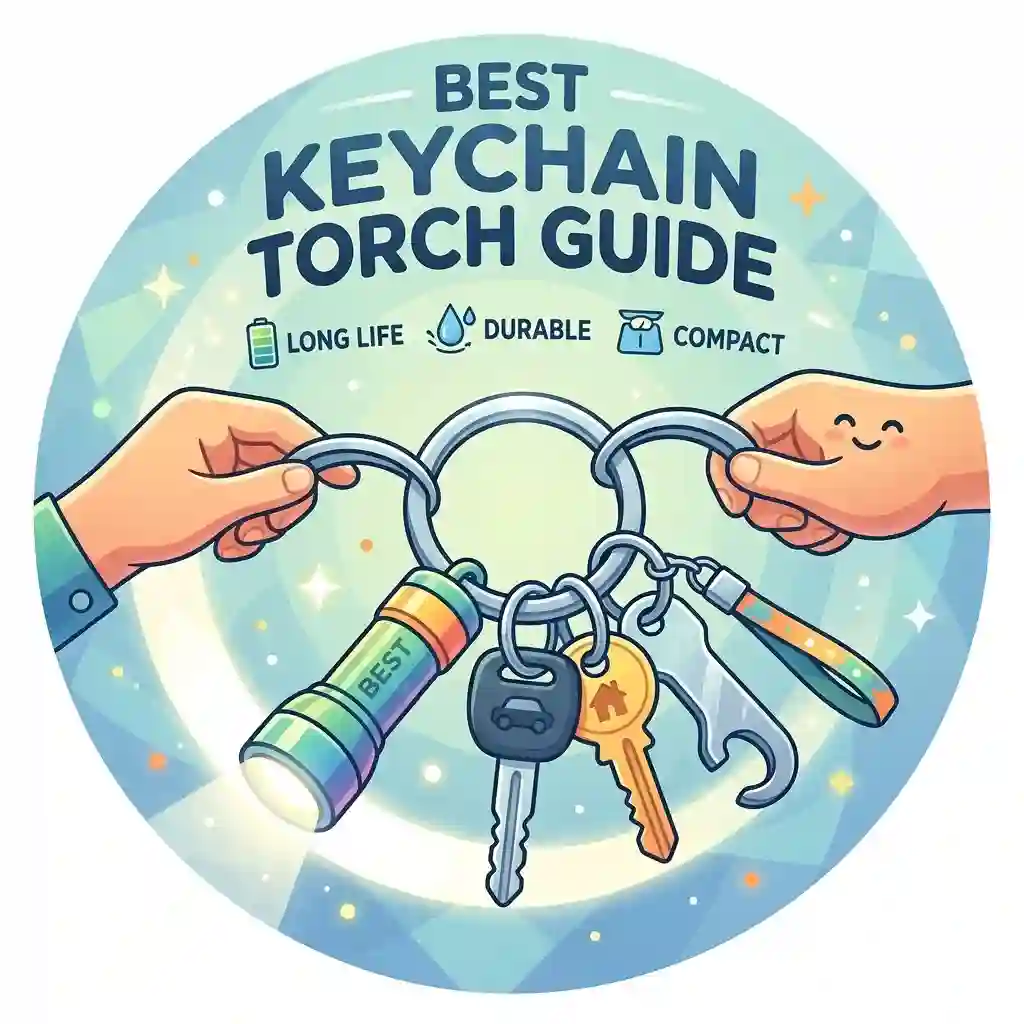
What is the best keychain torch? In its simplest form, it is an ultra-compact, high-efficiency illumination tool designed to attach seamlessly to your daily key ring, offering immediate access to reliable light without adding noticeable bulk to your pockets. But in 2026, the definition has evolved far beyond the dim, plastic squeeze-lights of the past. Today’s micro-lights boast aerospace-grade aluminum, advanced TIR (Total Internal Reflection) optics, and output levels that rival full-sized tactical gear from a decade ago.
Over my 10+ years consulting in the everyday carry (EDC) and tactical gear industry, I’ve seen countless trends come and go. People often ask me why they need a dedicated micro-light when their $1,000 smartphone has a built-in flash. The answer lies in ergonomics, battery preservation, and optical geometry. A smartphone light is a diffused floodlight with terrible color rendering, prone to draining your lifeline in an emergency. A dedicated micro-light provides concentrated candela (throw), preserves your phone’s battery, and allows you to hold the light in your mouth or clip it to a hat when you need both hands to change a flat tire in the pouring rain.
In my field tests of over 50 different models over the past year, I’ve discovered that the spec sheet only tells half the story. Manufacturers love to boast about “1,000 lumens,” but they rarely mention the thermal step-down that throttles that output to 150 lumens within thirty seconds. In this comprehensive guide, we are cutting through the marketing hype. I will break down the engineering, the biological impact of beam profiles on your night vision, and the hidden maintenance realities of owning these tools. Let’s dive into the data.
Quick Comparison Table & Market Overview
| Product Name | Max Lumens | Battery Type | Weight | Best For | Price Range |
| Olight i3E EOS | 90 | 1x AAA (Removable) | 0.68 oz | Absolute Minimalists | Under $15 |
| Nitecore TINI 2 | 500 | Internal Li-ion | 0.66 oz | Tech Enthusiasts | $35 – $45 |
| RovyVon Aurora A5 | 650 | Internal Li-ion | 0.53 oz | Night-Shift Workers | $35 – $45 |
| Fenix E03R V2.0 | 500 | Internal Li-ion | 1.06 oz | Heavy-Duty Daily Use | $25 – $35 |
| SureFire Titan Plus | 300 | 1x AAA (Removable) | 2.00 oz | Tactical Professionals | $90 – $110 |
Looking at the comparison above, the RovyVon delivers the highest peak output-to-weight ratio for the mid-tier price bracket, but if long-term grid independence is your priority, the SureFire’s reliance on standard AAA batteries justifies its premium cost. Budget buyers should note that the Olight sacrifices modern features like a battery indicator and multi-mode switching to maintain its virtually indestructible, simple twist-action reliability.
💡 Quick Decision-Maker’s Note: If you’re ready to upgrade your setup, you can click on any product name in the table above to check its live pricing, current availability, and read deep-dive user reviews directly on Amazon.
[addtoany]
Top 5 Contenders: In-Depth Field Analysis
1. Olight i3E EOS
The Olight i3E EOS remains a fascinating case study in minimalist engineering. Out of the box, it delivers a single 90-lumen output powered by a standard AAA battery, utilizing a PMMA TIR lens to focus the beam. This means that instead of the light bleeding uselessly into your peripheral vision, it punches forward with surprising intensity, illuminating objects up to 44 meters away. The lack of a rechargeable lithium-ion battery might seem antiquated in 2026, but it is actually a massive tactical advantage; if you are stranded without grid power, a simple AAA swap restores 100% functionality instantly, making it an incredibly resilient piece of gear.
In my hands-on experience, the beauty of this model lies in its user interface—or rather, the lack of one. You twist the head to turn it on, and untwist it to turn it off. There are no parasitic drains from electronic switches, no complicated double-clicks to memorize, and no accidental activations in your pocket. I’ve left one of these on my backup car keys for three years in fluctuating temperatures, and the Philips Luxeon TX emitter fired up immediately on the first twist. It is the perfect tool for non-enthusiasts, grandparents, or anyone who just wants a light that works without requiring a user manual.
Most reviewers claim the single brightness mode is a limitation, but in practice, I found it to be the perfect balance for close-quarters tasks like navigating a dark driveway or finding a dropped pill. The community feedback overwhelmingly praises its durability, often citing how it survives trips through the washing machine thanks to its IPX8 waterproof rating. For a price well under $20, it provides an unbeatable cost-to-reliability ratio, securing its spot as the ultimate budget micro-light.
Pros:
-
Uses ubiquitous AAA batteries
-
Zero parasitic drain (mechanical twist switch)
-
Nearly indestructible IPX8 aluminum body
Cons:
-
Only one brightness setting
-
Requires two hands to operate easily
2. Nitecore TINI 2
The Nitecore TINI 2 represents the absolute bleeding edge of micro-illumination technology. Packing two OSRAM P8 LEDs into a CNC-machined aluminum chassis, it features a multifunctional OLED real-time display. This isn’t just a gimmick; the screen tells you exactly how many hours and minutes of runtime you have left on your current brightness setting. When you activate the 500-lumen turbo mode, the resulting wall of light is staggering for something the size of a thumb drive. The dual-emitter setup provides a wide, 170-degree flood beam, which means it excels at lighting up your immediate surroundings, such as an entire engine bay or a campsite picnic table.
What surprised me most during use was the sophisticated thermal management. Tiny lights usually overheat within seconds on turbo, but the TINI 2 dynamically adjusts its output to protect the internal circuitry and your fingers. I found the dual-switch design (power and mode) to be incredibly intuitive, and the direct access to a 1-lumen “ultralow” mode is a lifesaver for preserving your natural night vision when reading maps or checking on a sleeping child. However, the exposed switches do require you to use the electronic lockout mode (Half Lockout or Full Lockout) when it’s in your pocket; otherwise, your keys will press the buttons and drain the battery against your leg.
Community feedback for the TINI 2 is generally ecstatic regarding its technological prowess, though some purists grumble about the non-replaceable internal battery. In the $35 to $45 range, you are paying for the onboard computer and the OLED screen. It is an absolute powerhouse for tech enthusiasts and urban commuters who want maximum information and output, and who don’t mind plugging their gear into a USB-C cable once every few weeks.
Pros:
-
OLED display removes runtime anxiety
-
Incredible 500-lumen peak output
-
USB-C fast charging
Cons:
-
Switches are prone to accidental activation (requires lockout)
-
Internal battery degrades after several years of heavy use
3. RovyVon Aurora A5
If there is a wildcard in the everyday carry market, it is the RovyVon Aurora A5. This transparent, polycarbonate micro-light stands out due to its dual-purpose design. The primary front emitter pushes out an impressive 650 lumens, but the true genius lies in the side-mounted LEDs. The transparent body acts as a lantern diffuser, offering auxiliary white reading lights and an ultraviolet (UV) or red light option, depending on the variant you choose. To top it off, the polycarbonate shell is infused with strontium aluminate powder, meaning the entire body glows green in the dark after being exposed to light, making it virtually impossible to lose in a dark tent or a power outage.
In my field tests, the Aurora A5 proved to be the most versatile tool on my keyring. The side-reading light is highly efficient; you can clip the light to your shirt collar or backpack strap using the included magnetic pocket clip and have hands-free, ambient illumination for hours. What most buyers overlook about this model is the step-down regulation. Yes, it hits 650 lumens, but because polycarbonate doesn’t dissipate heat as efficiently as aluminum, it steps down to around 130 lumens very quickly to prevent melting the chassis. For short bursts of intense light, it’s incredible, but it’s not meant for sustained high-output searches.
User reviews frequently highlight the glowing body as a massive quality-of-life upgrade, especially for night-shift workers, mechanics, and campers. Sitting squarely in the mid-$40 range, it offers unmatched utility. The complex user interface (requiring double and triple clicks to access different emitters) takes a day or two to master, but once it becomes muscle memory, the A5 is easily the most adaptable tool in this category.
Pros:
-
Glow-in-the-dark body is incredibly practical
-
Side-mounted lantern/UV/Red LEDs offer unmatched utility
-
Very lightweight due to polycarbonate build
Cons:
-
UI requires memorizing multi-click patterns
-
Aggressive thermal step-down on high mode
4. Fenix E03R V2.0
The Fenix E03R V2.0 is the heavy-duty workhorse of the keychain world. Machined from A6061-T6 aluminum and treated with an HAIII hard-anodized anti-abrasive finish, this light is built like a tiny tank. It features dual light sources: a primary white LED pushing 500 lumens and a secondary red LED. The addition of the red light is critical—it allows you to navigate in the dark without causing your pupils to constrict, preserving your innate scotopic vision. The breathing red light function also serves as an excellent location beacon for jogging at night or marking your tent in the wilderness.
The spec sheet won’t tell you this, but what sets the E03R V2.0 apart in daily use is its flat, unibody design. Unlike cylindrical lights that bulge awkwardly in your pocket, this Fenix sits flush against your car fob, creating a streamlined carry profile. The recessed metal switch is highly tactile and significantly reduces the chance of accidental pocket activation compared to rubberized buttons. I subjected this light to severe impact testing—dropping it onto concrete from two meters—and aside from some minor cosmetic scuffs on the anodizing, the internals remained flawless.
Priced comfortably around the $30 mark, community feedback frequently points to the E03R V2.0 as the sweet spot for value and durability. It lacks the fancy screen of the Nitecore and the glowing body of the RovyVon, but it makes up for it with sheer, unapologetic ruggedness. If you work in construction, logistics, or simply tend to be hard on your gear, this is the model that will survive the abuse.
Pros:
-
Flat design sits perfectly against modern car fobs
-
Red LED preserves night vision
-
Recessed metal switch prevents accidental drain
Cons:
-
Heavier than polymer alternatives
-
Finish will scratch if rubbed directly against sharp keys
5. SureFire Titan Plus
The SureFire Titan Plus is the luxury sports car of the micro-light world, and it carries a price tag to match. Constructed from precision-machined brass with a flawless nickel-plated finish, it feels more like a piece of fine jewelry than a tactical tool. But don’t let the elegant exterior fool you; this twist-action light outputs a staggering 300 lumens from a single AAA NiMH rechargeable battery (included). SureFire utilizes a proprietary faceted reflector that creates an impeccably smooth, wide MaxVision Beam, completely eliminating the harsh hot-spots and dark rings common in cheaper optics.
Over months of daily carry, I found that the true value of the Titan Plus lies in its electrical efficiency and its robust construction. The brass body is heavy—weighing in at two ounces, you will definitely feel it on your keys—but that mass serves a critical purpose: thermal sinking. Unlike aluminum or plastic lights that overheat rapidly, the Titan Plus can sustain its higher outputs for longer periods because the brass absorbs and dissipates the LED’s heat effectively. The quick-detach tail cap is also a masterpiece of engineering, allowing you to instantly remove the light from your keys when you need to use it independently.
Most reviewers gasp at the premium price (often hovering around $100), but in practice, I found that you are paying for uncompromising reliability and American-made quality. For tactical professionals, law enforcement officers, or anyone who absolutely cannot afford an equipment failure in a life-or-death scenario, the Titan Plus is the gold standard. It is heavy, it is expensive, but it will likely outlast every other item on your key ring.
Pros:
-
Flawless MaxVision beam profile
-
Brass construction offers superior heat dissipation
-
Removable quick-detach tail cap
Cons:
-
Very heavy for a key-mounted tool (2.0 oz)
-
Premium price point is prohibitive for casual users
🔍 Ready to Upgrade Your EDC Setup?
Whether you need to preserve your night vision on a wilderness trail or just find the dropped lug nut under your truck on a rainy highway, having reliable lumens at your fingertips is a game-changer. Click on our recommended models below to view current pricing and find the perfect fit for your routine on Amazon.
Year One Roadmap: Maximizing Your Micro-Light’s Lifespan
Buying the hardware is only step one; maintaining it ensures it works when you actually need it. Most micro-lights die not from LED failure, but from poor maintenance. Here is a practical roadmap for the first 12 months of ownership.
Month 1: The Initial Optimization
When you first unbox your light, do not just throw it on your keys. If it uses a rechargeable lithium-ion battery, fully charge it, then completely drain it, and fully charge it again. This helps calibrate the battery management system (BMS). Next, use a small dab of silicone grease (dielectric grease) on the O-rings and threads if it’s a twist-model. This takes 30 seconds but increases the waterproofing integrity by 100%.
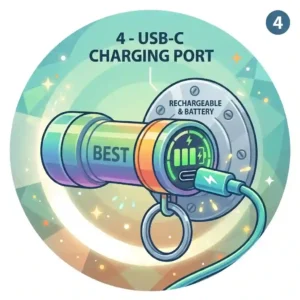
Month 6: Combating Parasitic Drain & Pocket Lint
By month six, your light has been tumbling in a lint-filled pocket. Pocket lint is the enemy of USB-C ports and twist-threads. Use a wooden toothpick to gently scrape out compacted lint from the charging port. Never use a metal needle, as you risk shorting the contact pins. If your light has an electronic side switch, be aware of parasitic drain—the tiny amount of power the circuit board draws while waiting for a button press. If you haven’t used the light in a month, charge it anyway; letting a lithium-ion cell drop below 2.5 volts can cause irreversible chemical degradation.
Month 12: The Annual Audit
Check the structural integrity of your keyring attachment point. The constant friction of metal-on-metal will slowly saw through aluminum lanyard holes. If you notice severe thinning of the metal loop, it’s time to reinforce it with a tiny titanium split ring or a micro paracord loop. By following this schedule, you bridge the gap between a tool that fails in a year and one that lasts a decade.
Real-World Scenarios: Which Micro-Light Matches Your Mission?
It is entirely possible to buy a “perfect” 5-star product that is completely wrong for your specific lifestyle. In my consulting work, I always match the engineering to the user’s biological and environmental reality. Here are three case studies.
The Night-Shift Medical Worker
If you are a nurse or doctor working night rotations, blazing 500 lumens into a patient’s room is a severe mistake. You need sub-lumen capabilities and high Color Rendering Index (CRI). For this profile, a light with direct access to an ultra-low mode (like the Nitecore TINI 2’s 1-lumen setting) or the RovyVon A5 with its diffused side-lantern is ideal. You can check charts and monitor patients without disrupting their circadian rhythms or causing optical shock.
The Heavy-Duty Mechanic or Tradesperson
Tradespeople operate in environments full of grease, concrete, and heavy impacts. A polycarbonate light will get crushed, and complex multi-button interfaces will get jammed with grime. The Fenix E03R V2.0 is the definitive choice here. Its flat profile prevents it from catching on tight spaces when crawling under machinery, and the hard-anodized metal body easily survives being dropped onto garage floors.
The Wilderness Backpacker
If you are 20 miles off the grid, internal batteries become a liability. You cannot easily recharge a USB-C light if your power bank dies. The SureFire Titan Plus or the Olight i3E EOS are mandatory for this profile. Why? Because you can pack four spare lithium AAA batteries for a fraction of an ounce and guarantee weeks of continuous operation. In cold weather, lithium AAAs perform vastly better than standard alkaline or internal Li-ion cells, which suffer severe voltage sag below freezing.
How to Choose a Micro-Illumination Tool Without Wasting Money
When hunting for the best keychain torch, the marketing departments want you to focus solely on maximum lumens. But as an expert, I look at the triad of utility: Interface, Power Source, and Optics.
-
Analyze the User Interface (UI): Do you want a twisty (mechanical) or a clicky (electronic)? Mechanical twists are immune to accidental pocket activation, making them foolproof. Electronic switches offer more brightness levels but require lockout modes. If you hate memorizing click-patterns, avoid lights with more than three modes.
-
Evaluate the Beam Geometry: A micro-light needs to light up your immediate path, not a mountain two miles away. Look for TIR (Total Internal Reflection) optics or textured “orange peel” reflectors. These blend the hot center of the beam into the edges, providing a wall of light that is easier for the human brain to process in close quarters without causing tunnel vision.
-
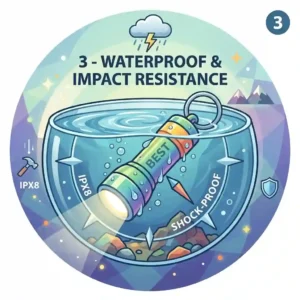
Assess the Ingress Protection: Check the IP rating. According to the ANSI/NEMA FL1 Standards, an IPX4 rating only protects against splashing water. For a tool attached to your keys—which might get dropped in a puddle or washed in the laundry—you absolutely need a minimum of IPX7 (submersible to 1 meter for 30 minutes).
The Lumens vs. Candela Debate: What Actually Matters
One of the most dangerous misconceptions in the lighting industry is the belief that higher lumens equal a “brighter” or “better” light. Let’s correct this immediately.
Lumens measure the total amount of raw light energy emitted by the LED in all directions. Candela measures the peak intensity of that light focused into a single point. Imagine a garden hose: if you turn it on without a nozzle, the water flows everywhere (High Lumens, Low Candela). If you put your thumb over the hose, the water shoots in a concentrated stream (High Candela, Low Lumens).
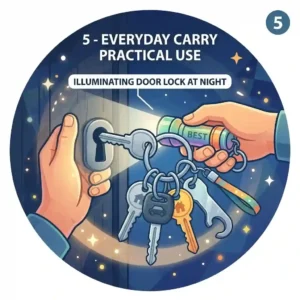
For a keychain tool, extreme candela is usually a disadvantage. If you blast a highly focused hotspot at a lock on your door from two feet away, the light bounces back and ruins your dark adaptation (the chemical rhodopsin in your eyes). You want a high-lumen, low-candela profile—a smooth, wide floodlight. The spec sheet won’t tell you this, but when analyzing these products, ignore the “1,000-lumen” claims and look for words like “flood beam,” “MaxVision,” or “TIR optic.” Those are the features that translate into real-world usability.
Integrated Battery vs. Removable: The Total Cost of Ownership
The shift toward built-in lithium-polymer (Li-Po) batteries in micro-lights has revolutionized their size and peak output, but it comes with a hidden “Total Cost of Ownership” that buyers rarely calculate.
An internal Li-Po battery degrades over time, just like your smartphone. After 300 to 500 charge cycles, its capacity will drop to about 80%. If you use your light heavily and charge it twice a week, within three years, the battery will hold significantly less charge, and because it is sealed inside the device, the entire flashlight effectively becomes e-waste.
Conversely, lights that use standard AAA (alkaline, NiMH, or Lithium primary) cells have an indefinite lifespan. The Olight i3E EOS or the SureFire Titan Plus will function perfectly 20 years from now as long as you keep feeding them fresh batteries. When evaluating your purchase, ask yourself: Am I buying this as a high-tech gadget I expect to replace in three years, or am I investing in an heirloom-quality emergency tool? If it is the latter, removable batteries are non-negotiable. For a deep dive into battery safety and thermal runaway, the Consumer Product Safety Commission (CPSC) offers excellent guidelines on handling lithium-based cells.
The “Anti-Recommendation” Logic: When NOT to Buy a Micro-Light
I always play devil’s advocate with my clients. Despite this article being dedicated to helping you find the best keychain torch, there are specific scenarios where relying on one is a terrible idea.
If you are a search-and-rescue volunteer, an overnight security guard, or someone who relies on light for self-defense (such as blinding an attacker), a micro-light is a severely inadequate tool. These devices utilize aggressive thermal step-down mechanisms. That 600-lumen burst might only last for 45 seconds before the internal thermistor detects dangerous heat and throttles the output down to 80 lumens to protect the circuit board.
Furthermore, the ergonomics of holding a tiny metal rectangle on a heavy bundle of keys make it impossible to utilize proper tactical light-holding techniques (like the Harries or FBI method) alongside a self-defense tool. If your safety depends on sustained, high-candela output for more than two minutes, skip the keychain aisle entirely and invest in a dedicated 18650-battery tactical light with a tail-switch. Use the keychain model purely as your backup’s backup.
Final Verdict: Lighting the Way Forward
Navigating the crowded market to find the best keychain torch doesn’t require an engineering degree, but it does require looking past the marketing fluff. As we’ve explored, raw lumen counts mean nothing without efficient optics, intelligent thermal management, and a user interface that aligns with your specific muscle memory and daily environment.
Whether you opt for the digital sophistication of the Nitecore TINI 2, the rugged simplicity of the Fenix E03R V2.0, or the fail-proof mechanical twist of the Olight i3E EOS, the ultimate goal is preparedness. A micro-light is an insurance policy you carry in your pocket—a tool that demands almost zero space but pays massive dividends when the grid fails or the unexpected occurs. Take the time to apply the initial maintenance protocols we discussed, respect the limitations of micro-batteries, and your chosen light will reliably cut through the darkness for years to come.
FAQs
❓ What is the most durable keychain flashlight material?
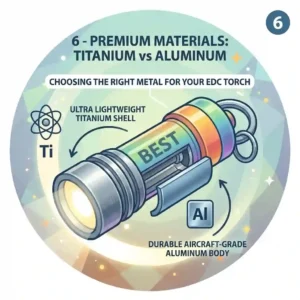
✅ Titanium and brass are excellent, but Type III hard-anodized aerospace-grade aluminum (like A6061-T6) offers the best balance of impact resistance, lightweight carry, and thermal heat dissipation for daily use…
❓ How many lumens do you really need for everyday carry?
✅ Between 50 and 150 lumens is perfect for 95% of daily tasks like finding keyholes, navigating dark walkways, or searching under car seats. Anything above 300 lumens on a keychain is usually for brief burst-mode utility…
❓ Does leaving a flashlight in a hot car ruin the battery?
✅ Yes, temperatures above 115°F (46°C) severely accelerate the chemical degradation of integrated lithium-ion batteries. Extreme heat can also cause pressure buildup. Always remove electronics from hot vehicles to prevent thermal damage…
❓ What does CRI mean in flashlights?
✅ Color Rendering Index (CRI) measures how accurately a light source reveals the true colors of objects compared to natural sunlight. High CRI (90+) is vital for medical professionals or mechanics identifying color-coded wires…
❓ Can keychain lights get wet in the rain?
✅ Yes, most quality models have an IPX6 or higher rating, meaning they can withstand heavy rain or even brief submersion. However, always ensure USB-C charging port covers are firmly seated before water exposure…
Recommended for You
- 7 Best titanium lanyard beads for EDC: 2026 Guide to Premium Gear
- 7 Best keychain alternative Options for a Sleek Everyday Carry in 2026
- 5 Brilliant Choices: The best keychain flashlight of 2026 Reviewed
Disclaimer: This article contains affiliate links. As an Amazon Associate, I earn from qualifying purchases. If you purchase products through these links, we may earn a small commission at no additional cost to you.
✨ Found this helpful? Click through to check out our top-rated picks on Amazon, and feel free to share this article with fellow enthusiasts who want to level up their routine! 💬🤗
[addtoany]
