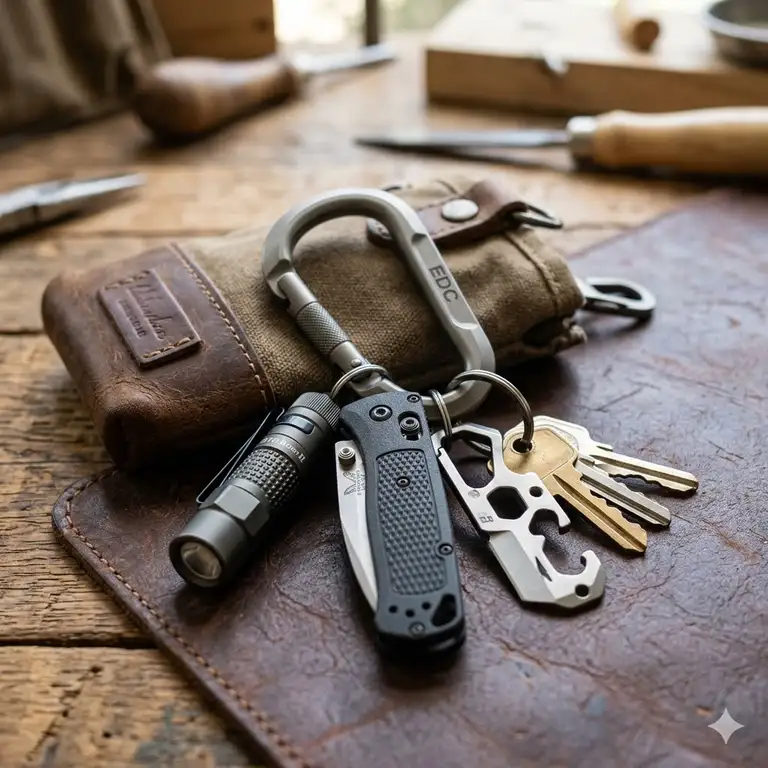
A carabiner isn’t just a climbing tool that wandered into your pocket; it is the fundamental anchor of a modern organizational system. When we talk about the best edc carabiner, we are looking for a device that balances security, weight, and rapid accessibility. In the context of 2026, where our daily carry includes high-tech key fobs, titanium multi-tools, and perhaps a stray air-tag, the clip holding it all together can’t be a weak link.
What is the best edc carabiner? It is a specialized, compact spring-loaded gate clip designed specifically for daily organization rather than life-safety climbing. Unlike standard hardware store clips, these are engineered with tighter tolerances, premium materials like Grade 5 titanium, and features like dual compartments to prevent gear from falling off when you open the gate…
In my years of testing gear, I’ve found that most people treat their carabiner as an afterthought until their keys vanish during a morning jog. The market has shifted toward “unibody” designs—frames cut from a single piece of metal—which eliminate the traditional pivot pin, a notorious failure point. Whether you are a minimalist looking to hang a single key from a belt loop or a “prepared-for-everything” enthusiast with a heavy loadout, the right carabiner acts as the skeletal structure of your pocket inventory. It’s the difference between a jangling mess and a silent, streamlined kit.
Quick Comparison: Top Picks for 2026
Before we dive into the deep-dive reviews, here is a high-level look at how the leading contenders stack up in terms of material, weight, and primary utility.
| Product Name | Material | Gate Style | Best For | Price Range |
| The James Brand Mehlville | Aluminum/Steel | Dual-Gate | Style-Conscious EDC | $60–$80 |
| Nite Ize G-Series | Stainless Steel | G-Hook | Maximum Security | $5–$15 |
| Trayvax Link | Aluminum/Climbing Grade | Snap-Shackle | Heavy Duty Use | $30–$50 |
| StatGear Ledge | Stainless Steel | Spring Gate | Multitool Users | $25–$40 |
| Handgrey H3 | Grade 5 Titanium | Unibody Lateral | Minimalists | $70–$90 |
Looking at the comparison above, the Nite Ize G-Series delivers the best value for under $15, providing a secondary security chamber that is hard to beat for the price. However, if weight and long-term durability are your priorities, the Handgrey H3’s titanium construction justifies the higher investment. Users who frequently swap gear on and off their belt will find the Trayvax Link’s snap-shackle mechanism much faster than traditional spring gates.
💬 Just one click — help others make better buying decisions too! 😊
[addtoany]
Top 5 best edc carabiner Options: Expert Analysis
1. The James Brand Mehlville — The Dual-Compartment Specialist
The Mehlville is often cited as the gold standard for aesthetic EDC, but its beauty isn’t just skin deep; the dual-compartment design is a functional masterstroke.
Key Specs & Interpretation:
-
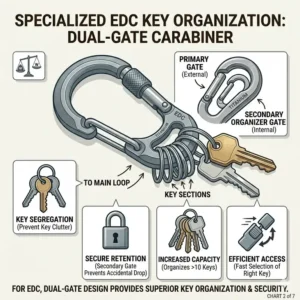
Dual-Chamber Design: This means your keys stay trapped in the bottom loop even when you open the top gate to clip it to your belt.
-
6063 Aluminum Construction: Lightweight yet stiff enough to resist bending under the weight of a heavy key set.
-
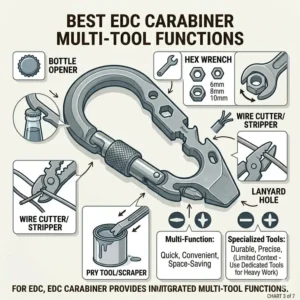
Integrated Bottle Opener: A notch in the frame provides utility without adding the bulk of a separate tool.
In my experience, the Mehlville solves the “falling key” syndrome better than almost any other premium clip. What most buyers overlook is the notch design; it’s specifically shaped to sit flat against the hip, reducing the annoying “thwack” against your leg as you walk. It’s best for the urban professional who wants a tool that looks as good in a boardroom as it does on a hiking trail.
Customer Feedback Summary:
Users consistently praise the crisp spring tension and the matte finish that resists scratching. Some note that the bottle opener requires a bit of a learning curve to find the right leverage point…
Pros:
-
Highly secure dual-gate system
-
Extremely lightweight and slim profile
-
Integrated utility features (bottle opener)
Cons:
-
Higher price point for aluminum
-
Gate can feel stiff initially
Price Range: Around $60–$75.
Value Verdict: A premium investment for those who value refined design and security.
2. Nite Ize G-Series — The Budget Security King
The G-Series evolves the classic S-Biner design into a more secure, “G” shaped format that provides two distinct zones for gear.
Key Specs & Interpretation:
-
Stainless Steel Body: Offers high tensile strength, meaning it won’t warp if you accidentally snag it on a car door.
-
G-Hook Geometry: The “G” shape creates a secondary hook that acts as a physical barrier against accidental gate openings.
-
Multiple Sizes Available: Ranges from #1 to #4, allowing you to choose between a tiny keychain clip or a large gear hauler.
What I love about the G-Series is its simplicity. The spec sheet won’t tell you this, but the “G” shape is actually more intuitive to use with gloves than a standard carabiner because the secondary hook provides a natural finger rest. It is the perfect choice for anyone on a budget who refuses to compromise on the safety of their gear.
Customer Feedback Summary:
Buyers frequently mention that they switched from the S-Biner to this model because the G-Series feels much more “locked in.” It’s a favorite for dog walkers and hikers alike…
Pros:
-
Incredible price-to-performance ratio
-
Stainless steel is virtually indestructible
-
Available in various sizes for customization
Cons:
-
Heavier than titanium alternatives
-
Finish can wear down over years of use
Price Range: Around $5–$12.
Value Verdict: The best “bang-for-your-buck” option for general daily use.
3. Trayvax Link — The Heavy-Duty Quick Release
Trayvax is known for over-engineered wallets, and the Link carabiner follows that same philosophy of “built to outlast the owner.”
Key Specs & Interpretation:
-
Stainless Steel Snap-Shackle: This is a marine-grade mechanism designed for high-load environments, providing a “quick-pull” release.
-
Climbing-Grade Longevity: While not for life-safety, the pivot points are reinforced to handle hundreds of pounds of static pressure.
-
Integrated Hex Wrench: The frame includes a cutout that fits standard bits, turning your clip into a functional repair tool.
If you are a tradesman or someone who works in a rugged environment, this is your best edc carabiner choice. The snap-shackle is a game changer; instead of fumbling with a spring gate, you simply pull the pin. It’s bulky, yes, but that bulk translates to a level of confidence that standard wire-gate clips simply cannot provide.
Customer Feedback Summary:
Fans of the brand love the industrial aesthetic and the “click” of the shackle. A few users mentioned it’s a bit heavy for thin-fabric shorts, so keep it to your work jeans…
Pros:
-
Fastest release mechanism on the market
-
Extraordinarily high weight capacity
-
Includes basic multi-tool functionality
Cons:
-
Heaviest option in this lineup
-
Industrial look isn’t for everyone
Price Range: Around $35–$45.
Value Verdict: An indestructible tool for those who demand mechanical reliability.
4. StatGear Ledge — The Minimalist Multitool
The Ledge takes the standard carabiner silhouette and hides a folding blade and screwdriver within the frame.
Key Specs & Interpretation:
-
420 Stainless Steel Blade: A small, 2-inch blade that is legal in most jurisdictions but sharp enough for package opening.
-
Liner Lock Mechanism: Ensures the blade doesn’t fold back on your fingers—a safety feature often missing in carabiner knives.
-
Spring-Loaded Gate: A standard, reliable gate that clips easily to loops or bags.
This product is for the person who hates carrying a dedicated pocket knife but always finds themselves needing one. In my professional opinion, the Ledge is a “lifestyle” carabiner. It’s not meant for climbing or heavy lifting; it’s meant to solve the three most common daily problems: opening a box, tightening a screw, and keeping your keys organized.
Customer Feedback Summary:
Reviewers appreciate the “stealth” nature of the tool, noting it fits into small pockets without bulging. Some wish the blade steel was a higher grade, but for the price, it performs well…
Pros:
-
Consolidates two tools (knife/clip) into one
-
Features a genuine locking blade for safety
-
Slim enough for front-pocket carry
Cons:
-
Not “climbing” rated—do not use for heavy loads
-
Spring gate is basic compared to the Mehlville
Price Range: Around $30–$40.
Value Verdict: Ideal for the casual user looking to minimize their pocket clutter.
5. Handgrey H3 — The Titanium Perfectionist
Handgrey redefined the EDC world with their unibody titanium designs, and the H3 is the pinnacle of that evolution.
Key Specs & Interpretation:
-
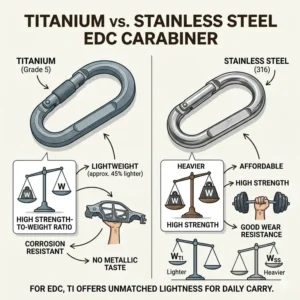
Grade 5 Titanium (Ti6Al4V): The same alloy used in aerospace; it has a higher strength-to-weight ratio than steel and is completely rust-proof.
-
Unibody Construction: The “spring” is actually the metal itself, tensioned via a precise EDM (Electrical Discharge Machining) cut.
-
Integrated Key Loop: A dedicated hole at the bottom keeps your key ring separated from the main gate area.
The H3 is a masterpiece of materials science. Because there are no pins, screws, or separate springs, there is nothing to break. In ten years, this carabiner will function exactly as it does today. It’s best for the “Buy It For Life” (BIFL) enthusiast who wants the absolute lightest and strongest clip possible. According to NIST research, Grade 5 Titanium is preferred for its biocompatibility and fatigue resistance, making it perfect for something you touch every day.
Customer Feedback Summary:
Users often call this “pocket jewelry” because of the stone-washed finish and elegant lines. The common consensus is that while expensive, you never have to buy another carabiner again…
Pros:
-
Weightless feel (titanium is 45% lighter than steel)
-
Zero moving parts to fail or lose tension
-
Rust-proof even in saltwater environments
Cons:
-
The most expensive option on the list
-
Requires a bit more force to open than a wire gate
Price Range: Around $75–$95.
Value Verdict: The ultimate choice for the titanium-obsessed minimalist.
✨ Don’t Miss These Exclusive Deals!
🔍 Take your organization to the next level with these carefully selected products. Click on any highlighted item to check current pricing and availability. These tools will help you create an authentic daily carry setup your family and friends will envy!
The 30-Day EDC Maintenance Ritual (Transformation Guide)
A high-quality best edc carabiner is a mechanical device, and even the “unibody” titanium versions require a little love to ensure they don’t fail when you need them most. I recommend a monthly check-up to keep your gear in peak condition.
Step 1: The Tension Test
Every 30 days, check the gate tension. If you have a traditional spring-loaded gate (like the Mehlville or G-Series), open it fully and let it snap shut. If it “lazily” returns or stays slightly open, dust or pocket lint has likely worked its way into the pivot. Use a can of compressed air to blow out the hinge.
Step 2: Lubrication (The Pro Trick)
Never use heavy oils or WD-40 on your carabiner. These attract lint and create a grinding paste that wears down the metal. Instead, use a “dry” lubricant like graphite or a specialized PTFE-based spray. Apply a tiny amount to the pivot pin, work the gate 10 times, and wipe away any excess.
Step 3: Material Inspection
If you carry a stainless steel or aluminum clip, check for “burrs” or sharp edges. Constant rubbing against keys can create small nicks in the metal that might snag your clothing or cut your skin. A quick pass with a high-grit sandpaper (400+) can smooth these out in seconds.
Step 4: The Ring Check
Don’t just check the carabiner; check the split ring attached to it. These often stretch out over time. If there is a gap in your key ring, replace it immediately. A $90 titanium carabiner is useless if a $0.10 steel ring fails.
The Commuter’s Loadout: Matching Carabiners to Lifestyles (Transformation Guide)
Not everyone uses their gear the same way. Finding the best edc carabiner requires matching the tool to your environment. Here are three common profiles to help you self-identify.
The Urban Commuter
-
The Scenario: You take the subway, walk several blocks to an office, and frequently need to scan a badge or unlock a bike.
-
The Match: The James Brand Mehlville.
-
Why: You need the dual-compartment security so your keys don’t fly off when you’re rushing through a turnstile. The aluminum build keeps it light enough for dress slacks.
The Weekend Warrior / Hiker
-
The Scenario: You spend your Saturdays on trails, clipping water bottles to your pack and ensuring your car keys are locked down tight.
-
The Match: Nite Ize G-Series.
-
Why: The secondary hook provides that “peace of mind” factor. If a branch snags the gate, the “G” shape acts as a secondary fail-safe to keep your items attached.
The Industrial Professional
-
The Scenario: You work in construction, HVAC, or automotive repair. You’re constantly moving, climbing ladders, and using your hands.
-
The Match: Trayvax Link.
-
Why: You need the snap-shackle. When your hands are greasy or you’re wearing gloves, the pull-pin release is significantly easier to operate than a standard gate. Plus, the frame can take a literal beating from heavy machinery.
How to Choose Your Next Daily Carry Clip
Choosing the best edc carabiner isn’t as simple as picking the prettiest one. You need a framework to evaluate what actually matters for your specific carry style.
-
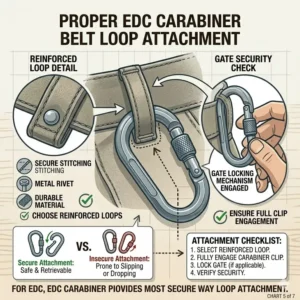
Determine Your Attachment Point: Are you clipping to a belt loop, a backpack MOLLE web, or inside a pocket? A wide-gate carabiner is better for thick belt loops, while a slim unibody design is better for internal bag organization.
-
Evaluate the Gate Security: If you are active (running, biking), look for a locking gate or a dual-chamber system. Simple spring gates can be “bumped” open relatively easily.
-
Choose Your Metal: Aluminum is cheap and light but can bend. Stainless steel is heavy but incredibly strong. Titanium is the middle ground—light, strong, and corrosion-resistant—but it comes with a price premium.
-
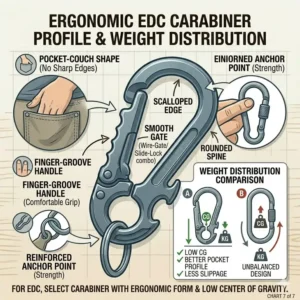
Check for “Snag-Free” Design: Look at the nose of the carabiner. A “keylock” nose (where the gate meets the body) is smooth and won’t snag on fabric. Older “hook-and-pin” designs are notorious for catching on threads.
-
Assess Multi-Functionality: Do you actually need a bottle opener or a knife on your clip? If you already carry a Swiss Army Knife, extra features on your carabiner are just unnecessary weight and bulk.
Materials Matter: Titanium vs. Stainless Steel vs. Aluminum
The soul of the best edc carabiner lies in its metallurgy. In 2026, we have more choices than ever, but three materials dominate the market.
Stainless Steel is the workhorse. It’s significantly harder than aluminum, meaning the gate will retain its “snap” for years. However, it is dense. A full-sized steel carabiner can feel like a lead weight in your pocket. If you are budget-conscious and want something that won’t break, steel is the default.
Aluminum (specifically 6061 or 7075 alloys) is the lightweight alternative. It’s what most climbing carabiners are made of. The downside? It’s a softer metal. Over time, steel key rings will actually “eat” into an aluminum frame, creating notches. It’s great for light-duty carry but isn’t a “forever” material.
Grade 5 Titanium is the enthusiast’s choice. It’s roughly half the weight of steel but just as strong. More importantly, it has “memory.” In unibody designs, the titanium can be flexed thousands of times without losing its shape. It’s also “non-magnetic,” which is a niche but helpful feature for people working around sensitive electronics. According to materials science databases like MatWeb, Titanium’s resistance to fatigue makes it the superior choice for spring-based applications.
Security vs. Accessibility: Finding the Right Gate Tension
There is a constant tug-of-war in the EDC world: you want your keys to stay put, but you also want to be able to grab them in half a second. The best edc carabiner finds the “Goldilocks” zone of gate tension.
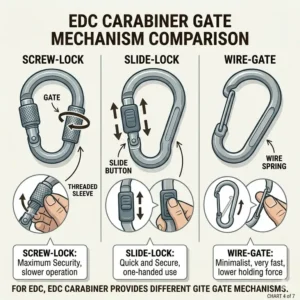
In my testing, I’ve found that “wire gates” offer the most accessibility. They are easy to push open with a single finger and have a very wide opening. However, they are also the most prone to accidental opening. If you sit down and your leg pushes against the wire, the gate can easily swing inward.
On the other hand, “locking gates” (which use a threaded sleeve) provide 100% security but are a nightmare for daily use. Do you really want to unscrew a sleeve every time you need to unlock your front door? Probably not. This is why the dual-chamber design has become so popular in 2026. It provides the accessibility of a standard gate for the belt loop while keeping the keys locked in a separate, non-opening section.
Common Mistakes When Buying Daily Carry Carabiners
Even experienced gear-heads fall into these traps. Avoid these pitfalls to ensure you don’t waste money on a clip that doesn’t fit your life.
-
Buying “Not for Climbing” Clips for Heavy Loads: Most EDC carabiners explicitly state they are not for climbing. This isn’t just a legal disclaimer; their gates are not designed to take a “side load.” If you plan to hang a 20lb tool bag from one, make sure it has a weight rating.
-
Ignoring the “Jangle” Factor: A large, metal-on-metal carabiner setup can be loud. If you prefer a silent carry, look for carabiners with rubber dampeners or those made of polymer-coated metals.
-
Overestimating the Utility of Gadgets: A carabiner with 15 integrated tools usually does 15 things poorly. A screwdriver on a carabiner often lacks the reach to get into tight spots, and a wrench cutout can weaken the structural integrity of the frame.
-
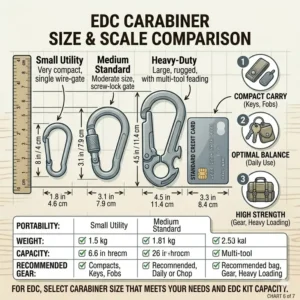
Choosing the Wrong Size: A #4 carabiner looks cool in photos but is massive in person. For most people, a carabiner between 2 and 3 inches in length is the sweet spot for belt-loop carry.
Beyond the Belt Loop: Creative Ways to Use Your Carabiner
The best edc carabiner isn’t limited to just holding keys. Once you start carrying a high-quality clip, you’ll find uses for it everywhere.
-
Temporary Bag Anchor: When eating at a restaurant, clip your bag to the chair frame. This prevents the “grab and run” theft method and keeps your bag off the dirty floor.
-
Dog Leash Extension: Clip a carabiner to your dog’s leash handle. When you need to stop at a coffee shop, you can quickly loop the leash around a post and clip it to itself.
-
Grocery Bag Carrier: If you have five heavy bags to carry into the house, clip all the handles into one large carabiner. The thick frame of the carabiner is much more comfortable on your hand than thin plastic straps.
-
Gym Locker Security: Many people use a carabiner as a temporary “placeholder” for their gym locker door while they are moving between machines, keeping their towel and water bottle inside without needing to fully lock and unlock a combination dial every five minutes.
Long-Term Value: Why Investing in Quality Saves Money
It’s tempting to grab a 5-pack of colorful carabiners from a bin for $5. But in the world of EDC, you get what you pay for. A cheap carabiner uses a simple tension wire that will eventually lose its “spring,” leading to a gate that stays perpetually open.
If you buy a $50 titanium carabiner like the Handgrey H3, you are making a ten-year investment. At $5 a year, it’s actually cheaper than replacing $10 worth of cheap clips every twelve months. Furthermore, consider the cost of what the carabiner is holding. If you are carrying a $300 key fob and a $100 multi-tool, trusting them to a $1 clip is a massive risk. The “Total Cost of Ownership” of a premium carabiner is actually lower when you factor in the avoided cost of lost gear.
✨ Don’t Miss These Exclusive Deals!
🔍 Take your daily routine to the next level with these carefully selected products. Click on any highlighted item to check current pricing and availability. These tools will help you create a streamlined, efficient carry that makes life easier!
Conclusion
Finding the best edc carabiner in 2026 comes down to understanding the balance between security, weight, and utility. For those who want the peak of luxury and longevity, the Handgrey H3 is an unbeatable titanium masterpiece. If you need a reliable workhorse that won’t break the bank, the Nite Ize G-Series provides innovative security at a fraction of the cost.
Remember, your carabiner is the foundation of your carry system. Don’t let a weak clip be the reason you lose your most important daily tools. Choose a material that fits your environment, a gate style that matches your activity level, and a design that makes you happy every time you reach for your keys.
FAQs
❓ What is the strongest material for the best edc carabiner?
✅ Grade 5 Titanium and Stainless Steel are the top contenders. While steel is technically harder, Grade 5 Titanium offers a better strength-to-weight ratio and will not rust or corrode over time…
❓ Can I use an EDC carabiner for climbing or rappelling?
✅ Absolutely not. Unless the carabiner is UIAA certified and has a Kilo-Newton (kN) rating stamped on the spine, it is for gear organization only and could fail under human weight…
❓ Why do some carabiners have two holes or compartments?
✅ This is for security. The dual-chamber design ensures that when you open the main gate to clip it to your belt, your keys stay securely trapped in the bottom section…
❓ How do I stop my carabiner from making noise?
✅ Look for models with a “shackle” design or use small O-rings between your keys. Some brands also offer “silent” carabiners with polymer coatings that dampen the clinking of metal…
❓ Is a locking carabiner necessary for daily carry?
✅ For most people, no. A locking gate adds too much friction to the process of getting your keys. A dual-compartment design or a high-tension spring gate is usually sufficient…
Recommended for You
- Knife Carabiner: 7 Best Rugged Tools for Your 2026 EDC Essentials
- 7 Best Carabiner Keychain with Strap Options for EDC in 2026
- 7 Best break away lanyard Options for 2026: Safety and Style Guide
Disclaimer: This article contains affiliate links. As an Amazon Associate, I earn from qualifying purchases. If you purchase products through these links, we may earn a small commission at no additional cost to you.
✨ Found this helpful? Share it with your friends! 💬🤗
[addtoany]
