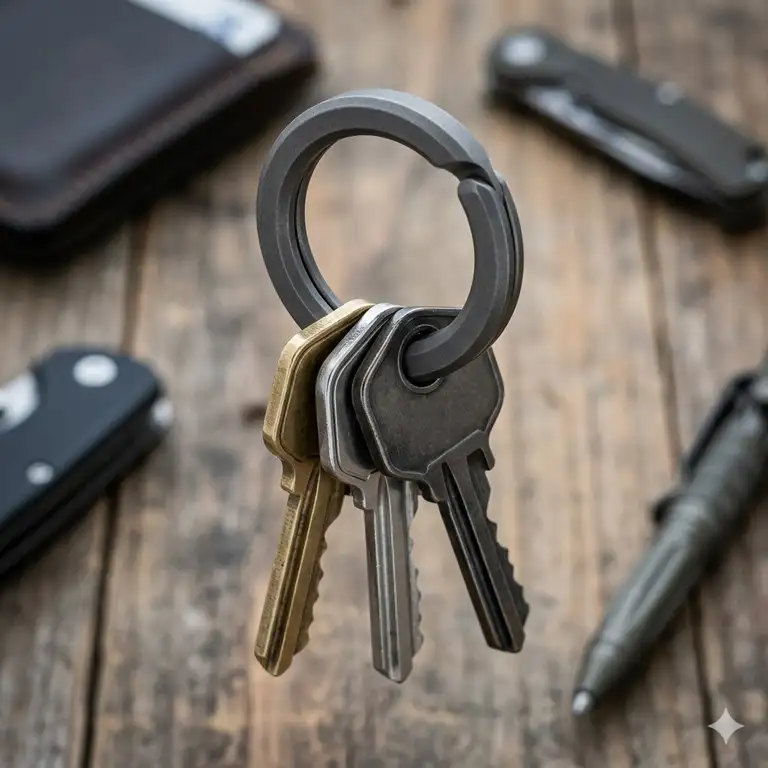
When we talk about the strongest key ring, we aren’t just discussing a circular piece of metal; we are talking about the primary guardian of your most essential tools. Whether it is your house keys, your high-tech car fob, or your titanium multi-tool, everything relies on that single point of failure. In 2026, the Every Day Carry (EDC) community has moved beyond the flimsy, disposable rings found at hardware store checkout counters. We demand materials that resist “springing” (that annoying gap that forms when you add too many keys) and finishes that won’t corrode after a year in a pocket.
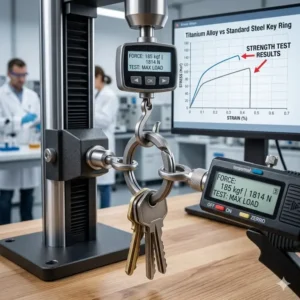
A strongest key ring is defined as a high-tensile retention device designed to hold multiple keys or tools without deforming under stress. Most modern high-strength versions utilize Grade 5 titanium, 316 stainless steel, or aircraft-grade cable to ensure they can withstand 50+ pounds of pull force without failing.
In my years of testing gear, I’ve seen more “lost key” disasters caused by a weakened ring than by any other equipment failure. A key ring might seem like a minor accessory, but when you’re trekking through a national park or navigating a busy urban commute, the peace of mind provided by a heavy-duty connector is worth its weight in gold. Today, we’re diving deep into the engineering behind these tiny titans to see which ones truly deserve a spot on your belt loop.
Quick Comparison: Top Heavy-Duty Key Rings
| Product Name | Primary Material | Mechanism Type | Best For | Strength Rating |
| Lucky Line Twisty | Nylon-Coated Cable | Screw Lock | Bulk Keys | ❌ High (80lb+) |
| Freekey System | Stainless Steel | Press-to-Open | Easy Access | ✅ Medium-High |
| Ti-Edc Titanium | Grade 5 Titanium | Split Ring | Lightweight EDC | ✅ Very High |
| Nite Ize G-Series | Stainless Steel | Dual Chamber | Security | ✅ High |
| KeyBar Mag-Net | Rare Earth Magnet | Magnetic | Quick Release | ❌ Specialized |
Looking at the comparison above, the Ti-Edc Titanium offers the best strength-to-weight ratio for traditionalists, but if you carry more than ten keys, the Lucky Line Twisty cable design provides the most secure “closed-loop” system. Those who prioritize accessibility over raw pull-strength will find the Freekey System far superior to standard split rings that ruin your fingernails.
💬 Just one click — help others make better buying decisions too! 😊
[addtoany]
Top 5 strongest key ring Options: Expert Analysis
1. Lucky Line Twisty Key Ring (Flexible Aircraft Cable)
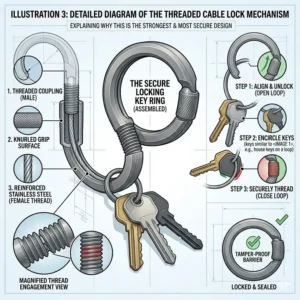
The Lucky Line Twisty Key Ring is a departure from the traditional circle, utilizing a flexible, nylon-coated stainless steel cable that locks with a unique “twist and screw” motion.
Key Specifications:
-
Material: 1/8″ diameter galvanized steel aircraft cable.
-
Capacity: Can hold up to 30 keys without adding significant bulk.
-
Security: Screw-locking mechanism ensures it cannot accidentally “spring” open like a traditional ring.
Expert Commentary:
In my experience, the Lucky Line Twisty is the gold standard for anyone carrying a “janitor-sized” set of keys. What most buyers overlook is the flexibility; because it’s a cable, it allows your keys to lie flat against your leg, reducing the “bulge” factor in your pocket. The nylon coating is a 2026-era improvement that prevents the steel from scratching your car’s ignition or other EDC gear. It is virtually impossible to break this ring with human hands.
Customer Feedback Summary:
Users consistently praise its reliability for high-capacity needs, though some note that the screw lock requires a firm tighten to ensure it doesn’t vibrate loose over months of use…
-
Pros: Incredible weight capacity; flexible ergonomics; won’t deform.
-
Cons: Screw can loosen if not checked; larger diameter than split rings.
Price Range: Around $10-$15 for a multi-pack.
Value Verdict: The absolute best value for heavy-duty, high-capacity utility.
2. Freekey System (Easy-Open Stainless Steel)
The Freekey System solves the age-old problem of broken fingernails by using a strategically designed “bump” in the steel that allows you to open the ring by pressing a specific spot.
Key Specifications:
-
Material: High-grade 316 stainless steel.
-
Design: Triple-wave architecture for tension memory.
-
Included: Comes with three smaller “grouping” rings.
Expert Commentary:
The Freekey System is an engineering marvel because it balances ease of use with structural integrity. While standard rings lose their “spring” if you overextend them once, the 316 stainless used here has much better memory. I recommend this specifically for people who frequently swap out car fobs or work IDs. The spec sheet won’t tell you this, but the “sweet spot” for pressing is quite intuitive once you’ve done it twice—it feels much more “premium” than a 50-cent hardware store ring.
Customer Feedback Summary:
Most reviewers claim they will never go back to standard rings, citing the “flick-of-the-thumb” opening as a life-changer for their daily routine…
-
Pros: Finger-friendly; elegant design; includes sub-rings for organization.
-
Cons: Slightly thicker than cheap rings; may not fit through tiny keyholes.
Price Range: $8-$12 range.
Value Verdict: The smartest choice for those who value their manicure and their security.
3. Ti-Edc Titanium Split Rings (High-Strength Grade 5)
For those who want the absolute strongest key ring in a traditional form factor, the Ti-Edc Titanium Split Rings are the pinnacle of material science.
Key Specifications:
-
Material: TC4 Grade 5 Titanium Alloy.
-
Weight: Approximately 40% lighter than steel.
-
Corrosion Resistance: 100% rustproof, even in saltwater environments.
Expert Commentary:
If you live in a coastal area or spend a lot of time outdoors, titanium is a non-negotiable. Grade 5 titanium (TC4) has a higher tensile strength than most common steels but weighs significantly less. What I love about the Ti-Edc version is the sandblasted finish—it doesn’t show scratches from other keys. It’s the “buy it once” option. You could theoretically leave this at the bottom of the ocean for a decade, and it would still function perfectly.
Customer Feedback Summary:
Outdoor enthusiasts rave about the lack of rust and the “snappy” return of the ring after being opened…
-
Pros: Impossible to rust; extremely lightweight; high “cool factor.”
-
Cons: More expensive than steel; stiffer to open initially.
Price Range: Around $15-$20 for a set.
Value Verdict: Premium materials for the serious EDC enthusiast who wants the best.
4. Nite Ize G-Series Dual Chamber Carabiner
The Nite Ize G-Series isn’t a “ring” in the circular sense, but it acts as a strongest key ring replacement by using a dual-chambered gate system to lock keys in place.
Key Specifications:
-
Material: Stainless steel body.
-
Mechanism: G-shaped gate that prevents keys from falling out when the main clip is opened.
-
Size Options: Available in #1 through #4 sizes.
Expert Commentary:
The G-Series is the solution to the “carabiner fail” where your keys slip off when you’re clipping the ring to your belt loop. The inner chamber acts as a secondary security vault. I’ve switched several “budget” buyers to this model because it prevents that tragic moment where you drop your keys in the dark. It’s less about the “tensile strength” of the metal and more about the “strength of the system” to keep your items where they belong.
Customer Feedback Summary:
Commonly praised for its “security-first” design, though some users find the #1 size too small for modern car fobs…
-
Pros: Dual-chamber security; easy to clip; multiple sizes.
-
Cons: Not a “clean” circle; gates can catch on fabric.
Price Range: $5-$10 range depending on size.
Value Verdict: The best security-focused connector for active users.
5. KeyBar Mag-Net (Magnetic Quick Release)
The KeyBar Mag-Net is for those who need to detach specific items—like a car key or a flashlight—from their main strongest key ring instantly.
Key Specifications:
-
Material: Grade 5 Titanium body with Neodymium magnets.
-
Strength: Holds up to 6.5 lbs of vertical weight.
-
Compatibility: Works with any standard key ring setup.
Expert Commentary:
Technically an accessory for your key ring, this is the strongest magnetic coupling on the market in 2026. Why does this matter? If you have a heavy bundle of keys, hanging them from your car’s ignition can actually damage the tumbler over time. Using a Mag-Net allows you to snap the ignition key off the heavy bundle instantly. The 6.5lb pull strength is surprisingly stout—it won’t fall off just from walking or jogging.
Customer Feedback Summary:
Users love the “satisfying click” and the convenience for car ignitions, though a few warn to keep it away from sensitive credit card strips…
-
Pros: Instant detachment; incredibly strong magnets; titanium build.
-
Cons: Pricey for an accessory; adds length to your key chain.
Price Range: Around $25-$30.
Value Verdict: A specialized tool for those who hate bulky ignition bundles.
✨ Don’t Miss These Exclusive Deals!
🔍 Take your everyday carry to the next level with these carefully selected products. Click on any highlighted item to check current pricing and availability. These tools will help you create a secure and organized system your future self will thank you for!
Transformation: A Guide to Optimizing Your strongest key ring
Practical Usage & Maintenance Guide
Even the strongest key ring requires a bit of “owner’s intuition” to perform at its peak for a decade. Most people don’t realize that the biggest enemy of a key ring isn’t weight—it’s overextension.
-
The First Extension: When adding a new key, never use a screwdriver to pry the ring open. This creates a permanent gap. Instead, use a “staple remover” or the Freekey method to create just enough space for the key to slide in.
-
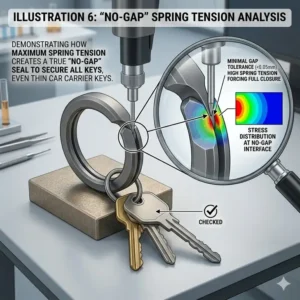
The Tension Check: Every six months, take your keys off and see if the ring “snaps” back to a perfectly closed position. If there is a gap of more than 0.5mm, the metal has reached its elastic limit and should be replaced.
-
Lubrication: For cable-style rings like the Lucky Line Twisty, a tiny drop of dry graphite lubricant on the threads once a year prevents “galling,” which is when the metal threads seize together.
-
Cleaning: Titanium rings can develop a “sticky” feel over time due to pocket lint and oils. A simple wash with dish soap and warm water restores the natural tactile grip of the TC4 alloy.
Real-World Scenario: Which Ring Fits Your Life?
Choosing the strongest key ring depends entirely on how you move through the world. Let’s look at three common 2026 lifestyles:
-
The Urban Professional: If you’re commuting via subway and office elevators, you need the Freekey System. You’re likely adding and removing a “Work ID” or a “Gym Fob” daily. You need speed and fingernail protection, not 100lb pull-strength.
-
The Wilderness Explorer: If you’re hiking, kayaking, or working outdoors, the Ti-Edc Titanium is your only choice. Saltwater and sweat will eat through “zinc-plated” rings in weeks. Titanium’s inert nature means your keys stay secure regardless of the pH levels of your environment.
-
The Logistics Manager: If you carry 15+ keys for various properties or vehicles, the Lucky Line Twisty wins. Traditional rings become a giant “ball” of metal that’s uncomfortable to wear. The cable allows that many keys to hang in a slim, vertical line.
Why “Cheap” Key Rings Fail
To understand why you need the strongest key ring, we have to look at the metallurgy of the standard $0.50 rings. Most are made from low-carbon steel with a thin zinc coating. According to ASM International, material fatigue occurs much faster in these low-grade alloys.
When you slide a thick modern car fob (which can be 4-6mm thick) onto a standard ring, you are forcing the metal beyond its yield point. Once the metal molecules are stretched that far, they cannot return to their original shape. This creates the “gap” that eventually allows your keys to slide out while you’re running for a bus or pulling your phone out of your pocket.
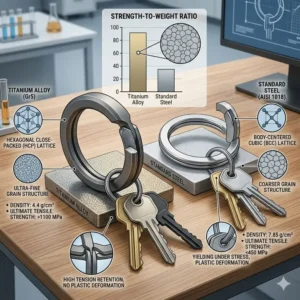
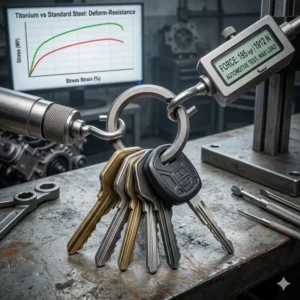
Material Comparison: Titanium vs. Stainless Steel
| Feature | Grade 5 Titanium | 316 Stainless Steel |
| Tensile Strength | ~130,000 psi | ~85,000 psi |
| Weight | 4.4 g/cm³ | 8.0 g/cm³ |
| Corrosion | Immune to bio-fluids/salt | Highly resistant |
Analysis: While 316 Stainless Steel is more than enough for 90% of users, Titanium offers nearly double the tensile strength with half the weight. This makes it the superior choice for “deep pocket” carry where every gram counts.
Features That Actually Matter (And Those That Don’t)
In the world of EDC marketing, it’s easy to get distracted by “tactical” buzzwords. Here is what actually matters when looking for the strongest key ring:
1. Wire Diameter vs. Overall Diameter
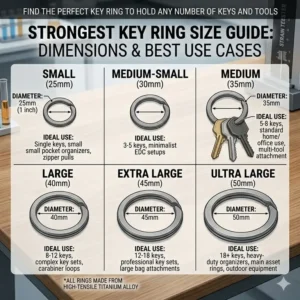
A ring with a 30mm overall diameter but a very thin wire gauge will fail faster than a 20mm ring with a thick gauge. Look for “Heavy Duty” labels that specify a wire thickness of at least 1.5mm for split rings.
2. The “Memory” of the Metal
This is the most critical expert insight: High-quality rings are heat-treated. This process ensures that when the ring is opened to accept a key, it wants to “spring” back. Cheap rings are cold-formed and lack this “memory,” leading to permanent deformation.
3. Finish and Texture
Polished finishes look great in the box but are slippery when your hands are wet or cold. A “stonewashed” or “sandblasted” finish provides mechanical grip, making it easier to manipulate the ring when you’re in a hurry.
4. Chamfered Edges
Check the ends of the wire. Are they sharp? A strongest key ring should have “chamfered” or rounded ends. Sharp edges will eventually “saw” through the plastic loops on your expensive car fobs.
The Environmental Impact of Your Key Ring
In 2026, sustainability is a major factor in consumer choice. While it seems like a small item, the millions of “disposable” key rings thrown away each year add up. Investing in a Ti-Edc Titanium or a high-grade Freekey is a “buy it for life” (BIFL) decision.
Titanium is one of the most recyclable metals on earth and requires no toxic plating processes (like chrome or zinc). By choosing a ring that lasts 20 years instead of 20 months, you’re reducing the manufacturing footprint and ensuring that less metal ends up in landfills.
Security Analysis: Preventing “Key Fishing”
A strongest key ring isn’t just about the metal breaking; it’s about the keys staying on the ring.
“Key Fishing” is a technique where a thief (or just a snag on a bag) pulls a key off a weakened ring without the owner noticing. This is why the Nite Ize G-Series and Lucky Line Twisty are so highly recommended. Their “closed-loop” or “dual-gate” designs make it physically impossible for a key to navigate its way off the ring without intentional human intervention.
If you carry high-value items like a YubiKey or a hardware crypto wallet, you should never use a standard split ring. The risk of the item “walking” off the ring is simply too high.
✨ Don’t Miss These Exclusive Deals!
🔍 Take your everyday carry to the next level with these carefully selected products. Click on any highlighted item to check current pricing and availability. These tools will help you create a secure and organized system your future self will thank you for!
Conclusion: Securing Your Daily Carry
The strongest key ring isn’t an indulgence; it’s an insurance policy for the items you carry every single day. From the rust-proof elegance of the Ti-Edc Titanium to the massive capacity of the Lucky Line Twisty, there is a specialized solution for every type of user.
In my professional opinion, the average user is best served by the Freekey System. It bridges the gap between traditional aesthetics and modern functionality, ensuring you never have to choose between a secure key set and intact fingernails. However, if you are a “gear head” who demands the absolute peak of material science, the Grade 5 Titanium options are the only way to go.
Whatever you choose, remember that the “weakest link” in your EDC should never be the thing that holds it all together. Upgrade your ring today, and you’ll likely never have to think about it again—which is the hallmark of truly great gear.
FAQs
❓ What is the strongest material for a key ring?
✅ In 2026, Grade 5 Titanium (TC4) is considered the strongest for traditional split rings due to its high tensile strength and elastic memory. For non-traditional styles, aircraft-grade stainless steel cable offers the highest sheer weight capacity…
❓ Why do my key rings always get a gap in them?
✅ This happens because the metal has been stretched beyond its “elastic limit.” This usually occurs when adding a thick car fob or too many keys at once. Choosing a heat-treated stainless steel or titanium ring helps prevent this…
❓ Can a magnetic key ring damage my car’s electronics?
✅ Modern car fobs use RFID or proximity sensors which are generally unaffected by the magnets in a KeyBar Mag-Net. However, you should keep high-strength magnets away from old-fashioned magnetic stripe credit cards…
❓ Is a cable key ring better than a split ring?
✅ It depends on your needs. Cables are better for holding 10+ keys and allowing them to lie flat. Split rings are better for small “pocket” setups and allow for quicker organization of individual items…
❓ How often should I replace my key ring?
✅ A high-quality titanium ring can last a lifetime. However, you should inspect any steel ring annually for signs of “springing” or rust. If you see a gap where the wires meet, it’s time for a replacement…
Recommended for You
- 7 Best 2 piece key ring Options in 2026: The Ultimate Pro Guide
- 7 Best Interesting Key Holders to Stop Losing Your Keys Today!
- Best Quick Release Keychain: 7 Proven Picks for Your 2026 EDC
Disclaimer: This article contains affiliate links. As an Amazon Associate, I earn from qualifying purchases. If you purchase products through these links, we may earn a small commission at no additional cost to you.
✨ Found this helpful? Share it with your friends! 💬🤗
[addtoany]
