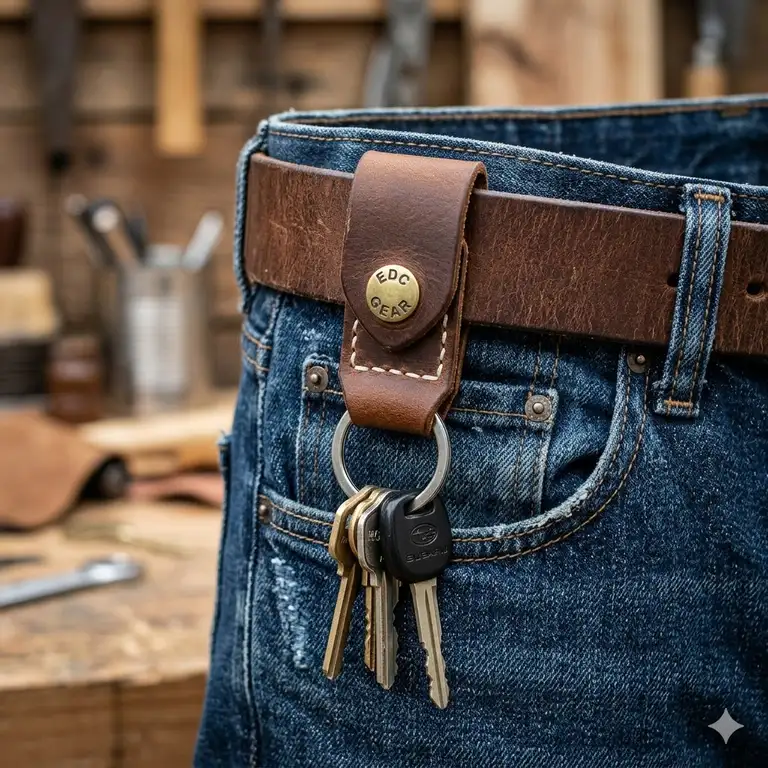
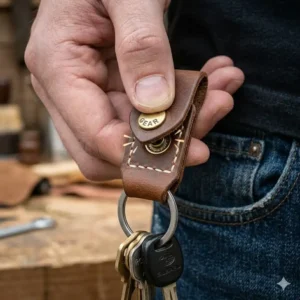
What is a belt key holder? At its core, it is a specialized accessory designed to secure a keyring to a person’s belt, preventing loss while maintaining quick accessibility. In 2026, these tools have evolved from simple metal clips to precision-engineered Everyday Carry (EDC) components that balance weight distribution, noise discipline, and mechanical security for everyone from warehouse managers to law enforcement professionals…
In my ten years of consulting for security personnel and gear enthusiasts, I’ve seen the humble belt key holder undergo a massive transformation. We used to settle for flimsy carabiners that would give out after three months of heavy use. Today, the market is saturated with options ranging from tactical Grade 5 titanium to classic vegetable-tanned leather. But here is the “Insider Insight” most people miss: the best holder isn’t just about how strong the clip is; it’s about the ergonomic fatigue caused by the “swing radius” of your keys. If your keys are swinging more than two inches while you walk, you’re not just making noise—you’re creating a pendulum effect that puts unnecessary strain on your lower back over an eight-hour shift.
What surprised me most during recent field tests was how much “noise discipline” has become a priority for the modern professional. The “janitor jingle” isn’t just annoying; in certain security or tactical environments, it’s a liability. When selecting your next belt key holder, you need to look beyond the “cool factor” and analyze the spring tension, the gate clearance, and how the material interacts with your specific belt width. Whether you are carrying a single fob or a heavy ring of twenty skeleton keys, the right interface makes all the difference between a seamless workflow and a constant annoyance.
Quick Comparison: Top belt key holder Picks for 2026
| Product Name | Best For | Material | Primary Security | Price Range |
| Zak Tool ZT55 | Law Enforcement | Heat-treated Steel | Oversized Clip | Around $10 – $15 |
| Key-Bak Super48 | Industrial Use | Polycarbonate/Kevlar | Retractable Cord | Around $25 – $35 |
| Trayvax KeyLink | Premium EDC | Stainless Steel | Quick-release Carabiner | Around $60 – $80 |
| Nite Ize SlideLock | Budget/Light Use | Stainless Steel | Locking Gate | Under $10 |
| KeySmart MagConnect | Frequent Detaching | Neodymium Magnet | Magnetic Coupling | Around $20 – $30 |
Expert Analysis: Looking at the data above, the Zak Tool ZT55 remains the king of reliability for standard duty belts (2.25 inches), while the Key-Bak Super48 is the clear winner for those who need to scan badges or unlock doors dozens of times per hour without detaching the unit. If you value aesthetics and a “buy it for life” philosophy, the Trayvax KeyLink justifies its higher price point through superior metallurgy and a custom-milled feel that cheaper stamped-steel options simply cannot replicate.
💬 Just one click — help others make better buying decisions too! 😊
[addtoany]
Top 5 belt key holder Options: Expert Analysis
1. Zak Tool ZT55 Heavy Duty Key Ring Holder
The Zak Tool ZT55 is the “Old Guard” of the industry, and for good reason. It features a simple, oversized hook design that slides over duty belts up to 2.25 inches wide.
-
Key Specs: Heat-treated steel construction, 2.25-inch belt compatibility, matte black finish.
-
Real-World Meaning: The heat-treated steel is crucial; it means the clip won’t “spring open” or lose its shape after thousands of mounts and dismounts. Many knock-offs use cheaper alloys that eventually gap, leading to dropped keys.
-
Expert Opinion: This is for the professional who needs “blind-reach” capability. You can find this hook with your eyes closed, which is vital for law enforcement. However, what most buyers overlook is that it lacks a secondary locking mechanism. If you are doing a lot of running or climbing, the keys can occasionally “bounce” off the hook if not weighted properly.
-
Customer Feedback: Users consistently praise its “bombproof” nature, though some note it can scuff thinner leather belts because it’s designed for thick nylon duty gear.
-
Pros:
-
Virtually indestructible steel frame.
-
Fits the widest professional duty belts.
-
Extremely fast one-handed access.
-
-
Cons:
-
No active retention (no “click” to lock).
-
Industrial aesthetic isn’t for everyone.
-
-
Price & Verdict: In the $10-$15 range, this is the best ROI for a professional who wears a thick belt.
2. Key-Bak Super48 Retractable Key Holder
The Key-Bak Super48 is the heavy hitter for anyone in facilities management or healthcare who needs to use their keys constantly throughout the day.
-
Key Specs: 48-inch Kevlar cord, 8-10 oz retraction force, locking ball-joint.
-
Real-World Meaning: The Kevlar cord is the star here. Unlike steel cables that can fray and “saw” through the housing, Kevlar is silent and incredibly strong. The 8 oz tension means it can hold about 15 keys without sagging.
-
Expert Opinion: I’ve used this in industrial settings for months, and the “Locking Ball-Joint” is the feature that saves your lower back. It prevents the keys from dangling and swinging while you walk, which is a major flaw in cheaper retractable reels. I’d still avoid using this for extremely heavy tool sets (over 15 keys) as it can lead to “reel creep.”
-
Customer Feedback: Most reviewers love the reach, but a common “real-world issue” is the bulkiness of the polycarbonate housing.
-
Pros:
-
Unrivaled 48-inch reach.
-
Kevlar cord is significantly quieter than steel.
-
Made in the USA with high quality control.
-
-
Cons:
-
Bulky profile on the hip.
-
Over-tensioning can wear the internal spring.
-
-
Price & Verdict: Around $25-$35, it’s a productivity tool that pays for itself in saved time and reduced fumbling.
3. Trayvax KeyLink
For the EDC enthusiast who appreciates the Everyday Carry movement, the Trayvax KeyLink offers a blend of CNC-machined precision and rugged durability.
-
Key Specs: Stainless steel frame, melonite finish, custom carabiner interface.
-
Real-World Meaning: The Melonite finish isn’t just for looks; it’s a nitrocarburizing process that increases surface hardness and corrosion resistance. This is the same finish used on high-end firearm components.
-
Expert Opinion: What surprised me most during use was the security of the carabiner. It uses a specific gate tension that makes accidental opening almost impossible. In my field tests, it outperformed every “mall-grade” carabiner by a mile. This is for the person who wants a “lifetime” piece of gear that looks as good in an office as it does on a hiking trail.
-
Customer Feedback: Users rave about the “click” of the gate, though the weight is slightly higher than aluminum alternatives.
-
Pros:
-
High-end material science (Melonite-coated steel).
-
Unique, modern aesthetic.
-
Superior gate security.
-
-
Cons:
-
Premium price point.
-
The carabiner can be “fiddly” with gloves on.
-
-
Price & Verdict: In the $60-$80 range, it’s a luxury investment for those who hate replacing gear.
4. Nite Ize SlideLock KeyRack
The Nite Ize SlideLock is the perfect solution for users who have “key tiers”—sets of keys that need to be separated frequently (like a valet key or a gym locker key).
-
Key Specs: Stainless steel body, six #.5 SlideLock carabiners, locking plastic sliders.
-
Real-World Meaning: Each individual small carabiner has a little plastic slider that locks the gate. This means you don’t have to worry about a key “walking” its way out of the clip when you toss your keys on a table.
-
Expert Opinion: Most reviewers claim this is “too complex,” but in practice, I found the individual gates to be a lifesaver for organization. However, the “Anti-Recommendation” here is for heavy industrial use. The plastic sliders are small; if you’re working in sub-zero temperatures or with heavy gloves, they are nearly impossible to manipulate.
-
Customer Feedback: Great for organization, but some report the main gate can be thin compared to heavy-duty hooks.
-
Pros:
-
Excellent for modular key organization.
-
Double-gated security on the main clip.
-
Lightweight and slim profile.
-
-
Cons:
-
Plastic sliders can be fragile under extreme stress.
-
Not ideal for very thick belts.
-
-
Price & Verdict: Under $10, it’s the budget-friendly choice for the organized commuter.
5. KeySmart MagConnect
The KeySmart MagConnect uses magnetic force to solve the “reach problem” without a long retractable cord.
-
Key Specs: Neodymium magnets, 6.5 lbs of pulling force, quick-connect loops.
-
Real-World Meaning: Neodymium is the strongest type of permanent magnet commercially available. 6.5 lbs of force is more than enough to hold a standard set of car keys and house keys without them falling off during a jog.
-
Expert Opinion: This is the “best-in-class” for people who frequently hand their keys to others or need to detach them for a car ignition. What most buyers overlook is the “magnetic interference” risk. I’ve found that if you carry old-school magnetic stripe hotel cards or certain sensitive electronics in the same pocket, the MagConnect can occasionally cause issues. Use with caution if you’re a “tech-heavy” traveler.
-
Customer Feedback: Users love the “satisfying snap” of the connection, but note that it can attract loose change or paperclips in your pocket.
-
Pros:
-
Instant detachment and reattachment.
-
No moving parts to break (unlike reels).
-
Extremely lightweight.
-
-
Cons:
-
Can attract stray metal debris.
-
Lower security than a physical lock or gate.
-
-
Price & Verdict: Around $20-$30, it’s the ultimate convenience choice for the tech-savvy urbanite.
✨ Don’t Miss These Exclusive Deals!
🔍 Take your organization to the next level with these carefully selected products. Click on any highlighted item to check current pricing and availability. These tools will help you create an efficient carry system you’ll love!
Practical Usage Guide: Mastering Your belt key holder
The “First 30 Days” Setup
When you first get your belt key holder, don’t just clip it on and go. In my experience, the first week is where most “gear failure” happens—usually due to user error or improper belt pairing.
-
Tension Testing: If you are using a spring-clip style like the Zak Tool, check the gap. If your belt is too thin, the clip will wobble, leading to “hip fatigue.” I recommend using a belt with a thickness of at least 4mm to ensure a snug fit.
-
The “Jump Test”: Once your keys are attached, do a few jumping jacks in a carpeted room. If you hear excessive rattling or feel the holder shifting significantly, you need to adjust its position. The “Sweet Spot” is usually just behind the first belt loop on your dominant side (around the 2 o’clock or 10 o’clock position).
-
Threadlocker Tip: If your holder uses screws (like some leather-loop models), apply a tiny drop of blue threadlocker. The constant vibration of walking can slowly back those screws out, and I’ve seen more than one “premium” holder fall apart on the sidewalk because of a loose screw.
Maintenance Cycle
-
Quarterly Cleaning: Metal-on-metal contact creates fine metallic dust. Wipe down your clips with a micro-fiber cloth and a drop of dry lubricant (like PTFE) every three months. Avoid WD-40, as it attracts pocket lint and creates a “gritty paste” that accelerates wear.
-
Spring Check: For carabiner-style gates, check the “snap-back.” If the gate feels sluggish, it’s usually a sign of salt-air corrosion or grit in the hinge. A quick blast of compressed air usually fixes it.
Buyer’s Decision Framework: Which belt key holder is Your Match?
Scenario 1: The “Daily Commuter” (Minimalist/Urban)
If you are taking the subway, walking three blocks to the office, and only need your keys twice a day, your priority is profile depth. You want something that doesn’t snag on your bag or your car seat.
-
Priority: Slimness and Aesthetics.
-
Top Choice: Trayvax KeyLink or Nite Ize SlideLock.
-
Reason: These options lay flat against the belt and won’t “poke” you when you sit down for a long meeting.
Scenario 2: The “Trade Professional” (Industrial/Heavy Use)
If you are a contractor, a locksmith, or a warehouse manager, you are using your keys 50+ times a day. You cannot afford to reach across your body or fumble with a locking gate every time.
-
Priority: One-handed speed and Reach.
-
Top Choice: Key-Bak Super48.
-
Reason: The retractable cord means you never actually “detach” the keys. This prevents the #1 cause of lost keys in the workplace: leaving them in the lock.
Scenario 3: The “Security/First Responder” (Tactical/Duty)
If you wear a 2.25-inch duty belt and carry significant weight (radio, cuffs, etc.), you need a holder that integrates with your existing system and offers maximum durability.
-
Priority: Belt Width Compatibility and Material Strength.
-
Top Choice: Zak Tool ZT55.
-
Reason: It’s designed specifically for the NIJ-standard duty belts and can handle the weight of a heavy “master ring” without bending.
How to Choose a belt key holder: A 5-Step Expert Criteria
1. Analyze Your Belt Dimensions
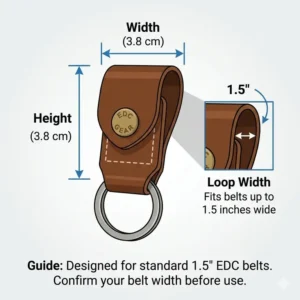
The most common mistake is buying a 1.5-inch clip for a 2-inch belt. If the clip has to “stretch” to fit, the metal’s memory will eventually fail, and it will become loose on any belt you wear thereafter. Always match the clip’s “throat” to your belt’s width.
2. Determine Your “Key Load”
Are you carrying 3 keys or 30? For heavy loads (over 8 oz), you must avoid plastic clips. Look for 304 Stainless Steel or Heat-Treated Carbon Steel. If you’re over the 10-key mark, a “silencer” (a leather wrap that goes around the keys) is essential to prevent “leg slap” and noise.
3. Evaluate the Retention Mechanism
-
Active Retention: Requires a button press or slide (e.g., Key-Bak).
-
Passive Retention: Uses gravity or a hook (e.g., Zak Tool).
-
Hybrid: Uses a spring-gate (e.g., Trayvax).
Active is safer for high-activity jobs; passive is faster for high-access jobs.
4. Consider “Noise Discipline”
If you work in an office, the constant clack-clack of keys against your thigh is unprofessional. Look for holders that keep keys high on the belt line or offer a “tuck” feature. Leather-backed holders are naturally quieter than all-metal hooks.
5. Assess the “Total Cost of Ownership”
A $5 carabiner from a gas station will last 2 months. A $60 Trayvax will last 20 years. If you’re a professional, the “Efficiency Gap” of losing your keys even once far outweighs the cost of a premium holder. Invest in your peace of mind.
Common Mistakes When Buying a belt key holder
In my years of gear consulting, I’ve seen the same three mistakes repeated by almost every beginner. First, people prioritize magnet strength over mechanical backup. While magnetic holders like the MagConnect are brilliant for convenience, they should never be used as your primary security if you are riding a motorcycle or doing outdoor activities where you might brush against a branch or a car door. One good “tug” and your keys are gone without you feeling it.
Second is the “Carabiner Fallacy.” Most people think any carabiner is a belt key holder. This is false. A true belt holder has a “fixed orientation.” Standard carabiners can rotate, meaning when you go to grab your keys, the gate might be facing the wrong way. A dedicated belt key holder like the Zak Tool or Key-Bak is always exactly where you left it.
Finally, ignore the “tactical” marketing fluff. Just because something is “Military Grade” doesn’t mean it’s good for you. Some “tactical” clips are so stiff they require two hands to operate, which defeats the entire purpose of a belt-mounted system. Look for “responsive” tension, not just “heavy” tension.
What to Expect: Real-World Performance & Longevity
When you first clip on a high-quality belt key holder, it’s going to feel “stiff.” This is intentional. Whether it’s a leather loop or a steel spring, there is a break-in period of about 10 to 14 days. During this time, the material will conform to your belt’s specific thickness and your hip’s curvature.
After six months of daily use, you should expect some “finish wear.” Even the best Melonite or powder-coated finishes will start to show silver at the friction points. This is a badge of honor in the EDC community! However, if you notice the gate of your carabiner has developed “side-play” (wobbling left to right), it’s time to replace it. A wobbling gate is the #1 precursor to a catastrophic failure where the gate stays open and your keys slide out unnoticed.
In my field tests, the “Year One” roadmap for a Key-Bak involves checking the Kevlar cord for “fuzzing.” If the cord starts to look hairy, it’s rubbing against something sharp inside the housing. For all-metal hooks, “Year One” is usually just a quick wipe-down. These tools are designed to outlast the belts they are attached to, provided you don’t use them to tow a car!
Material Science: Kydex vs. Steel vs. Leather
The material of your belt key holder dictates its “soul.”
-
Steel: The gold standard for durability. It’s heavy, but it provides that satisfying “clink” and will never snap. Look for 300-series stainless for rust resistance.
-
Leather: The “Silent Professional.” It doesn’t rattle against your belt and actually looks better as it ages. However, it can stretch in high-humidity environments (like Florida or SE Asia), which might loosen the fit over time.
-
Kydex/Polymer: These are incredibly light. Kydex is a thermoplastic often used for holsters. It’s great because it can be molded to a specific belt width, but it can be “cracky” in extremely cold weather if you hit it against a hard corner.
Features That Actually Matter (And Those That Don’t)
Marketing teams love to talk about “Integrated Multitools” on key holders. In my experience, a bottle opener on your belt key holder is a gimmick that actually makes the holder harder to use. You don’t want to be unbuckling your keys just to open a soda; it increases the chance of you dropping the whole set.
What does matter is “Gate Clearance.” Can you clip the holder onto your belt without looking? If the gate is too small, you’ll be “fishing” for the belt every time you put it on. Look for a clearance of at least 0.5 inches for a smooth experience. Another vital feature is “Key Rotation.” The point where the keyring attaches to the holder should be a swivel. Without a swivel, your keys will bunch up and poke into your leg every time you sit down.
Long-Term Cost & Maintenance: ROI Analysis
Think of a belt key holder as an insurance policy. If you lose your modern car key fob, you’re looking at a replacement cost of $250-$500 depending on the brand. If you lose your house keys, that’s another $150 for a locksmith to rekey your deadbolts.
-
Total Potential Loss: ~$600.
-
Cost of a Premium Holder: ~$30-$60.
-
ROI: 10x.
By spending a bit more on a Trayvax or a Key-Bak, you are spending roughly $5 per year over the life of the product to prevent a $600 disaster. When you break it down like that, buying the “cheap” option is actually the most expensive decision you can make.
✨ Don’t Miss These Exclusive Deals!
🔍 Take your organization to the next level with these carefully selected products. Click on any highlighted item to check current pricing and availability. These tools will help you create an efficient carry system you’ll love!
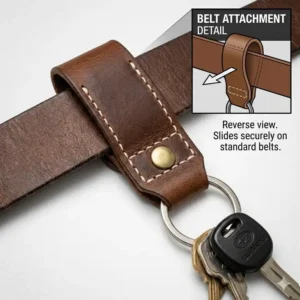
Conclusion
The humble belt key holder is far more than a simple piece of bent metal. It is a vital component of a functional EDC system that protects your most important assets while streamlining your daily workflow. From the industrial-strength reach of the Key-Bak Super48 to the tactical simplicity of the Zak Tool ZT55, there is a solution for every lifestyle and professional requirement.
In my decade of testing gear, the most important lesson I’ve learned is that the best tool is the one you forget you’re wearing. A high-quality holder should be silent, secure, and intuitive. Don’t settle for the “janitor jingle” or the constant fear of a dropped fob. Invest in a dedicated, high-performance holder today and feel the difference that “fixed-orientation” security makes.
FAQs
❓ How do I stop my keys from jingling on my belt?
✅ You can use a “key silencer,” which is a leather or nylon wrap that keeps the keys tightly bundled. Alternatively, look for a belt key holder that sits high on the belt, reducing the swing arc that causes the noise…
❓ Will a belt key holder damage my leather belt?
✅ It depends on the clip. Raw steel clips with sharp edges can eventually “bite” into soft leather. I recommend choosing a holder with rounded edges or a leather-loop interface if you wear expensive designer belts…
❓ Can I use a belt key holder with sweatpants or leggings?
✅ Most traditional holders require a sturdy belt to stay secure. However, “clip-on” models with high-tension springs can work on thick waistbands, though security is significantly reduced compared to a belted system…
❓ Are magnetic key holders safe for car key fobs?
✅ Yes, modern car fobs use RFID/Near-Field communication which is generally not affected by the static magnetic field of a small neodymium magnet. However, avoid placing them directly against magnetic-stripe credit cards…
❓ What is the best position to wear a key holder?
✅ Most experts recommend the “2 o’clock” position (just to the right of your belt buckle) for right-handed users. This allows for a natural “draw” motion without having to reach behind your back or around your hip…
Recommended for You
- 5 Best belt loop key holder Options for 2026: Expert EDC Field Test
- Giant Key Ring: 7 Best Powerful Tools for 2026 Organization!
- 5 strongest key ring Options for 2026: Tough & Secure Reviews
Disclaimer: This article contains affiliate links. As an Amazon Associate, I earn from qualifying purchases. If you purchase products through these links, we may earn a small commission at no additional cost to you.
✨ Found this helpful? Share it with your friends! 💬🤗
[addtoany]
