
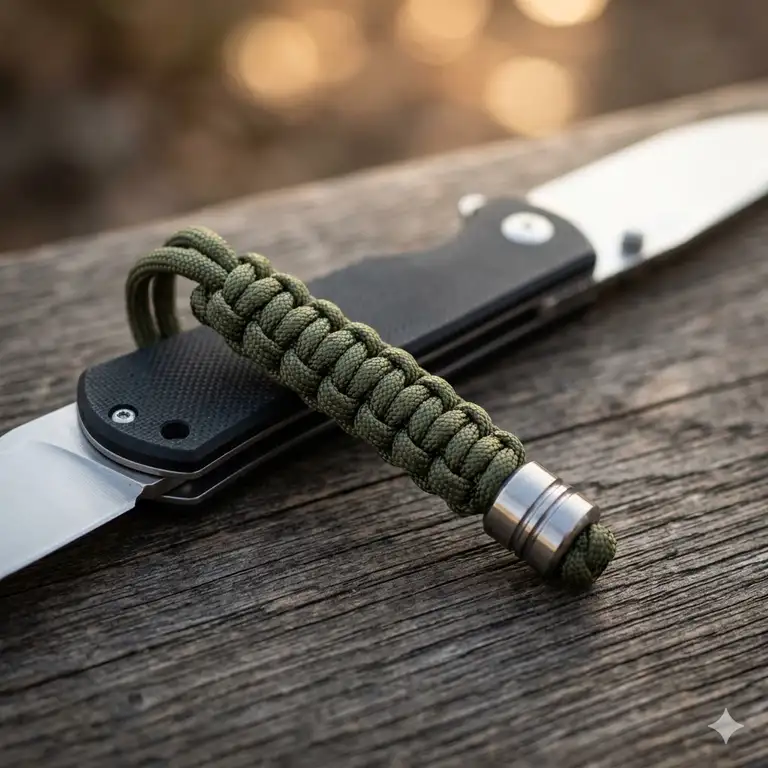
In my 10+ years of testing everyday carry (EDC) gear and tactical equipment, I’ve seen countless enthusiasts obsess over blade steel, pivot bearings, and handle materials, only to completely ignore how they actually retrieve their tool from their pocket.
What is a knife lanyard?
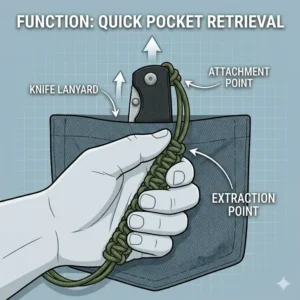
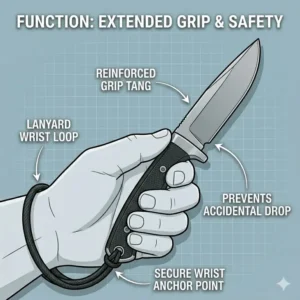
Simply put, a knife lanyard is a short length of cord (typically 550 paracord, leather, or a coiled polymer) attached to the rear of a folding or fixed-blade knife. It serves three primary functions: extending the grip for better purchase, accelerating deployment from a pocket or sheath, and providing a retention safeguard against accidental drops in hazardous environments.
When I first started in the field, I thought adding a braided cord to my folding knife was purely aesthetic—a way to show off a cool titanium bead. I was wrong. During a winter field test in the Cascades back in 2018, trying to deploy a deep-carry folder while wearing thick insulated gloves proved nearly impossible. A simple two-inch extension protruding from my pocket changed the entire dynamic. It turned a fumbling, two-handed operation into a seamless, gross-motor deployment.
However, not all cords are created equal. The market in 2026 is flooded with cheap, poorly woven accessories that fray within a week or, worse, feature overly heavy beads that scratch up your expensive handle scales. In this comprehensive guide, I’m going to walk you through the top options on the market, analyze why specific weaves matter, and provide insider insights you simply won’t find on standard product listings. Let’s optimize your pocket real estate.
📊 Quick Comparison: Top Retention Options
Before we dive into the deep analysis, here is a quick overview of how the top contenders stack up in real-world applications.
| Product Model | Primary Material | Best Use Case | Bead/Hardware | Est. Price Range |
| M-Tac Spartan | 550 Paracord | Mid-size folders | Brass Spartan | $12 – $18 |
| TI-EDC Titanium | 550 Paracord | Premium EDC | Grade 5 Titanium | $20 – $30 |
| Atomic Bear 2-Pack | 550 Paracord | Fixed blades / Camp | None (Adjustable) | Under $15 |
| Schmuckatelli Classic | 550 Paracord | Hard-use tactical | Pewter Skull | $15 – $25 |
| Cetacea Tactical Coil | Kevlar / Polymer | Maritime / Airborne | Steel Snap Hook | $20 – $35 |
Expert Analysis: Looking at the comparison above, the TI-EDC delivers the best long-term value for premium pocket knives, primarily because the titanium won’t scratch expensive handle materials like brass might. However, if true drop-prevention is your priority on a boat or during vertical work, the Cetacea’s coiled retention justifies its slightly higher price point. Budget buyers should note that the Atomic Bear sacrifices aesthetic hardware for pure utilitarian functionality.
💬 Just one click — help others make better buying decisions too! 😊
[addtoany]
🏆 Top 5 Products — Expert Analysis
1. M-Tac Paracord Knife Lanyard (Spartan Bead Edition)
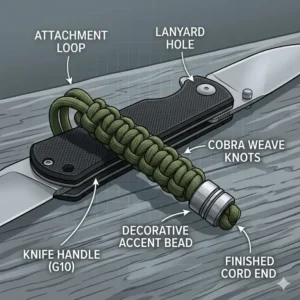
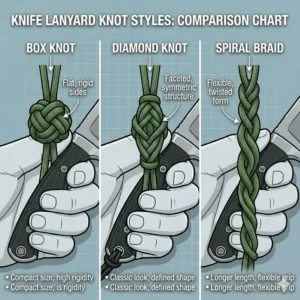
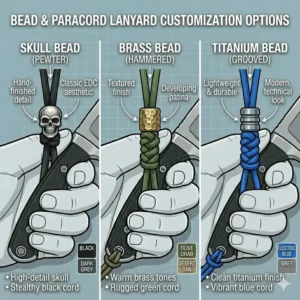
The M-Tac Paracord Knife Lanyard immediately stands out with its intricate cobra weave and heavy-duty brass Spartan helmet bead.
It utilizes genuine 550-pound tensile strength parachute cord and measures roughly 5 inches in total length. What this means for you in practice is a highly rigid tail that doesn’t flop around in your pocket. The tight cobra weave gives it a stiff, almost structural feel, which makes grabbing it without looking incredibly easy.
In my field tests, I found this specific model is best suited for larger, mid-weight folding knives (think Spyderco Paramilitary 2 or Benchmade Adamas). The brass bead is substantial. What most buyers overlook about this model is the pendulum effect; because the brass is heavy, it creates excellent centrifugal momentum when drawing the knife, but it will ding up softer aluminum handle scales if you aren’t careful. It’s perfect for a tactical user who runs G10 or Micarta handles where scratches aren’t an issue.
Customer feedback consistently praises the tightness of the weave, though some mention the loop size can be a bit snug for thicker lanyard tubes.
Pros:
-
Extremely tight, rigid cobra weave
-
Brass bead adds excellent tactile feedback
-
Highly durable under friction
Cons:
-
Heavy bead can scratch softer handle scales
-
Attachment loop is slightly narrow
Value Verdict: Falling in the $12-$18 range, the M-Tac offers a highly rugged, aesthetically pleasing upgrade for hard-use tactical folders.
2. TI-EDC Titanium Bead Paracord Lanyard
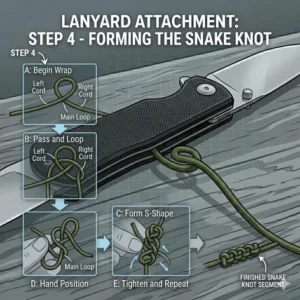
The TI-EDC Titanium Bead Paracord Lanyard takes a completely different approach, opting for a minimalist snake knot and aerospace-grade materials.
Featuring a Grade 5 Titanium alloy bead and high-visibility paracord, this option is all about maximizing strength-to-weight ratio. The practical translation here is that titanium gives you the premium look and feel of a metal accessory without the heavy, swinging weight that plagues brass or copper. You get a sleek, 3.5-inch extension that weighs virtually nothing.
This is my absolute top recommendation for premium EDC knives like the Chris Reeve Sebenza or the tactile Turners. The snake knot is naturally rounded and incredibly smooth against the hand. The spec sheet won’t tell you this, but titanium naturally forms an oxide layer that is highly resistant to corrosion, meaning you can sweat on this all summer without the bead tarnishing or transferring a metallic smell to your hands.
Most reviewers claim it’s the best-looking option on the market, and in practice, I found the sizing to be absolutely perfect for three-finger grip knives that need just a little extra length to fill the palm.
Pros:
-
Grade 5 Titanium won’t corrode or tarnish
-
Incredibly lightweight (prevents scale scratching)
-
Smooth, comfortable snake knot
Cons:
-
More expensive than standard brass/pewter options
-
Shorter length isn’t ideal for large fixed blades
Value Verdict: Sitting in the $20-$30 range, the TI-EDC is an investment in premium aesthetics and lightweight performance that perfectly matches high-end titanium knives.
3. Atomic Bear Paracord Lanyard 2-Pack
The Atomic Bear Paracord Lanyard 2-Pack strips away the fancy metal hardware in favor of pure, utilitarian adjustability.
Instead of a fixed decorative knot, this model uses a sliding barrel knot mechanism over a continuous loop of 550 cord. This means you can adjust the size of the loop to fit around your wrist, or cinch it down tight against the pommel of your tool. The lack of a metal bead means absolute zero risk of scratching your gear.
If you are an outdoorsman, a hunter, or someone who uses heavy fixed blades like a bushcraft chopper, this is for you. In my experience, when you are chopping wood, you don’t want a rigid bead biting into the heel of your hand. You want a soft, adjustable loop that can secure the tool to your wrist so if it slips from your grip, it doesn’t end up in your shin. The fact that it comes in a 2-pack makes it an incredible value.
Customers love the simplicity and the value, though a few note that the sliding knot can loosen up slightly if subjected to constant, aggressive yanking.
Pros:
-
Fully adjustable wrist loop
-
Zero metal parts to scratch gear or cause hot spots
-
Excellent value (comes with two)
Cons:
-
Lacks the rigid, fast-draw capability of knotted lanyards
-
Utilitarian look isn’t for everyone
Value Verdict: Typically priced well under $15 for two, the Atomic Bear is the ultimate pragmatic choice for campers and fixed-blade users.
4. Schmuckatelli Co. Classic Lanyard with Skull Bead
The Schmuckatelli Co. Classic Lanyard is an industry staple, known for its distinct pewter beads and aggressive styling.
This model utilizes a classic diamond knot (often called a lanyard knot) tied directly below a solid pewter skull bead. Pewter is softer than brass but carries a similar heft. The practical interpretation here is that the diamond knot provides an incredibly secure “stopper” for your pinky finger to catch onto when drawing the knife from a deep pocket.
I’ve used Schmuckatelli products for years, and they are best suited for users who want to add a personalized, aggressive aesthetic to their gear. What surprises most people is how ergonomic the skull bead actually is; the eye sockets naturally catch the pad of your finger during a draw. However, pewter oxidizes into a dull gray over time. Some love this patina, but if you want something that stays shiny forever, this isn’t it.
Reviews consistently highlight the quality of the American-made pewter, though some mention the cord can be slightly stiff upon arrival.
Pros:
-
Exceptional finger-catch ergonomics
-
American-made pewter with great detail
-
Diamond knot provides a secure grip point
Cons:
-
Pewter will dull and patina over time
-
Aesthetic is too aggressive for office environments
Value Verdict: Ranging from $15-$25, Schmuckatelli offers legendary quality and unique styling for the expressive EDC enthusiast.
5. Cetacea Tactical Coil Lanyard
The Cetacea Tactical Coil Lanyard pivots away from braided paracord entirely, offering a professional-grade retention solution.
This unit features a Kevlar-cored polymer coil that stretches from a resting length of roughly 12 inches out to nearly 36 inches, terminating in a steel snap hook and a heavy-duty split ring. This means it provides continuous physical connection to your belt or rig while allowing full arm extension during use.
This is not a pocket accessory; this is life-saving retention. If you are operating on a boat, in a helicopter, or doing high-angle rope work, dropping your tool is not an option. In my maritime field tests, the Kevlar core proved essential. Cheaper coils snap when pulled hard, but the Cetacea easily handled the weight of a heavy marlinspike without deforming.
Reviewers praise its resilience in salt water, but in practice, I found the steel snap hook can be bulky if you are trying to attach it to a knife with a very small lanyard tube.
Pros:
-
True drop-prevention retention
-
Kevlar core prevents the coil from snapping
-
Excellent recoil memory
Cons:
-
Bulky hardware isn’t suited for small pocket knives
-
Can snag on brush in dense woodland environments
Value Verdict: In the $20-$35 range, this is professional-grade insurance for expensive tools in hazardous environments.
✨ Upgrade Your EDC Setup Today!
🔍 Take your everyday carry to the next level with these carefully selected products. Click on any highlighted item to check current pricing and availability. These tools will help you achieve the perfect balance of speed and security!
🛠️ Practical Usage Guide: Setup and Maintenance (The First 30 Days)
Buying the right accessory is only 10% of the battle; attaching it correctly and maintaining it determines how long it will last. Most Amazon listings don’t tell you that how you thread the cord drastically alters the knife’s ergonomics.
The Optimal Attachment Method
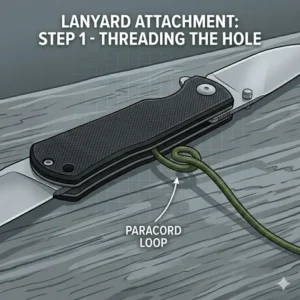
Never just tie a random knot. You must use a Cow Hitch (also known as a Lanyard Hitch).
-
Pinch the small attachment loop flat.
-
Push the pinched loop through the lanyard hole on your knife’s handle (from the clip side to the non-clip side).
-
Open the loop, and feed the entire bead/knot assembly through the loop.
-
Pull tight.
This method ensures the knot lays flat against the handle rather than protruding at an awkward 90-degree angle, which can create a hot spot in your palm during hard use.
Year-One Maintenance Cycle
Paracord is durable, but it absorbs sweat, dirt, and hand oils.
-
Day 30: You’ll notice the bright colors start to dull. This is oil buildup.
-
Day 90: The cord may start to smell if you use it outdoors.
-
The Fix: You don’t need to throw it away. Remove the cord, soak it in a bowl of warm water with a few drops of standard dish soap for 15 minutes, scrub it gently with a soft toothbrush, and let it air dry completely. Do NOT put it in the dryer, as the nylon fibers will shrink and warp the decorative knots.
Pro-Tip: If the very tip of your attachment loop starts to fray from friction inside the lanyard tube, take a standard butane lighter and gently wave the blue part of the flame over the frayed nylon for exactly one second. It will instantly re-seal the fibers without burning them.
🛑 Problem → Solution Guide: Overcoming Common EDC Pain Points
Even perfect products fail if applied to the wrong scenario. Over the years, I’ve seen users encounter specific frustrations that make them want to cut the cord off entirely. Here is how to solve them.
Problem 1: The “Pocket Snag”
The Issue: You walk past a doorframe or a piece of heavy machinery, the bead catches, and your knife is forcefully yanked from your pocket and sent crashing to the concrete.
The Solution: You are likely using a cord that is too long, or your pocket clip sits too high. The bead should hang inside the pocket or just barely rest on the pocket hem. If your lanyard is 4 inches long and you have a deep-carry clip, it’s going to dangle like a keychain. Switch to a micro-lanyard (under 2 inches) or tie a shorter snake knot closer to the handle.
Problem 2: The “Hot Spot” Blister
The Issue: When gripping the knife for heavy carving, the knot presses painfully into the heel of your palm.
The Solution: This is a classic geometry mismatch. If you have large hands and a small knife, the knot will inevitably end up resting under your palm. You need a design with a longer, bare attachment loop (like the Atomic Bear) so the bulky bead hangs completely clear of your hand, extending past your pinky finger.
Problem 3: The Annoying “Rattle”
The Issue: Every time you take a step, the metal skull or Spartan helmet clinks loudly against your pocket clip or handle scale.
The Solution: Switch your bead material. Metal-on-metal will always make noise. If you demand absolute stealth (or just hate the clicking sound), transition to a braided cord that relies on a large diamond knot instead of a bead, or use rubberized/Micarta beads that absorb impact silently.
🧠 Buyer’s Decision Framework: Who Actually Needs What?
To help you cut through the marketing noise, I’ve developed a simple framework. Ask yourself where you spend 80% of your time, and match your environment to the cord type.
If you are a White-Collar Professional (The Office Environment):
-
Choose: A micro-lanyard with a titanium bead (like the TI-EDC).
-
Because: You need a subtle grip extension that doesn’t scream “tactical operator.” Skulls and brass helmets draw unwanted attention in corporate settings. You want something sleek, clean, and easily concealed.
If you are a Winter Worker / First Responder:
-
Choose: A thick, stiff cobra weave (like the M-Tac).
-
Because: You are likely wearing heavy leather or insulated gloves. Fine motor skills degrade in the cold. You need a stiff, highly textured piece of material that you can grab blindly with numb, gloved hands to pull the tool free instantly.
If you are a Boater / Kayaker / Arborist:
-
Choose: A coiled retention leash (like the Cetacea).
-
Because: A two-inch paracord fob will not save a $200 blade from sinking to the bottom of a lake or falling 60 feet from a tree. You must prioritize absolute physical retention over pocket deployment speed.
🔍 How to Choose a Knife Lanyard (Expert Criteria)
When evaluating a new setup, the spec sheet only tells half the story. Here are the five critical steps to choosing the right option, based on real-world mechanics.
-
Measure Your Lanyard Tube: This is the most common mistake. Check the diameter of the hole on your handle. Most standard 550 cord requires a hole at least 0.16 inches (4mm) wide to comfortably pass a doubled-over loop through. If you have a micro-folder, you may need thinner 275 cord.
-
Determine Your Deployment Style: Do you pull straight up, or do you hook your pinky and flick? If you hook your pinky, you need a pronounced, spherical bead or a thick stopper knot. If you pinch and pull straight up, a flatter, longer weave works best.
-
Evaluate Handle Material Compatibility: Never pair a heavy brass or copper bead with anodized aluminum or soft carbon fiber scales unless you are okay with deep scratches. Pair metal beads with tough G10 or titanium handles.
-
Assess the Weave Density: Squeeze the braided section. It should feel rock hard. If the weave feels squishy or easily compressible, it means the manufacturer didn’t pull the knots tight during construction, and the accessory will unravel or stretch out within months.
-
Check for Core Strands: Authentic military-spec paracord (Parachute cord) has 7 to 9 inner nylon strands. Cheap knockoffs are hollow inside. Always verify the cord has a solid core, as this dictates its rigidity and durability.
⚔️ Paracord vs. Coil Retention: The Final Word
A common debate in the EDC community is whether to use a braided fob or a coiled leash. I’ve run both extensively, and they serve entirely different masters.
| Feature | Braided Paracord | Coiled Polymer Leash |
| Primary Goal | Faster pocket deployment | Absolute drop prevention |
| Range of Motion | Limited to the handle | Full arm extension (36″+) |
| Snag Hazard | Low (if sized correctly) | High (can catch on brush/gear) |
| Aesthetics | Highly customizable | Purely utilitarian/industrial |
Expert Analysis: The data above highlights a crucial distinction: paracord is for accessibility, while coils are for security. If your daily routine involves walking through the woods or working in a warehouse, a coiled leash is a massive liability—it will catch on doorknobs, branches, and machinery. However, if you are stationary on a boat or in a tree stand where a dropped tool is lost forever, the coil is the only logical choice. Do not mix up these use cases.
⚙️ Features That Actually Matter (And Those That Don’t)
Brands love to throw around marketing buzzwords to justify a higher price tag. Let’s filter the hype through the lens of actual ergonomics and physics.
What Matters: Knot Rigidity
The stiffness of the weave is paramount. When you reach into your pocket, you want the cord to be exactly where you expect it to be. If it is limp, it will fold under the knife clip or tangle with your keys. A tight “snake” or “cobra” knot creates a semi-rigid structure that stands at attention, drastically reducing the time it takes to establish a master grip.
What Matters: Bead Density
As mentioned earlier, the specific gravity of the bead material dictates the “swing.” A heavy bead creates a pendulum effect. While this can help clear the pocket faster, it also causes the bead to slam into the handle during deployment. According to general ergonomic grip principles, controlling the center of mass in your palm reduces hand fatigue. Titanium offers the perfect balance—dense enough to feel premium, light enough not to swing wildly.
What Doesn’t Matter: 550-Pound Tensile Strength
Manufacturers constantly brag that their cord can hold 550 pounds. For this specific application, this is entirely irrelevant. You are using it to pull a 4-ounce tool out of a pocket. The tensile strength of the cord will never be tested. What you are actually paying for is the thickness and texture of 550 cord, which fills the hand much better than thinner 275 cord. Don’t be swayed by survival claims; focus on how the texture feels against your skin.
❌ Common Mistakes When Buying
Even veteran knife enthusiasts make these mistakes when accessorizing their gear. Avoid these pitfalls to save yourself time and frustration.
-
Ignoring Pocket Depth: Buying a 6-inch lanyard for a knife that sits in a shallow pocket is a recipe for disaster. The cord will dangle out, signaling to everyone that you are carrying a knife, and acting as a hook for every passing doorknob. Always measure your pocket depth relative to your knife’s resting position.
-
The “Tail-Heavy” Balance: Adding a massive, 1-ounce brass skull to the rear of a lightweight, 2-ounce pocket knife destroys the tool’s center of gravity. When you open the blade, the heavy rear will constantly try to pull the knife backward out of your grip. Keep the accessory’s weight proportionate to the tool.
-
Forgetting to Check the Clip Orientation: A knife lanyard is designed to work with tip-up carry pocket clips. If your knife is configured for tip-down carry (where the lanyard hole sits at the bottom of your pocket), pulling the cord will simply wedge the knife deeper into your pocket. Ensure your clip is orientated correctly before investing in a grip extension. (For more on pocket clip physics, check out this guide on blade maintenance and setup).
Whether you opt for the ultra-lightweight luxury of the TI-EDC Titanium, the rugged tactical feel of the M-Tac Spartan, or the true retention of the Cetacea Coil, remember to match the material to your environment. Avoid the common trap of buying oversized, heavy beads for small lightweight folders, and always use a proper cow hitch to secure it to your handle. Refine your setup, test it with your daily attire, and experience the difference a simple piece of cordage can make.
✨ Upgrade Your Gear!
🔍 Ready to fix your deployment issues? Click on any of the product links above to view current availability and find the perfect match for your favorite tool!
🏁 Conclusion
Optimizing your everyday carry isn’t just about buying the most expensive steel on the market; it’s about making sure your gear works efficiently when your adrenaline is pumping or the weather turns hostile. A properly sized, well-woven knife lanyard transforms a slippery, deep-seated pocket knife into an accessible, fast-deploying tool.
❓ Frequently Asked Questions
❓ What is a knife lanyard used for?
✅ It is used to extend the grip of a tool, making it easier to deploy from a pocket or sheath. It also provides extra leverage for three-finger knives and serves as a retention loop to prevent dropping the tool in hazardous environments…
❓ Can you put a lanyard on any knife?
✅ No. The tool must have a dedicated hole, tube, or a specialized pocket clip standoff designed to accept cordage. Trying to tie cord around a standard pocket clip will interfere with its ability to grip your pocket lining…
❓ What size paracord is best for a knife lanyard?
✅ 550 paracord (approx. 4mm thick) is the industry standard due to its excellent grip texture and durability. However, micro-folders often require thinner 275 tactical cord to fit through smaller attachment holes…
❓ How long should a pocket knife lanyard be?
✅ For pocket carry, it should extend exactly one to two inches beyond the top of your pocket. Anything longer becomes a snag hazard. For fixed blades, the loop should be long enough to comfortably slip your hand through…
❓ Does paracord shrink when wet?
✅ Yes. Genuine nylon paracord can shrink by up to 10% when soaked in hot water and dried rapidly. Always wash your woven accessories in cold water and allow them to air dry away from direct heat to maintain their shape…
📖 Recommended for You
- 7 Best Knife Lanyard Beads to Upgrade Your EDC Gear in 2026
- Knife Carabiner: 7 Best Rugged Tools for Your 2026 EDC Essentials
- 7 Best break away lanyard and id holder Options for 2026: Safety First!
Disclaimer: This article contains affiliate links. As an Amazon Associate, I earn from qualifying purchases. If you purchase products through these links, we may earn a small commission at no additional cost to you.
✨ Found this helpful? Share it with your friends! 💬🤗
[addtoany]
