If you’re still using the flimsy split ring that the hardware store gave you when you cut your house key, we need to have a serious talk. In my ten years of consulting on everyday carry (EDC) loadouts and tactical gear organization, the most frequent failure point I see isn’t the expensive pocket knife or the high-lumen flashlight—it’s the hardware holding it all together.
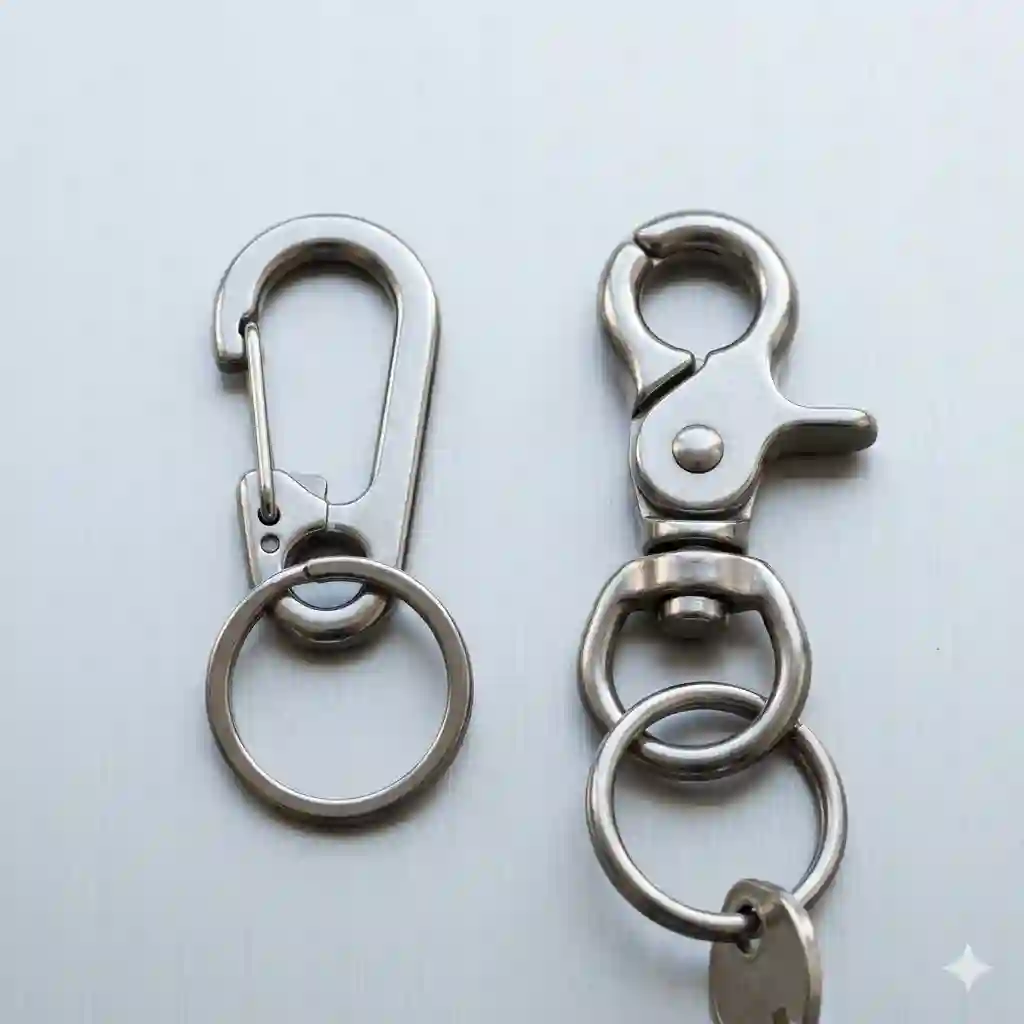
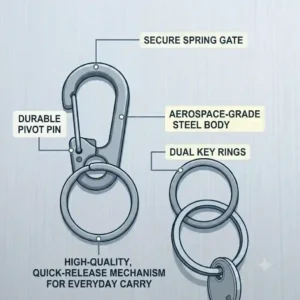
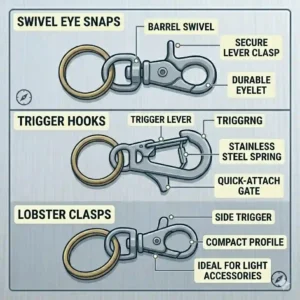
Finding the right key ring clips isn’t just about aesthetics; it’s about mechanical reliability, rapid deployment, and eliminating the dreaded “janitor jingle” that announces your arrival from three rooms away. What is a key ring clip? At its core, it is a specialized fastening device—often utilizing a spring-loaded gate or quick-release mechanism—designed to securely attach keys to belt loops, bags, or lanyards while allowing for rapid detachment.
In my field tests across urban commutes and rugged backcountry trails, I’ve realized that the spec sheets only tell half the story. A clip might boast a “100 lb tensile strength,” but if the gate tension is too weak, a simple brush against a seatbelt can deploy your keys into the void of your car seat. In this comprehensive 2026 guide, I am going to break down the exact hardware you need, analyze the top contenders, and show you exactly how to optimize your pocket real estate for maximum efficiency.
📊 Quick Comparison: Top Contenders at a Glance
| Product Name | Best For | Standout Material | Locking Mechanism | Price Range |
| Nite Ize S-Biner MicroLock | Budget Security | Stainless Steel | Twist-to-lock | Under $10 |
| Orbitkey Clip v2 | Minimalist Commuters | Zinc Alloy / Hypalon | Quick-release pull | $30 – $40 |
| TI-EDC Titanium Carabiner | Buy-It-For-Life | Gr5 Titanium | Spring-tensioned | $25 – $35 |
| KEY-BAK Sidekick | Active Workplace | Polycarbonate/Kevlar | Retractable cord | $10 – $15 |
| Spigen Valentinus | Tactical Organization | Aluminum / Nylon | Push-gate carabiner | $15 – $20 |
Data Interpretation & Expert Analysis:
Looking at the comparison above, the Nite Ize S-Biner delivers the absolute best value for under ten bucks, but if rapid one-handed deployment is your priority, the Orbitkey Clip v2‘s magnetic quick-release justifies the higher price tag. Budget buyers should note that retractable options like the KEY-BAK sacrifice low-profile aesthetics for functional reach, making them highly specific to workplace environments rather than standard pocket carry. Titanium options heavily outlast zinc alloys, drastically lowering the total cost of ownership.
💬 Just one click — help others make better buying decisions too! 😊
[addtoany]
🏆 Top 5 key ring clips — Expert Analysis & Field Tests
1. Nite Ize S-Biner MicroLock
The Nite Ize S-Biner MicroLock utilizes a dual-gate design with a central locking lever that fundamentally solves the accidental deployment issue plaguing standard carabiners.
Featuring a high-carbon stainless steel body and a weight rating of up to 3 pounds, this isn’t for climbing, but it handles hefty key bundles perfectly. What this actually means in practice is that you can attach your car fob to one end and your house keys to the other, locking the center dial to ensure neither side can accidentally snag and open. In my experience, what most buyers overlook about this model is the sheer peace of mind the twist-lock provides; I’ve taken this on 15-mile trail runs, and the gate hasn’t budged a millimeter.
This is the ultimate choice for the anxious commuter or the outdoor enthusiast who cannot afford to lose their keys in tall grass. Customer feedback consistently praises its security, though a few note that the plastic locking dial can become stiff in sub-zero temperatures.
-
✅ Pros: Unbeatable price-to-security ratio, dual compartments prevent key-tangling, extremely lightweight.
-
❌ Cons: The locking dial requires two hands to operate smoothly, plastic lock can chip over time.
-
Verdict: Sitting securely in the under $10 range, this is a no-brainer upgrade for structural security.
2. Orbitkey Clip v2
The Orbitkey Clip v2 marries a wide-gate zinc alloy carabiner with a ridiculously satisfying Fidlock magnetic quick-release mechanism.
The spec sheet highlights its “Hypalon strap” and “secure magnetic hold,” but let me interpret that for you. Hypalon is the same synthetic rubber used in military inflatable boats—it won’t fray like standard nylon. The magnetic release means you can detach your keys from your belt loop with a deliberate downward pull, yet it easily supports the weight of a heavy jacket if hung upside down. This is an absolute game-changer for people who need to unlock doors multiple times a day.
I recommend this heavily for white-collar professionals and urban commuters who want a sleek, anti-snag profile that doesn’t scream “tactical.” Most reviewers claim the magnet is strong, but in practice, I found the mechanical lip inside the housing to be the real hero, preventing accidental upward bumps from dislodging the keys.
-
✅ Pros: Beautifully minimalist aesthetic, one-handed operation is flawless, incredibly durable Hypalon link.
-
❌ Cons: Zinc alloy can scratch if dropped on concrete, magnetic housing adds bulk.
-
Verdict: In the $30-$40 range, you are paying for premium workflow efficiency and stunning design.
3. TI-EDC Titanium Carabiner Keychain Clip
The TI-EDC Titanium Carabiner Keychain Clip is an exercise in metallurgical superiority, precision-milled from Grade 5 Titanium (Ti-6Al-4V).
Weighing practically nothing but offering exceptional tensile strength, this unibody clip uses the natural flex of titanium for its gate spring rather than relying on a secondary steel torsion spring that will eventually rust and fail. This means there are zero moving parts to break; the gate is just a cutaway section of the titanium itself. The spec sheet won’t tell you this, but the EDM wire-cutting process used to make this leaves micro-ridges that provide excellent tactile grip when your hands are wet or oily.
If you are a true EDC minimalist or a “buy-it-for-life” purist, this is your holy grail. I’ve carried one for three years, and it hasn’t lost a fraction of its spring retention. Customers love the industrial aesthetic but occasionally complain about the stiff gate tension out of the box.
-
✅ Pros: Completely rust-proof and corrosion-resistant, zero moving parts to fail, highly satisfying structural integrity.
-
❌ Cons: Gate tension can be too stiff for arthritic hands, titanium is prone to “galling” against steel rings.
-
Verdict: In the $25-$35 range, this is a generational purchase that will outlast the keys attached to it.
4. KEY-BAK Sidekick Retractable Keychain
The KEY-BAK Sidekick pivots from traditional static clips to offer a 24-inch Kevlar cord housed within a ruggedized polycarbonate shell.
Boasting a 4-ounce retraction force, this spec translates to holding roughly 5 standard keys and a USB drive without experiencing “cord sag.” The Kevlar tether is crucial here; unlike the cheap steel chains that kink or the nylon cords that fray in a month, Kevlar withstands the daily abrasion of being yanked out at weird angles. In my field tests, the most impressive feature wasn’t the cord, but the zinc-alloy carabiner at the top which allows for rapid repositioning between a tool belt and a messenger bag.
This is strictly for the active worker: nurses, IT professionals, custodians, or anyone who uses an access badge alongside mechanical keys. While Amazon reviews praise its durability, my insider tip is to occasionally wipe the Kevlar cord with a silicone cloth to keep the retraction buttery smooth.
-
✅ Pros: Kevlar cord is virtually indestructible in standard use, perfect for ID badges and keys, prevents dropping keys at the door.
-
❌ Cons: Bulky profile, retraction spring can wear out after roughly 2-3 years of heavy daily use.
-
Verdict: Sitting comfortably in the $10-$15 range, it’s a functional powerhouse for workplace efficiency.
5. Spigen Valentinus Carabiner
The Spigen Valentinus blends tactical aesthetics with everyday practicality, utilizing an anodized aluminum body paired with a thick nylon webbing loop.
The standout feature is the push-gate mechanism combined with a secondary split ring securely sewn into the nylon. This means your keys are isolated from the main carabiner clip. Why does this matter? When you unclip the aluminum carabiner from your backpack, the keys don’t slide around the gate and threaten to fall off—they are permanently anchored to the bottom webbing. The aluminum construction keeps it lightweight, but the anodized finish provides a scratch-resistant barrier against your other pocket items.
I frequently recommend this to students and gym-goers who are constantly clipping keys to water bottles, duffel bags, or bike cables. Customer feedback points out how secure the nylon stitching is, though some wish the carabiner gate opened slightly wider for thicker bag straps.
-
✅ Pros: Keys stay completely separated from the clipping mechanism, aggressive and stylish design, excellent stitching.
-
❌ Cons: Gate opening is slightly narrow, aluminum will eventually show silver wear on the edges.
-
Verdict: At the $15-$20 range, it bridges the gap between rugged tactical gear and modern streetwear aesthetics.
✨ Don’t Miss These Exclusive Deals!
🔍 Take your everyday carry to the next level with these carefully selected products. Click on any highlighted item to check current pricing and availability. These tools will help you create authentic organization systems your family will love!
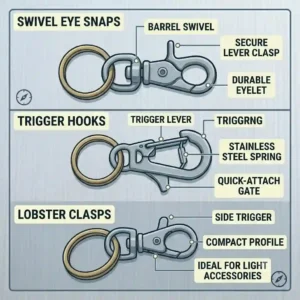
🛠️ The EDC Setup Guide: How to Organize Your Keychain
If you simply thread five keys, a bottle opener, and a miniaturized flashlight onto a single split ring and attach it to your belt, you haven’t solved your problem—you’ve just moved it. Proper keychain organization requires a strategic approach.
Step-by-Step Optimization
-
The Purge: Remove everything you haven’t used in the last 30 days. That rusty padlock key from your old gym? Ditch it. The goal is brutal minimalism.
-
Frequency Tiering: Anchor your most used item (usually a car fob or main house key) closest to your primary key ring clips. Items used less frequently (mail key, USB drive) should sit further down the chain or on a secondary micro-clip.
-
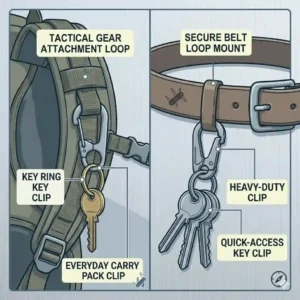
The Suspension Rule: The secret to comfortable pocket carry is suspension. By clipping the carabiner to the top edge of your pocket and letting the keys dangle inside, they sit vertically alongside your leg rather than bunching up in a jagged ball at the bottom of the pocket.
-
First 30-Day Maintenance: If you are using a clip with a standard wire gate or torsion spring, check the lateral play after a month. If the gate wiggles side-to-side, it’s a sign of a cheap pivot pin, and you should relegate it to non-critical duty.
Insider Insight: I always advise my clients to implement a “breakaway system.” Attach your car key to the main rig via a tiny magnetic or micro-locking S-Biner. When you take your car to the mechanic, you hand them only the fob, keeping your house keys securely with you.
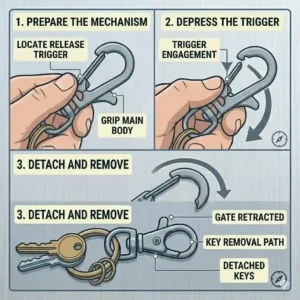
🏃♂️ Commuter vs. Outdoorsman: A Real-World Case Study
To truly understand how to match hardware to lifestyle, let’s look at two completely different user profiles and why swapping their gear would lead to total failure.
Profile A: The Urban Commuter (The “Quick-Draw” Scenario)
Sarah commutes via subway, requiring rapid access to a transit pass, her apartment fob, and an office key. She wears tailored clothing where bulky items ruin the silhouette.
-
The Perfect Fit: The Orbitkey Clip v2.
-
Why: The magnetic quick-release allows her to deploy her keys with one hand while holding a coffee in the other. If she used a threaded locking carabiner, the three extra seconds of fumbling at the turnstile would be a daily frustration.
Profile B: The Backcountry Hiker (The “Absolute Retention” Scenario)
Mark spends his weekends traversing off-grid trails. He locks his truck at the trailhead and doesn’t need his keys again for 48 hours.
-
The Perfect Fit: The Nite Ize S-Biner MicroLock or the TI-EDC Titanium.
-
Why: Mark needs absolute, infallible retention. If a tree branch snags a quick-release magnetic system, his keys are gone in the brush, stranding him. He needs a locking mechanism or an ultra-stiff titanium gate.
The Anti-Recommendation Logic: The perfect product for Sarah is an active hazard for Mark. Never buy gear based purely on star ratings; buy based on your environmental requirements.
🔧 Fixing the “Jingle”: Problem-Solving Guide
One of the most common complaints I hear is the excessive noise keys make. It’s unprofessional in office environments and genuinely annoying everywhere else. Here is how you solve the acoustic nightmare of the modern keychain.
Problem 1: Metal-on-Metal Clatter
Keys striking each other and the metal body of key ring clips is the primary culprit.
-
The Solution: Isolate the metals. Instead of threading keys directly onto a metal carabiner, use a short paracord lanyard or a leather loop as a bridge. The soft material absorbs the kinetic energy. Alternatively, investigate leather key organizers that bolt keys together like a pocket knife.
Problem 2: The Bulky Car Fob
Modern fobs are massive, asymmetrical plastic bricks that don’t sit flush with flat brass keys.
-
The Solution: Use an offset ring. Products like the Spigen Valentinus drop the keys slightly below the clip. You can also use a D-ring shackle (often called a horseshoe ring) with a screw-in pin to give the fob its own dedicated, articulating pivot point so it folds flat against your leg.
Problem 3: Worn-out Springs
If your carabiner makes a “clicking” noise when you walk, the torsion spring has lost tension, and the gate is rattling against the nose of the hook.
-
The Solution: It’s time for replacement. You cannot easily re-tension a micro torsion spring. Upgrade to a unibody titanium clip where the flex of the metal is the spring, eliminating this issue entirely.
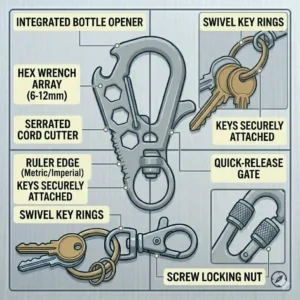
🧠 How to Choose the Perfect Hardware
When evaluating key ring clips, marketing departments love to throw around terms like “aircraft-grade” and “tactical.” Here is my expert framework for cutting through the noise and identifying features that actually dictate performance.
-
Analyze the Gate Style:
-
Wire Gates: Lighter, less prone to freezing in snow, but can be bent sideways under extreme torque.
-
Solid Gates: Heavier, often feature a “keylock” nose (meaning no notch to snag on belt loops), best for heavy-duty use.
-
-
Determine the Anchor Point:
Where are you clipping this? If it’s a thick leather belt, you need a wide-clearance gate. If it’s a thin nylon backpack loop, a smaller micro-clip provides a tighter, more secure hold without sliding around.
-
Assess the Swivel Feature:
Some clips feature a 360-degree swivel at the base. While this prevents key bunching and tangling, every moving joint is a potential point of mechanical failure. For maximum security, fixed-loops are superior; for maximum convenience, swivels win.
Perspective: A common mistake buyers make is over-indexing on weight ratings. You don’t need a clip rated for 400 lbs to hold 6 ounces of brass keys. Instead, prioritize gate tension and corrosion resistance. For a deeper dive into how carabiners are rated and tested, the Wikipedia page on Carabiners offers excellent insights into kn-ratings, though EDC gear rarely requires climbing-spec certification.
🔬 Titanium vs. Stainless Steel vs. Aluminum
Understanding the metallurgy of your gear dictates how long it will survive in your pocket.
Aluminum (The Lightweight Option)
Most budget and mid-tier clips use aluminum. It is exceptionally light and takes anodization beautifully, allowing for vibrant colors. However, aluminum is soft. Over months of rubbing against hardened steel keys, the color will scratch off, and deep gouges will form.
Stainless Steel (The Heavy Duty Option)
Steel provides fantastic tensile strength and won’t deform easily. However, it is significantly heavier. If you carry a massive bundle of keys, adding a solid steel carabiner might pull your pants down. It’s also important to note that “stainless” does not mean rust-proof; if exposed to salt air or heavy sweat, 304-grade steel will eventually pit. For more on the breakdown of steel degradation, materials science resources offer great technical background.
Titanium (The Premium Standard)
Titanium is roughly 45% lighter than steel but just as strong. It is entirely immune to rust and corrosion in standard environments. The drawback? Besides price, titanium suffers from “galling”—a form of wear where friction between titanium and steel (your split rings) can cause a gritty feeling over time.
Expert Advice: If you live in a coastal city or sweat heavily at a physical job, invest the extra $15 in titanium. The prevention of rust alone justifies the total cost of ownership.
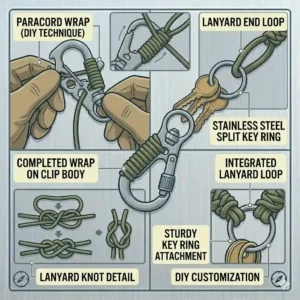
⚠️ Common Mistakes When Buying Everyday Carry Gear
In my years of reviewing tactical and EDC gear, I’ve watched thousands of dollars wasted on the wrong setups. Here are the pitfalls you must avoid.
Mistake 1: Paracord Dependency
Many “survival” keychains feature intricately woven paracord that supposedly unravels in an emergency. In reality, these absorb sweat, rain, and spilled coffee, quickly becoming unhygienic, smelly sponges. Stick to solid metals, Hypalon, or sealed Kevlar for daily carry.
Mistake 2: The Swiss Army Approach
Buyers often hunt for key ring clips that feature a built-in bottle opener, pry bar, hex wrench, and screwdriver. While this sounds efficient, you end up with a tool that does everything poorly. The pry bar digs into your thigh, and the hex wrench snags your pocket lining. Keep your clip designed for retention, and carry a dedicated multi-tool separately. For serious EDC enthusiasts, platforms like Everyday Carry showcase how professionals separate their tools for maximum efficiency.
Mistake 3: Ignoring the Split Ring Quality
You can buy a $50 titanium carabiner, but if you attach your keys to it using a cheap, deformed steel split ring that doesn’t close completely tight, your keys will slip off. Always upgrade your secondary rings to flat-milled titanium or high-carbon steel wire rings when you upgrade your main clip.
⏳ Long-Term Cost & Maintenance Cycle
The “Total Cost of Ownership” (TCO) of EDC gear is rarely discussed. A $5 aluminum clip from a big-box store seems like a bargain until the torsion spring snaps in month three, dropping your $250 electronic car fob into a storm drain.
The Year One Roadmap:
-
Months 1-3: Everything works perfectly. Factory lubricants are intact.
-
Months 4-6: For aluminum/steel clips, pocket lint begins accumulating inside the spring housing. You may notice the gate sticking open slightly. Maintenance required: A blast of compressed air followed by a single drop of dry PTFE lubricant (never use WD-40, as it attracts dirt).
-
Months 7-12: Cheaper anodized finishes will show severe “brassing” (silver metal shining through the color). Nylon straps may show fraying at the edges. Maintenance required: Carefully singe frayed nylon edges with a lighter to stop unraveling.
By calculating the TCO, the $30 Orbitkey Clip v2 or a solid titanium option actually costs less over a three-year period than replacing broken budget clips every six months, not to mention mitigating the catastrophic risk of lost keys.
✨ Don’t Miss These Exclusive Deals!
🔍 Ready to upgrade your pocket loadout? Click on the highlighted product links to view verified customer ratings and current availability. Stop trusting your home and vehicle security to cheap, gas-station hardware!
🎬 Conclusion
Upgrading your pocket hardware is one of the highest-ROI improvements you can make to your daily routine. The anxiety of patting your pocket to check if your keys are still there should be a thing of the past.
Whether you opt for the unyielding architectural strength of the TI-EDC Titanium Carabiner, the workflow mastery of the Orbitkey Clip v2, or the unbeatable budget security of the Nite Ize S-Biner MicroLock, the goal remains the same: reliable, intuitive retention. Stop settling for the frustrating, jingling mess of standard hardware. Audit your carry, identify your primary environment, and invest in the tool that matches your specific friction points. You interact with your keys multiple times a day—make those interactions seamless.
❓ FAQs
❓ What are key ring clips called?
✅ They are commonly referred to as carabiners, quick-releases, key organizers, or lanyard snaps. While “carabiner” implies a load-bearing climbing tool, EDC versions use the same spring-gate mechanism strictly for organization and pocket carry rather than safety support…
❓ Can key ring clips damage my car ignition?
✅ Yes. Hanging excessive weight (heavy metal clips, dozens of keys) from your ignition can prematurely wear out the ignition cylinder’s internal tumblers. Always use a quick-release mechanism to detach the car fob from the heavy main bundle while driving…
❓ What is the most durable material for a key clip?
✅ Grade 5 Titanium (Ti-6Al-4V) offers the best strength-to-weight ratio and is completely immune to rust. High-carbon stainless steel is also exceptionally durable but weighs significantly more and can develop surface rust if exposed to salt water…
❓ How do I stop my keys from jingling on a clip?
✅ Isolate the metal contact points. Use a leather loop, a Hypalon strap, or paracord to bridge the keys to the clip. Alternatively, utilize a bolt-style key organizer that tightly sandwiches the keys together to eliminate free-hanging movement…
❓ Are magnetic key clips secure?
✅ Yes, provided they use a mechanical-magnetic hybrid system like the Fidlock mechanism. These require a specific directional pull to release. However, pure friction-based magnetic releases should be avoided for heavy key bundles as they can easily snag and detach…
📚 Recommended for You
- The 5 Best Mini Flashlight Keychain Models in 2026: Expert Field Tests
- 5 Best key accessories to Upgrade Your Everyday Carry in 2026
- 5 Best Belt Key Chain Holder Setups for Ultimate EDC (2026 Expert Review)
Disclaimer: This article contains affiliate links. As an Amazon Associate, I earn from qualifying purchases. If you purchase products through these links, we may earn a small commission at no additional cost to you.
✨ Found this helpful? Share it with your friends! 💬🤗
[addtoany]
