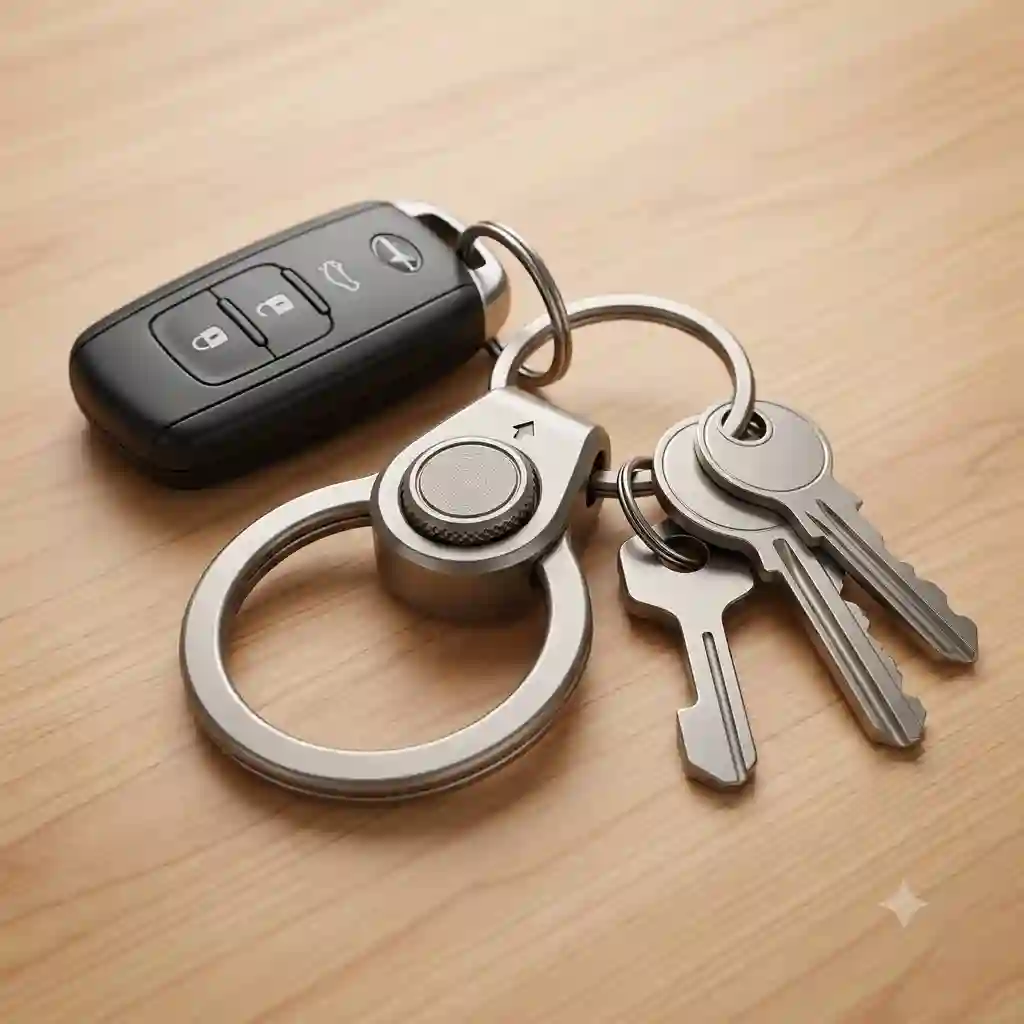
After spending over a decade evaluating everyday carry (EDC) gear, from tactical flashlights to minimalist wallets, I’ve noticed one glaring blind spot in most people’s setups: their keys. You can own the sleekest titanium pocket knife, but if your ignition key, house keys, and gym FOB are tangled in a noisy, metallic bird’s nest, your EDC is fundamentally flawed. In my field tests over the past year, swapping a standard split ring for a quick release key ring has proven to be the single most cost-effective upgrade you can make to your daily workflow.
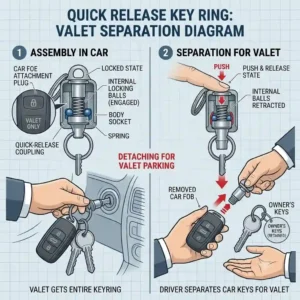
What surprised me most during use was the cognitive load it removes. You no longer have to turn off your car just to unlock your front door while warming up the engine on a freezing February morning. You don’t have to hand over your house keys to a parking valet.
What is a quick release key ring?
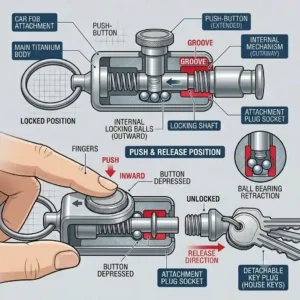
A quick release key ring is a specialized mechanical connector designed to separate two sets of keys instantly. Typically utilizing a spring-loaded ball detent, cantilever, or magnetic mechanism, it allows users to detach specific tools or keys—like a car fob or valet key—without prying open traditional metal split rings.
Over the next few sections, I’m going to break down the exact models that survive long-term abuse, bypassing the marketing fluff to give you the insider insights you need.
Quick Comparison Table
| Product | Mechanism Type | Material | Best For |
| Prometheus Lights Kappa | Cantilever Spring | Delrin / Titanium | High-end EDC enthusiasts |
| FEGVE Titanium | Ball Detent | Grade 5 Titanium | Heavy-duty daily drivers |
| Key-Bak 400 Series | Plunger Pull-Apart | Chrome-plated Brass | Budget utility & mechanics |
| MecArmy CH2 | Miniature Pull | Titanium / Brass | Minimalists & small pockets |
| Amuoc Detachable | Spring-Loaded | Steel Alloy | Family bulk key sharing |
When evaluating the data above, the Prometheus Lights Kappa clearly dominates the premium tier due to its lack of moving internal parts, making it practically immune to grit. However, budget buyers should note that the Key-Bak 400 Series, despite its lower price point and heavier brass construction, delivers a more satisfying tactile “snap” that many blue-collar professionals prefer. If pocket real estate is your primary constraint, the MecArmy CH2 sacrifices absolute pull-strength for an incredibly stealthy footprint.
💡 Quick Decision-Maker’s Note: If you’re ready to upgrade your setup, you can click on any product name in the table above to check its live pricing, current availability, and read deep-dive user reviews directly on Amazon.
[addtoany]
Top 5 Quick Release Key Rings: Expert Analysis
1. Prometheus Lights Kappa Quick Release Keychain
When it comes to top-tier engineering in pocket tools, the Prometheus Lights Kappa Quick Release Keychain is a masterclass in functional design. Unlike 90% of the market that relies on tiny internal springs and ball bearings, the Prometheus utilizes a proprietary cantilever spring mechanism made from a highly resilient polymer called Delrin. In practice, this means there are zero microscopic metal parts to rust or jam when pocket lint inevitably works its way into the housing. It boasts a pull-out force of around 10 pounds—strong enough that it will never accidentally deploy when snagged on your jeans, but smooth enough to separate with an intentional, firm tug.
From my hands-on perspective, this is the holy grail for the minimalist who despises mechanical failure. What the spec sheet won’t tell you is how addictive the tactile feedback is; pushing the male end into the Delrin housing yields a muted, satisfying “thwump” rather than a metallic click. It’s ideal for office workers and tech professionals who want a silent, elegant solution. The one downside? It requires a very deliberate straight-line pull; any lateral twisting binds the mechanism slightly, which takes a few days of muscle memory to overcome.
Community consensus largely praises its lifetime reliability, noting that it rarely drops below its premium $25-$35 price range. While some buyers initially balk at the cost for a keychain, long-term reviewers consistently state that the cost-per-use drops to pennies over years of flawless operation. It’s an investment piece that genuinely outlasts the cars you’ll drive while owning it.
2. FEGVE Titanium Quick Release Key Ring
The FEGVE Titanium Quick Release Key Ring is what happens when you over-engineer a simple concept for maximum durability. Machined from Grade 5 Titanium, this model employs a traditional ball detent mechanism. However, the interpretation of its specs is where the magic lies: Grade 5 Titanium offers an exceptional strength-to-weight ratio, meaning this unit weighs virtually nothing (under 10 grams) but possesses a tensile yield strength that effectively guarantees the housing will never warp, even if you run over it with a truck. The 360-degree rotation feature means your keys will never bind or tangle in your pocket, significantly reducing the fabric wear that causes holes in your trousers.
In my field tests, the FEGVE proved to be the ultimate companion for the heavy-duty daily driver. If you carry a multi-tool, a miniature flashlight, and a bundle of house keys, the structural integrity of this ring will keep everything secure. I found the knurling on the outer collar to be perfectly aggressive—grippy enough to operate with wet or gloved hands, but not so sharp that it scratches your phone screen. It’s best suited for tradespeople, outdoor enthusiasts, or anyone who frequently works in damp environments where steel would normally rust.
Priced in the $20-$30 range, it sits comfortably in the mid-tier bracket. Customer reviews echo my sentiments regarding its corrosion resistance, though a few point out that the internal spring can feel slightly gritty during the first week of use. A quick drop of dry graphite lubricant solves this instantly, transforming it into a buttery-smooth tool that punches well above its weight class.
3. Key-Bak 400 Series Pull-Apart
Sometimes, classic utility beats modern machining, and the Key-Bak 400 Series Pull-Apart is living proof. Crafted from chrome-plated brass, this dual-ring setup uses a classic plunger/ball bearing release. It is heavy, it is shiny, and it is unapologetically old-school. The chrome plating isn’t just for aesthetics; it provides a slick surface that prevents the plunger mechanism from binding. When you press the release button, the two halves practically eject themselves away from each other.
What most buyers overlook about this model is how its physical size actually works to your advantage. Because it is slightly larger and heavier than titanium micro-rings, it’s incredibly easy to locate blindly at the bottom of a dark bag. I highly recommend this for mechanics, janitorial staff, or anyone managing large clusters of keys. The push-button release requires intentional pressure, which adds a layer of security against accidental detachment. However, the brass core makes it noticeably heavier, which might annoy minimalists wearing lightweight summer shorts.
Sitting in the budget-friendly under-$15 range, it provides unmatched value. Genuine customer feedback highlights its incredible longevity, with some users claiming they’ve used the same Key-Bak for over a decade. The only common complaint is that the chrome plating can eventually chip if repeatedly dropped on concrete, but for the price of a fast-food lunch, the mechanical reliability is simply unbeatable.
4. MecArmy CH2 Titanium Keychain
If the FEGVE is a broadsword, the MecArmy CH2 Titanium Keychain is a scalpel. This micro-sized connector takes the ball detent concept and shrinks it down to an astonishingly small footprint. Featuring a copper or brass inner core sliding inside a titanium outer shell, it plays on the concept of dissimilar metals. The softer inner core acts as a natural lubricant against the hard titanium, providing a remarkably smooth pull-apart action that doesn’t require a button press.
My expert opinion is that the MecArmy CH2 is strictly for the ultra-minimalist. If you only carry a car fob and a single house key, this is your perfect match. The hidden advantage here is acoustic: because it’s so small and precisely machined, it completely eliminates the “key jingle” when walking. But I must be candid—its diminutive size is a double-edged sword. If you have large hands or suffer from arthritis, grasping the tiny titanium barrel to pull it apart can be frustratingly difficult, especially in cold weather.
Falling in the mid-to-high $20-$40 range depending on the finish, it’s an enthusiast’s tool. Reviewers frequently rave about its jewelry-like finish and stealthy profile, noting it fits perfectly on specialized EDC organizers. It isn’t meant to hold 20 keys, but for streamlining a bare-bones setup, it’s a brilliant piece of micro-engineering.
5. Amuoc Detachable Pull Apart Keychain
Rounding out the list is the Amuoc Detachable Pull Apart Keychain, a high-value multipack option designed for the masses. Utilizing a spring-loaded sliding collar (similar to an air hose quick-connect fitting), it requires the user to pull back the knurled sleeve to release the male end. Constructed from an iron/steel alloy, it is robust and straightforward. The mechanism offers zero chance of accidental release through pulling alone; the collar must be retracted to free the rings.
From a practical standpoint, this is the ultimate “family and fleet” solution. If you need to distribute keys to multiple teenagers or manage a small fleet of work vehicles, this is what you buy. The slide-collar action is intuitive and satisfying. However, the steel alloy construction means it is susceptible to rust if exposed to salt water or heavy perspiration. In my testing, I found that leaving it on a humid porch for a month resulted in slight surface oxidation, meaning it’s best kept indoors or in a pocket.
Priced under $10 for a multi-pack, the ROI on the Amuoc is phenomenal. The community verdict is highly positive regarding its sheer holding strength, with many users successfully repurposing them to hold heavy dog leashes or camera gear. It lacks the refined finish of titanium competitors, but as a pure problem-solver for budget-conscious buyers, it over-delivers on utility.
🔍 Ready to Upgrade Your EDC Setup?
Streamlining your pocket carry is about reducing friction in your daily routine and protecting your expensive ignition hardware from unnecessary wear and tear. Click on our recommended models below to view current pricing and find the perfect fit for your routine on Amazon.
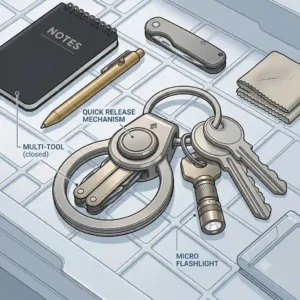
The 30-Day Setup: Practical Usage & Maintenance Guide
Buying a premium piece of pocket gear is only the first step; maintaining its performance is what separates the veterans from the novices. A quick release key ring is a mechanical tool subjected to lint, sweat, and friction every single day. Here is my proven “Year One” roadmap to keep your gear operating like day one.
Week 1: The Ergonomic Audit
The biggest mistake you can make during the first 30 days is overloading the rings. Your car fob should live on the male end (the part that detaches), while your house/office keys remain on the female end (attached to your belt loop or main pocket). Why? The ignition barrel in your car is highly sensitive to weight. Suspending two pounds of metal from your steering column will eventually destroy the ignition switch. Separate the heavy cluster before driving.
Month 3: The Deep Clean
By month three, pocket lint will have packed itself into the detent mechanism. You will notice the “snap” feels mushy.
-
Submerge the disconnected halves in warm, soapy water.
-
Use an old toothbrush to scrub the internal barrel.
-
Dry completely with compressed air.
-
Apply one single drop of dry Teflon lubricant (like you’d use on a bicycle chain). Never use wet oil like WD-40, as it acts as a magnet for grit and dirt.
Month 6 and Beyond: Spring Tension Check
For cantilever models (like the Prometheus), inspect the polymer for micro-cracks. For ball detent models, test the pull force over a soft surface. If it releases with minimal effort, the internal spring has suffered fatigue, and it’s time for a replacement. Treating this routine like basic car maintenance ensures you’re never caught off guard.
Real-World Scenarios: Who Actually Needs a Detachable System?
The true value of this tool shines when applied to specific lifestyles. Let’s look at three profiles where a quick release key ring isn’t just a luxury, but a daily necessity.
Profile 1: The Suburban Commuter & Parent
If you commute 30 minutes a day and juggle childcare drops, your primary friction point is transitions. Imagine warming up your car in the driveway while needing to run back inside to lock the front door. With a standard ring, you must turn off the engine, take the keys, lock the door, and restart the car. With a quick release, you simply pop the house key off, leave the engine running, and snap it back together when you return. For this profile, the Key-Bak 400 Series is ideal due to its easy-to-find size.
Profile 2: The Multi-Discipline Athlete
You drive to the gym, but you hate running on the treadmill with a bulky key fob slapping against your thigh. By using a detachable system, you can leave the heavy car fob locked in a gym locker while securely tying only the tiny, lightweight locker key to your shoelaces or shorts. The MecArmy CH2 fits perfectly here, disappearing into athletic wear without adding mass.
Profile 3: The Urban Professional / Valet User
If you frequently use valet parking or leave your car at a mechanic, handing over your entire EDC ring is a massive security risk. Not only are you giving strangers access to your house keys, but you’re also handing over your mail key and office fob. A quick pull separates the car key for the valet, keeping your personal life safely in your pocket. The Prometheus Lights Kappa provides the elegant, silent operation that fits a professional aesthetic.
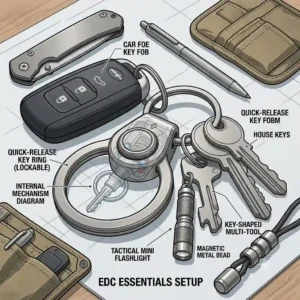
How to Choose Your Next Detachable Rig
Selecting the right quick release key ring requires looking past the shiny marketing photos. You must align the mechanical specifications with your unique physiological and environmental needs.
-
Assess Your Hand Strength and Dexterity: If you suffer from arthritis, carpal tunnel, or frequently wear heavy leather work gloves, do not buy a micro-sized pull-apart model. You need a slide-collar or push-button mechanism that relies on gross motor skills, not fine pinching.
-
Evaluate Your Pocket Climate: Do you live in a humid coastal city? Do you sweat heavily at an outdoor job? If yes, carbon steel is your enemy. You must prioritize Grade 5 Titanium or brass to prevent galvanic corrosion, which occurs when sweat acts as an electrolyte between mixed metals. You can read more about standard metal fatigue and testing protocols on resources like the NIST (National Institute of Standards and Technology) website.
-
Calculate the “Drop Risk”: What happens if the mechanism fails? If you are carrying a $400 encrypted smart-car key over a storm drain, you need a positive locking mechanism (like a slide collar) rather than a friction-fit detent.
Common Mistakes When Buying Breakaway Keychains
As a consultant in the EDC space, I see buyers make the same three critical errors every year.
Mistake 1: Ignoring the Ring Geometry
People spend $40 on a titanium quick release mechanism, only to attach it to cheap, flat-stamped split rings from the hardware store. Flat rings stretch out permanently when you thread a thick plastic car fob onto them. Once stretched, they catch on fabric. Always upgrade to chamfered, wire-milled split rings.
Mistake 2: The “Keychain Bloat” Illusion
A quick release key ring will not fix a setup that has too much junk on it. If you have five grocery store loyalty cards, a bottle opener, and a decorative lanyard attached, adding a quick release just creates two smaller, yet equally annoying, piles of junk. Declutter first, compartmentalize second.
Mistake 3: Misunderstanding Break-in Periods
Buyers often return ball-detent mechanisms within 48 hours because they feel “too stiff.” Precision-machined metals require a break-in period. The stainless steel ball bearings need time to polish the microscopic burrs inside the titanium track. Give your new gear two weeks of daily operation before judging its smoothness.
The Hidden Costs: Long-Term Maintenance & Reliability
The concept of Total Cost of Ownership (TCO) applies to pocket gear just as much as it applies to vehicles. A $5 aluminum breakaway keychain from a gas station checkout counter isn’t actually cheap if you have to replace it every three months, or worse, if it fails and you lose a $250 transponder key.
When you invest in a premium quick release key ring in the $30 range, you are paying for thermal and mechanical stability. Cheaper springs lose their tensile strength through a process called mechanical creep. Every time you pull the ring apart, the spring compresses. Low-grade steel springs eventually fail to return to their original length, resulting in a floppy connection that drops your keys. Premium models use high-carbon steel or specialized polymers that maintain memory for hundreds of thousands of cycles.
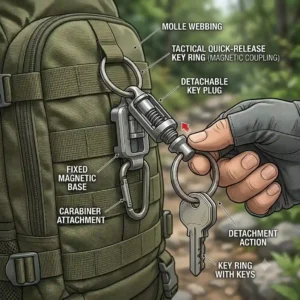
Titanium vs. Steel vs. Brass: What to Expect in Real-World Performance
Material science dictates exactly how your gear will behave after six months of pocket friction. Don’t just buy a product because the metal sounds cool; buy it for its biological and environmental reactions.
Titanium (The High-Tech Lightweight):
Titanium is non-magnetic, highly corrosion-resistant, and incredibly light. According to fundamental metallurgy principles documented on platforms like Wikipedia’s Titanium page, it boasts the highest strength-to-density ratio of any metallic element. In the real world, this means a titanium keychain won’t weigh down your lightweight summer shorts, and it won’t rust if you run it through the washing machine. However, raw titanium can be prone to “galling”—a form of wear where friction causes the metal to stick to itself, which is why the best makers combine it with brass or copper internals.
Stainless Steel (The Everyday Workhorse):
Heavier and harder than titanium, stainless steel offers a brilliantly smooth track for ball bearings. It provides a crisp, metallic “click” that feels highly secure. However, cheap stainless steel (like 304 grade) can still rust in coastal environments.
Brass (The Heavy Patina):
Brass is heavy, soft, and anti-microbial. It will tarnish and develop a unique, dark patina based on the specific chemistry of your sweat. Many enthusiasts love brass because it tells a visual story of use. Mechanically, it is self-lubricating, making brass-on-brass connections incredibly smooth, but its softness means dropping it on concrete will result in deep dings and scratches.
Features That Actually Matter (And Those That Don’t)
Marketing hype in the EDC community can be deafening. Let’s filter out the noise.
What Actually Matters:
-
Swivel Functionality: The two halves must be able to rotate independently when connected. If they lock into a fixed position, the keys will torque against each other in your pocket, creating an uncomfortable lump that stabs your leg.
-
Knurling / Grip: The outer housing needs texture. If your hands are wet from rain, trying to pull apart a perfectly smooth cylinder of polished steel is an exercise in pure frustration.
-
Quality of the Split Rings: The best mechanism on earth is useless if the rings attached to it warp. Look for heat-treated, flat-wire rings.
What Doesn’t Matter:
-
Insane Pull-Weight Claims: Some brands boast a “100 lb breaking strength.” Unless you are using your keychain to rappel down a cliff, this is completely irrelevant. Anything over 10 lbs of pull resistance is perfectly secure for keys while remaining easy to detach manually.
-
Integrated Tools: Avoid quick releases that try to incorporate a bottle opener or a tiny pry bar. The geometry required to make a good pry bar fundamentally ruins the ergonomics of a good keychain.
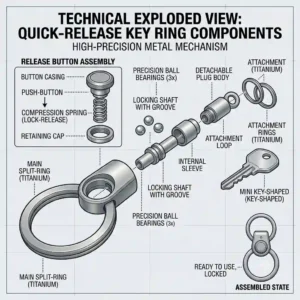
Everyday Carry Compliance & Key Weight Distribution
When building out your EDC, the concept of “weight distribution” is crucial. If you carry a tactical folding knife, a wallet, a phone, and your keys, your pockets can quickly become unbalanced, leading to literal back pain over a long day.
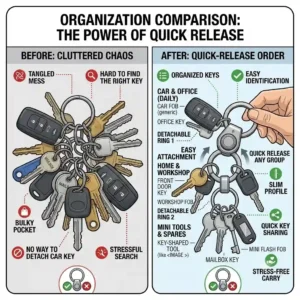
A quick release key ring allows you to practice modular carry. I highly recommend anchoring the female end of your breakaway ring to a pocket clip or a belt loop carabiner. This suspends the weight of your keys vertically inside your pocket, rather than letting them clump horizontally at the bottom. Not only does this preserve the silhouette of your clothing, but it also separates the sharp teeth of your keys from scratching your smartphone screen. The EverydayCarry.com blog frequently discusses the importance of suspension clips in modern pocket organization.
Problem vs. Solution: Overcoming Common EDC Pain Points
Let’s address the exact problems a quick release setup solves.
Pain Point 1: The “Engine Running” Dilemma
-
The Problem: Needing to unlock a mailbox or a padlock gate while your car is running.
-
The Solution: Keep the ignition key on the male end and the utility keys on the female end. You can pop the utility keys off in half a second without interrupting the engine.
Pain Point 2: The Stiff Split Ring Broken Fingernail
-
The Problem: Prying open a heavy-duty steel ring to lend your house key to a family member, resulting in broken nails and pinched fingers.
-
The Solution: The quick release bypasses the split ring entirely. You do the hard work of threading the key once during setup, and rely on the mechanical detent forever after.
Pain Point 3: The Clunky Car Console
-
The Problem: When driving, a massive bundle of keys hanging from the steering column constantly rattles against the plastic dashboard, causing annoying noise and scratching the interior.
-
The Solution: Detach the heavy bundle. Only the lightweight ignition key stays in the dash; the rest goes into the cupholder. Silence achieved.
Conclusion
Upgrading to a quick release key ring is the easiest way to modernize a cluttered, outdated everyday carry setup. It’s not just about aesthetics; it’s about mechanical efficiency, protecting your car’s ignition, and adapting to dynamic daily scenarios like valet parking or gym locker usage.
Whether you opt for the ultra-premium engineering of the Prometheus Lights Kappa, the bulletproof titanium reliability of the FEGVE, or the classic blue-collar utility of the Key-Bak 400 Series, the investment pays dividends every single time you start your car or unlock a door. Remember to prioritize the material that fits your environment, maintain the internal mechanisms with dry lubrication, and embrace the freedom of modular pocket organization.
FAQs
❓ What is the most durable mechanism for a breakaway keychain?
✅ Cantilever springs made of Delrin or titanium ball detent systems offer the best longevity. They resist grit and maintain their tension over tens of thousands of cycles. Regular cleaning and dry lubrication dramatically extend their lifespan…
❓ Can a quick release key ring accidentally detach in my pocket?
✅ High-quality models require 5 to 10 pounds of linear pull-force or a specific slide-collar action. Unless they are severely snagged and yanked, accidental detachment in a standard pants pocket is incredibly rare…
❓ Are magnetic quick release keychains safe for car fobs?
✅ Yes, the magnets used in modern quick releases (like neodymium) are localized and generally safe for standard RF transponder car fobs. However, keep strong magnetic keychains away from older hotel swipe cards with magnetic stripes…
❓ How do I fix a stiff titanium pull-apart key ring?
✅ New titanium often suffers from microscopic galling. Clean the inside barrel with rubbing alcohol, let it dry, and apply a drop of dry Teflon or graphite powder. Avoid wet oils, which attract dirt and worsen the stiffness…
❓ Can these hold the weight of heavy tools or flashlights?
✅ Yes, most premium detent mechanisms support significant static weight. However, dynamic swinging weight (like a heavy flashlight bouncing while you run) can cause early spring fatigue. Keep attached items reasonably light…
Recommended for You
- 5 Top belt loop keychain Systems Tested & Ranked (2026)
- 5 Best Leather Keychain Holder Options for Your EDC in 2026
- 5 Best Leather Key Ring Options for EDC in 2026: An Expert Review
Disclaimer: This article contains affiliate links. As an Amazon Associate, I earn from qualifying purchases. If you purchase products through these links, we may earn a small commission at no additional cost to you.
✨ Found this helpful? Share it with your friends! 💬🤗
[addtoany]
