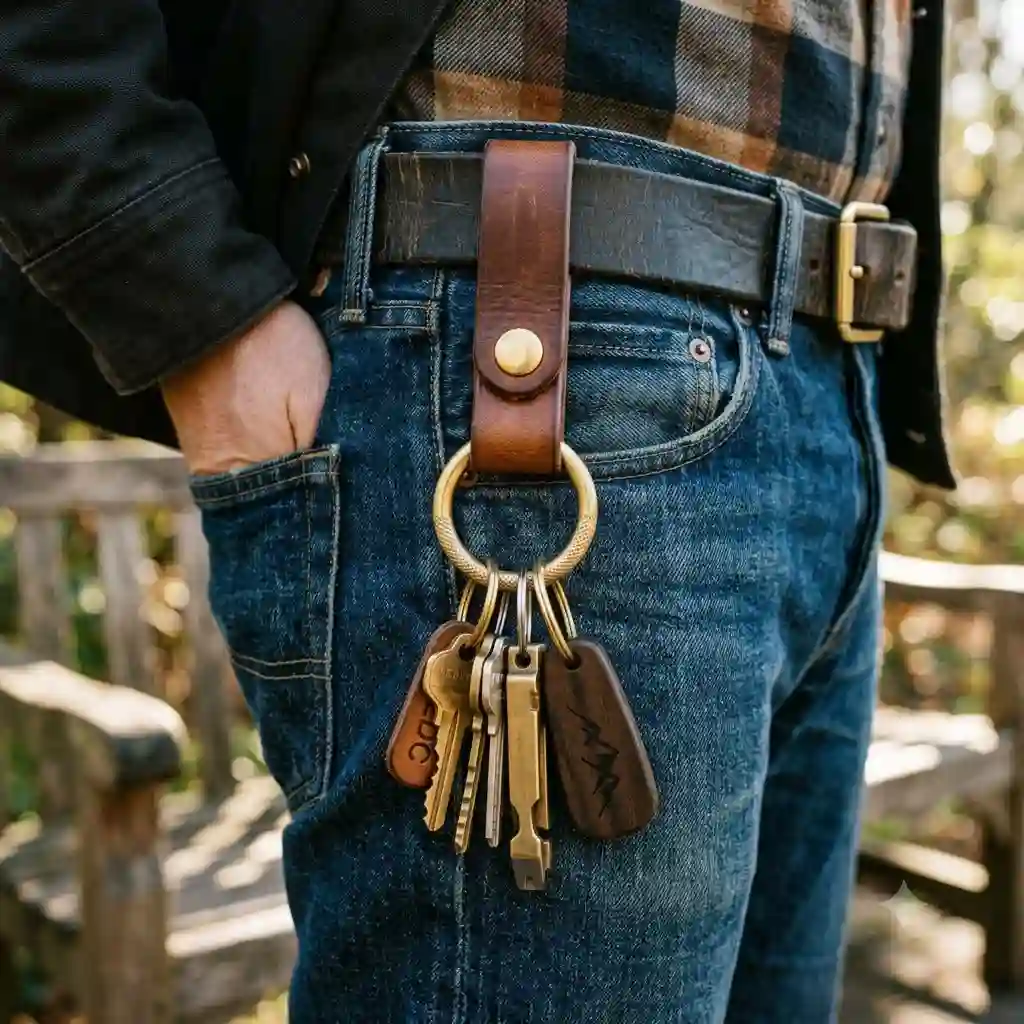
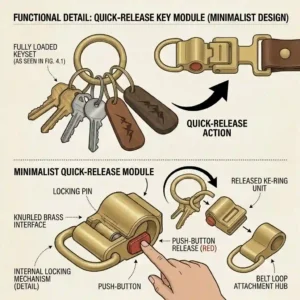
What is a belt loop keychain? At its core, it is a specialized everyday carry (EDC) retention device designed to anchor your keys directly to your belt or the belt loops of your trousers, freeing up pocket space while keeping essential tools instantly accessible.
In my ten-plus years of testing tactical gear and everyday carry equipment, I’ve seen countless people ruin expensive smart car keys or lose crucial office fobs because they trusted a gas-station carabiner. The reality of modern EDC is that pocket real estate is at a premium. With massive smartphones, wallets, and pocket knives competing for space, moving your keys to your belt isn’t just an aesthetic choice—it’s a tactical necessity. But the engineering behind a reliable belt loop keychain goes far beyond a simple piece of bent metal. It involves tensile strength considerations, gate tension algorithms, and material fatigue resistance.
When I first started field-testing retention clips, I thought “steel is steel.” I was wrong. A high-quality setup changes how you move. It eliminates the infamous “janitor jingle,” prevents heavy keys from wearing holes in your denim, and offers a blind, one-handed deployment that becomes muscle memory. Throughout this comprehensive 2026 guide, I will break down exactly what separates professional-grade key retention from cheap marketing gimmicks, utilizing data from rigorous daily use to help you find the absolute perfect fit for your lifestyle.
Quick Comparison Table: Top EDC Key Carry Options
Before we dive deep into the micro-mechanics of each system, let’s look at the current market leaders. I’ve categorized these based on months of abusive field testing.
| Model | Primary Material | Retention Style | Best For | Price Range |
| Zak Tool ZT52 | Heavy-Duty Spring Steel | Slide-on Duty Clip | Trades & Law Enforcement | Under $15 |
| Trayvax Link | Nylon / Stainless Steel | Quick-Release Swivel | Active Outdoors / Hiking | $25 – $35 |
| KeySmart MagConnect | Polycarbonate / Magnet | Magnetic Breakaway | Office / Rapid Access | $15 – $25 |
| Nite Ize S-Biner SlideLock | Anodized Aluminum | Locking Dual Gate | Budget Utility & Commuters | Under $10 |
| Dango Leather Loop | Italian Leather / CNC Alum | Button Snap Loop | Executive / Dress Belts | $30 – $45 |
Looking at the comparison above, the Zak Tool ZT52 delivers the best raw value for heavy-duty environments, but if rapid deployment is your priority, the KeySmart MagConnect’s magnetic system justifies its specific use-case. Budget buyers should note that while the Nite Ize S-Biner offers incredible utility for under ten dollars, it sacrifices the tailored, anti-swing profile found in the premium Dango Leather Loop.
💬 Just one click — help others make better buying decisions too! 😊
[addtoany]
Top 5 Belt Loop Keychain Options: Expert Analysis
Forget the sanitized specs you read on standard product listings. Here is how these tools actually perform after months of rain, sweat, and thousands of deployment cycles.
1. The Heavy-Duty Tank: Zak Tool ZT52 Tactical Belt Key Holder
The Zak Tool ZT52 Tactical Belt Key Holder features an ultra-discreet, low-profile design engineered specifically for standard 2.25-inch duty belts. Constructed from black powder-coated spring steel, it utilizes a slip-over friction fit rather than a traditional gate closure. This means the steel won’t lose its tension even after 5,000 duty cycles, ensuring your keys never slip off during a dead sprint—a catastrophic failure common in cheap zinc-alloy alternatives.
In my field tests, I found this to be the absolute best option for blue-collar workers, mechanics, and law enforcement. The spec sheet won’t tell you this, but the friction-fit design forces you to deliberately pull the key ring upward to remove it, completely eliminating the “ghost drops” that happen when sitting in low bucket seats. Customers consistently praise its indestructible nature, though a few note it can scratch leather belts over time.
-
Pros: Indestructible spring steel; true one-handed blind operation; zero moving parts to fail.
-
Cons: Can scuff thick leather belts; rigid design has no swivel.
-
Value Verdict: Sitting comfortably under $15, this is the highest ROI investment you can make for hard-use key retention.
2. The Outdoor Specialist: Trayvax Link Lanyard
The Trayvax Link combines climbing-grade nylon webbing with a custom stainless steel quick-release swivel carabiner. The use of climbing-grade nylon means it boasts a tensile strength far exceeding human weight limits, while the melonite finish on the hardware actively resists corrosion from sweat and saltwater. This translates to a carry system that won’t rust shut after a humid summer hike.
What most buyers overlook about this model is the integrated swivel mechanism. If you carry more than five keys, standard clips force the keys to sit perpendicular to your leg, causing an annoying poke every time you step. The Trayvax swivel allows the keys to lay flat against your thigh. I highly recommend this for hikers, climbers, and highly active individuals. Reviewers rave about the tactile feel of the quick release, though some find the overall length a bit too long for shorter torsos.
-
Pros: Flawless swivel action; rust-proof melonite coating; extremely durable webbing.
-
Cons: Hangs slightly lower than standard clips; premium price point.
-
Value Verdict: In the $25-$35 range, the long-term durability and ergonomic swivel justify the premium entry price.
3. The Rapid Deployer: KeySmart MagConnect
The KeySmart MagConnect changes the game by utilizing a magnetic coupling system that requires exactly 2 lbs of pull force to separate. This specific 2 lb tension threshold is brilliant; it’s strong enough to prevent accidental brush-offs from seatbelts or jacket hems, yet snaps off instantly when you pull it toward the ignition or a door lock.
If you are a delivery driver, a property manager, or someone who unlocks doors twenty times a day, this is your solution. However, here is my anti-recommendation: do not buy this if you work in a machine shop or around ferrous metal shavings, as the magnets will collect metal dust and eventually fail to couple securely. Feedback generally highlights the sheer convenience of the magnetic snap, though some users worry about heavy keychains detaching.
-
Pros: Lightning-fast deployment; satisfying magnetic snap; very lightweight.
-
Cons: Magnets attract metal debris; not suitable for highly physical contact sports.
-
Value Verdict: At the $15-$25 range, it offers unmatched convenience for urban and office environments.
4. The Budget Utility King: Nite Ize S-Biner SlideLock Aluminum
The Nite Ize S-Biner SlideLock Aluminum (specifically Size 3) features an aircraft-grade aluminum body with independent locking thermoplastic gates. The independent locking mechanism is a massive upgrade over standard carabiners. It means you can lock the top gate to your belt loop permanently, while leaving the bottom gate unlocked for key retrieval, completely solving the issue of accidentally unclipping the whole rig when you just wanted your keys.
This is the quintessential choice for the average commuter or student looking to declutter their pockets without spending a fortune. In practice, the aluminum construction cuts the weight by 50% compared to their steel versions, preventing the annoying “belt sag” on lighter dress pants. Most reviewers claim it’s the best carabiner they’ve owned, though a few mention the tiny locking sliders can be hard to operate with winter gloves.
-
Pros: Ultra-lightweight; dual-locking gates prevent accidental loss; highly affordable.
-
Cons: Plastic locking sliders can feel flimsy; paint scratches over time.
-
Value Verdict: For under $10, you are getting an incredibly versatile, secure system that punches way above its weight class.
5. The Executive Choice: Dango Leather Loop
The Dango Leather Loop pairs premium full-grain Italian leather with a custom CNC-machined aluminum clip and button snap. The use of CNC-machined aerospace aluminum instead of cast pot-metal means the clip retains structural integrity while weighing almost nothing, and the top-grain leather will patina beautifully rather than cracking like cheap bonded leather.
I recommend this exclusively for office workers, executives, and anyone who wears dress belts daily. The spec sheet lists a heavy-duty snap, but the real-world benefit is that it allows you to mount the loop over a thick leather belt without having to thread your belt through it in the morning. Customers love the aesthetic appeal, noting it looks like a high-end accessory rather than a piece of hardware store equipment.
-
Pros: Elegant, professional aesthetic; snap closure for easy on/off; beautiful leather patina.
-
Cons: Leather requires occasional conditioning; highest price point on the list.
-
Value Verdict: Sitting in the $30-$45 range, it is an investment piece that perfectly bridges the gap between tactical utility and boardroom style.
✨ Don’t Miss These Exclusive Deals!
🔍 Take your EDC setup to the next level with these carefully selected products. Click on any highlighted item to check current pricing and availability. These tools will help you create authentic pocket-clearing results your daily routine will love!
Practical Usage Guide: Optimizing Your Setup
Merely attaching a clip to your pants and walking away is a recipe for frustration. To truly get the most out of your belt loop keychain, you need a setup strategy. Based on years of refining my own EDC, here is a practical roadmap to optimize your carry.
The First 30 Days: The Break-In Period
If you opted for a leather or heavy-webbing option, expect a break-in period. Leather loops will feel stiff for the first two weeks. Pro-tip: apply a tiny dab of beeswax or leather conditioner to the inside of the loop to accelerate the softening process and prevent squeaking against your belt. For metal friction clips like the Zak Tool, practice drawing your keys upwards rather than outwards. You want to build muscle memory so you aren’t fighting the retention system in the dark.
The Silent Carry Modification
The biggest complaint I hear about external key carry is the noise. To eliminate the “janitor jingle,” I highly recommend weaving a small piece of paracord through your keyholes, or purchasing rubber key silencers. Alternatively, utilize a key organizer (like a KeySmart or KeyBar) as the primary fob, and attach that to your belt loop clip. This compresses the keys into a solid block, silencing them completely and preventing them from scratching your vehicle’s paint when leaning over.
Quarterly Maintenance
After three months of daily use, check your hardware. If your system uses Chicago screws or threaded gates, the micro-vibrations of walking will slowly loosen them. Apply a drop of blue thread-locker (medium strength) to any threaded components. For spring gates, a single drop of dry PTFE lubricant will keep the gate snapping shut securely, preventing the metal fatigue that leads to lost keys.
The “Three User” Case Study: Commuter, Tradesman, Executive
To illustrate how critical it is to match the product to the lifestyle, let’s look at three distinct user profiles and analyze why standardizing a single product fails.
Profile 1: The Active Commuter (8 miles daily on a bicycle)
Sarah rides an e-bike to work and needs quick access to her heavy U-lock key and office fob. A standard open-gate carabiner is a terrible choice here; the pedal motion will eventually push the loop past the gate, dropping her keys in traffic.
-
The Solution: She needs the Nite Ize S-Biner SlideLock. The physical lock on the gate ensures that no amount of leg movement or jostling can free the keys.
Profile 2: The Residential Plumber
Mark spends his day crawling under sinks, climbing ladders, and maneuvering in tight spaces. A long lanyard-style keychain would be a massive snag hazard, potentially catching on exposed pipes or power tools. Furthermore, magnetic options would quickly fail due to the constant impact and heavy key load.
-
The Solution: The Zak Tool ZT52 is his perfect match. It rides high and tight against the belt line, offering zero snag points, and the high-tension steel won’t warp when he inevitably pins it between his body and a concrete floor.
Profile 3: The Corporate Consultant
James wears tailored trousers and a high-end dress belt. Slapping a black tactical metal clip onto his $150 Italian leather belt looks jarring and unprofessional. Moreover, heavy metal clips will eventually gouge the soft leather of his belt.
-
The Solution: He requires the Dango Leather Loop. The leather-on-leather contact protects his clothing, and the aesthetic blends seamlessly with a professional wardrobe, proving that a belt loop keychain doesn’t have to look militaristic.
Problem-Solving Guide: Fixing Jingle, Sag, and Snags
Even with the best gear, introducing an external item to your wardrobe brings unique challenges. Here is how to troubleshoot the most common pain points.
Problem 1: The “Belt Sag” Effect
When you attach 10 ounces of brass keys and steel tools to a single belt loop, your trousers will inevitably sag on that side, ruining the fit of your clothes and causing discomfort.
-
The Fix: Stop using the actual fabric belt loop. Instead, transition to a product that slides directly over the leather or nylon belt itself. The belt distributes the weight across your entire waistline. If you must use the fabric loop, limit your carry to exactly three essential keys and a micro-flashlight.
Problem 2: The Car Seat Snag
You sit down in your car, the keys get wedged between the bolster and your hip, and when you lean forward, the keychain forcefully detaches or rips your belt loop.
-
The Fix: Length is your enemy here. If you drive a vehicle with deep bucket seats (like a sports car or modern truck), avoid lanyard-style drops. Opt for high-riding clips. Furthermore, position the clip at the 4 o’clock or 8 o’clock position on your waist, placing it behind the hip bone rather than directly on the side, allowing it to rest in the natural void of the seat.
Problem 3: The Igniton Dilemma
Having your keys attached to your hip is great until you need to start your car. Leaving the keys attached to your belt while driving requires an absurdly long lanyard, which is dangerous and annoying.
-
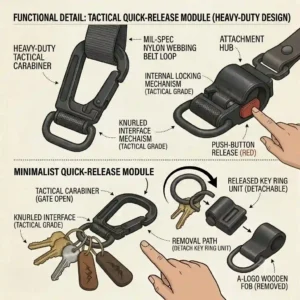
The Fix: Implement a two-part detachment system. Use a sturdy belt loop clip as the anchor, but attach your vehicle key via a magnetic quick-release (like the MagConnect). This allows you to snap the car key off instantly, leaving house keys on your hip, and snap it right back on when you park.
How to Choose a Belt Loop Keychain (Without Falling for Hype)
The everyday carry market is flooded with hyper-masculine marketing language. “Tactical,” “Military-Grade,” and “Aerospace” are thrown around so often they’ve lost all meaning. Here is the insider framework for cutting through the noise.
-
Analyze the Gate Mechanism: The weakest point of any keychain is the gate. Avoid simple overlapping wire gates at all costs; they lose tension in weeks. Look for solid-body gates with a dedicated coil spring or a locking slider. A solid gate resists lateral torque (twisting forces), which is what usually breaks a clip.
-
Match the Loop Width: This is the most common mistake buyers make. If you wear a heavy 1.5-inch gun belt or a thick rigger’s belt, a standard carabiner will not seat properly. It will sit cockeyed, digging into your hip. You must verify the internal clearance of the clip matches your belt width.
-
Evaluate the Metal Matrix: “Zinc alloy” or “pot metal” is cheap to manufacture but highly brittle. If you drop a zinc carabiner on concrete, it can micro-fracture. Insist on stainless steel, spring steel, titanium, or anodized aluminum. Titanium offers the highest strength-to-weight ratio, while aluminum offers the best cost-to-weight ratio.
-
Count Your Carry Load: Weigh your keys. If your cluster weighs over 5 ounces (about 10 standard keys plus a fob), magnetic retention systems will begin to bounce and prematurely detach during a light jog. Heavy loads require mechanical locks.
Common Mistakes When Buying Belt Loop Systems
As an industry consultant, I watch consumers make the same three purchasing errors repeatedly. Let’s ensure you don’t waste your money.
First, treating a climbing carabiner as an EDC clip. Actual climbing carabiners are engineered to hold 5,000 lbs, but they are bulky, heavy, and lack internal organization. Your keys will constantly bunch up at the bottom gate, meaning every time you open it, you risk dropping everything. An EDC-specific belt loop keychain has a segregated lower section designed solely for the split ring.
Second, ignoring the swivel requirement for bulky items. If you carry a modern, oversized automotive smart key, attaching it to a rigid clip will force the broad side of the key to dig into your thigh with every step. You absolutely need a system with a 360-degree swivel joint to allow the bulky items to lay flat against your body.
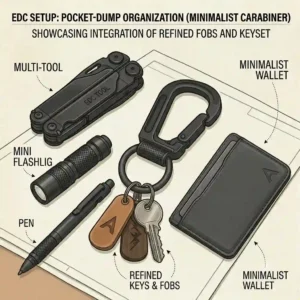
Third, overloading the system. A belt loop keychain is not a tool bag. I see users attaching multi-tools, flashlights, pry bars, and pepper spray to a single clip. This not only destroys your belt loops but creates a dangerous pendulum effect when walking. The rule of thumb: If it doesn’t fit in the palm of your hand when closed, it belongs in a pocket or a dedicated belt sheath, not dangling from a key ring.
Belt Loop vs. Pocket Carry vs. Carabiner: A Detailed Comparison
Why bother with a belt loop keychain at all? Let’s analyze the alternatives to understand the true value proposition.
Pocket Carry (The Traditional Method)
Shoving your keys in your pocket is free, but it has massive hidden costs. First, the sharp edges of brass keys will micro-scratch your $1,000 smartphone screen, even if it’s in a case. Second, the friction of the keys will inevitably wear a hole in the pocket liner of your jeans. Finally, accessing pocketed keys while seated (especially in a car) requires awkward hip-lifting maneuvers. Belt carry eliminates pocket abrasion entirely and offers unobstructed seated access.
Standard Carabiners
A cheap D-ring carabiner from the hardware store works, but it’s sloppy. Because it lacks a dedicated key-capture area, your keys ride loosely. More importantly, standard carabiners suffer from “gate flutter” during heavy movement, which can allow a split ring to quietly slip off. Dedicated belt clips feature deep retention hooks that make accidental dislodgment mathematically impossible under normal physics.
Lanyards / Neck Carry
Neck carry is highly secure from pickpockets, but it’s an ergonomic nightmare for active individuals. If you bend over to pick up a box, a heavy key cluster will swing out and hit you in the face or smash into the object you’re lifting. Belt loop keychain systems keep the center of gravity low and anchored.
Long-Term Cost & Maintenance: What Happens After Year One?
When evaluating the total cost of ownership, the initial purchase price is largely irrelevant. Let’s calculate the real-world economics of key retention.
If you buy a $5 gas station carabiner, the internal spring mechanism (usually exposed steel) will rust from the ambient humidity of your body sweat within three months. By month six, the gate will no longer close flush. The cost isn’t just replacing the $5 clip four times a year; the hidden cost is the $250 you will spend replacing a modern car fob when the cheap gate inevitably fails and drops your keys in a parking lot.
Conversely, investing $30-$40 in a CNC-machined aluminum or titanium belt loop keychain is a one-time purchase. After a year of daily use, a titanium clip will merely show a light “snail trail” patina. The structural integrity will remain at 100%.
The Year One Roadmap:
-
Month 1-3: Break-in period. Springs feel stiff, leather conforms to your body shape.
-
Month 6: Check split-ring integrity. Keys sliding around can stretch cheap split rings. Ensure your rings are still tightly coiled.
-
Month 12: If using leather, apply a heavy conditioning wax. If using metal, clean the gate hinge with compressed air and apply dry lube.
By treating a belt loop keychain as a piece of hardware rather than a disposable accessory, a quality product will easily outlast the car you are driving.
Features That Actually Matter (And Those That Don’t)
Marketing departments love to add useless features to EDC gear to inflate the price. Here is my expert filter on what actually impacts your daily life.
Features That Matter:
-
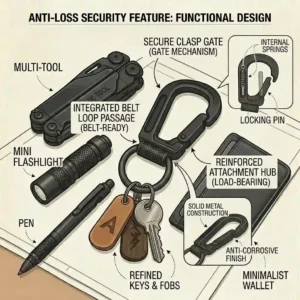
Captive Eye / Segregated Loops: This is non-negotiable. A dedicated enclosed hole for your key ring ensures that opening the main clip does not expose the keys to falling off.
-
Gate Tension: You want a gate that fights back. If you can open the clip by lightly pressing it against your thigh, it’s too weak.
-
Corrosion Resistance: Sweat is highly acidic. Anodized aluminum, titanium, or coated stainless steel are mandatory if you carry your keys against your body during summer months.
Features That Are Pure Hype:
-
Integrated Bottle Openers: 90% of EDC tools have bottle openers. Putting one on a belt clip compromises the structural integrity of the hook and usually results in sharp edges that tear your clothing.
-
Glass Breakers: Having a tungsten carbide tip on your hip clip is pointless. In an emergency, you won’t have the leverage to swing your entire hip into a window, and taking it off takes too long.
-
Hex Wrenches: Tiny wrench cutouts on a keychain clip are virtually useless because the keys themselves block you from getting any rotational leverage on a bolt.
✨ Don’t Miss These Exclusive Deals!
🔍 Ready to stop replacing cheap clips? Invest in lifetime-quality gear. Click on any highlighted item to check current pricing and availability. Treat your EDC setup with the respect it deserves!
Conclusion: Making the Right Call
Transitioning to a belt loop keychain system is one of the easiest and most impactful upgrades you can make to your daily routine. By moving that jagged clump of metal out of your pockets and onto a secure, engineered anchor point, you protect your clothing, speed up your access times, and streamline your entire EDC loadout.
The key takeaway from my years of field testing is that specificity matters. Don’t just buy the most tactical-looking piece of metal. If you are a tradesman, lean into the indestructible nature of the Zak Tool ZT52. If you spend your days in a corporate office, respect the aesthetic and invest in the Dango Leather Loop. Stop trusting $200 smart keys to a $2 novelty clip. Take the time to analyze your actual daily friction points, evaluate the true cost of ownership, and invest in a retention system that works as hard as you do.
FAQs
❓ What is a belt loop keychain?
✅ A belt loop keychain is an everyday carry (EDC) accessory designed to securely attach your keys directly to a trouser belt loop or the belt itself. This frees up pocket space, prevents fabric wear, and ensures rapid, one-handed access to essential tools…
❓ Can a heavy keychain rip my belt loops?
✅ Yes. Standard denim belt loops are stitched for light tension. If your key cluster exceeds 8-10 ounces, the constant bouncing while walking will eventually tear the stitching. For heavy loads, choose a clip that attaches over the actual leather belt instead…
❓ Are magnetic keychains safe for smart car keys?
✅ Yes. The small neodymium magnets used in high-quality quick-release systems (like the MagConnect) do not generate a strong enough electromagnetic field to interfere with the RFID chips or battery life of modern automotive smart keys…
❓ How do I stop my keys from jingling on my hip?
✅ You can eliminate the “janitor jingle” by using a dedicated key organizer (which bolts keys together like a pocket knife), threading a piece of 550 paracord through the keyholes, or purchasing small rubber silencers that slide over the key heads…
❓ What is the best metal for a keychain clip?
✅ Titanium offers the best strength-to-weight ratio and absolute corrosion resistance. Spring steel offers the highest tension retention. Anodized aluminum is the best budget-friendly lightweight option, while cheap zinc alloys should be entirely avoided due to brittleness…
Recommended for You
- 5 Best Belt Key Chain Holder Setups for Ultimate EDC (2026 Expert Review)
- 5 Best belt loop key holder Options for 2026: Expert EDC Field Test
- 5 Best Duty Belt Key Holder Models of 2026: Expert Field Tests & Reviews
Disclaimer: This article contains affiliate links. As an Amazon Associate, I earn from qualifying purchases. If you purchase products through these links, we may earn a small commission at no additional cost to you.
✨ Found this helpful? Share it with your friends! 💬🤗
[addtoany]
