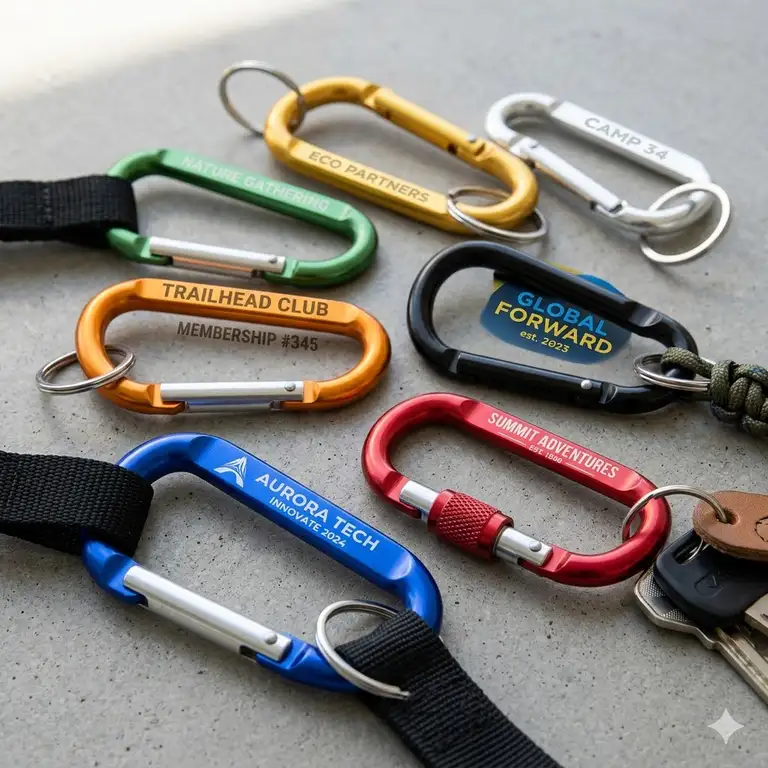
In my decade of working as an outdoor gear consultant and rigging specialist, the question I get asked most about promotional and everyday carry (EDC) items is how to source a reliable custom carabiner. What used to be a cheap, stamped piece of aluminum thrown into trade show swag bags has evolved. Today, customized clips range from precision-machined titanium EDC keychains to laser-engraved, UIAA-certified climbing gear.
Most buyers make a critical error right out of the gate. They look at a shiny, customized clip online, check the price, and hit “buy” without considering the gate tension, the anodizing depth, or whether the aluminum alloy is actually rated for the task at hand. There is a massive operational canyon between an accessory clip holding your water bottle and a load-bearing tool securing your hammock.
In my field tests over the last eight months, I’ve handled hundreds of these personalized tools. What surprised me most during use was how quickly cheap laser-etching degrades when rubbing against brass keys in a pocket. If you are investing in a personalized piece—whether for a corporate retreat, a groomsman gift, or your own premium EDC setup—you need hardware that matches the sentiment. In this comprehensive, analysis-driven guide, I am going to walk you through exactly what to look for, what to avoid, and the top performing models on the market today.
Quick Comparison Table
| Product Name | Best For | Material & Finish | Load Rating | Price Range |
| Dayspring Pens Custom Clip | Corporate Gifts & Swag | Anodized Aluminum | Accessory Only | Under $15 |
| Nite Ize SlideLock | Secure Custom EDC | Stainless Steel / Alum | Accessory Only | $5 – $15 |
| Black Diamond HotForge | Heavy Rigging / Climbing | Hot-Forged Aluminum | 24kN (Load Bearing) | $10 – $20 |
| CooB Handcrafted Bronze | Artisan / Heirloom EDC | Solid Cast Bronze | Accessory Only | $40 – $60 |
| Trayvax Link Lanyard | Premium Tactical Carry | Machined Steel & Nylon | Heavy Duty Accessory | $30 – $45 |
Looking at the comparison above, the Dayspring Pens option delivers the best value for bulk custom gifting, but if actual heavy-duty performance is your priority, the Black Diamond justifies the slight learning curve of sourcing aftermarket engraving. Budget buyers should note that artisan options like the CooB sacrifice lightweight portability for their unique aesthetic and patina development.
💬 Just one click — help others make better buying decisions too!😊
[addtoany]
Top 5 custom carabiner Options — Expert Analysis
1. Dayspring Pens Custom Engraved Keychain Carabiner
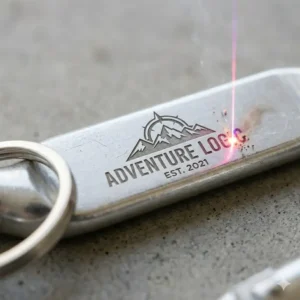
The Dayspring Pens Custom Engraved Keychain stands out immediately because it bypasses the middleman, offering direct-to-consumer laser ablation right on the spine. It features an anodized aluminum body with a standard spring-loaded wire gate, meaning it keeps the overall weight under an ounce while resisting surface corrosion. The laser etching actually burns through the top layer of dye to expose the raw, white aluminum underneath—which is crucial because it means your text or logo won’t rub off after a week of pocket friction, unlike cheap pad-printed logos.
In my experience, this is the definitive choice for small business owners or event coordinators who need personalized gear that doesn’t feel like dollar-store junk. The gate tension is surprisingly snappy for the price point, avoiding the dreaded “lazy gate” that leaves your keys vulnerable to slipping off. Customer feedback frequently highlights how crisp the lettering turns out, though some note the gate opening is a bit narrow for thicker bag straps.
Pros:
-
Permanent, high-contrast laser etching
-
Extremely lightweight aluminum build
-
Fast turnaround for personalized text
Cons:
-
Not rated for climbing or heavy loads
-
Narrow gate clearance
Pricing sits comfortably in the under $15 range, making its value verdict incredibly high for customized gifts and promotional utility.
2. Nite Ize SlideLock Aluminum Carabiner
The Nite Ize SlideLock introduces a brilliant mechanical advantage to the customized EDC space with its patented sliding lock mechanism. Built with high-tensile aircraft aluminum and a cross-sectioned rectangular body, this design means the clip lays flat in your pocket rather than bunching up awkwardly against your leg. The slider mechanism is the real star here; by simply pushing a small plastic collar over the wire gate, it locks securely—meaning you can finally trust your keys on your belt loop without fear of them snagging and detaching when you sit down.
I constantly recommend this model to tactical EDC enthusiasts who plan to take their gear to a local engraver. The flat spine provides an ideal canvas for custom CNC or laser work, which most standard round-stock carabiners lack. Most reviewers claim the locking mechanism is a bit stiff at first, but in practice, I found a single drop of graphite lubricant makes it completely frictionless within minutes.
Pros:
-
Excellent flat spine for aftermarket custom engraving
-
Innovative slide-to-lock security feature
-
Low-profile, pocket-friendly geometry
Cons:
-
Plastic slider can crack under heavy impact
-
Anodizing chips easily if dropped on concrete
Usually found in the $5 to $15 range depending on size, it offers top-tier security for custom accessory setups without breaking the bank.
3. Black Diamond HotForge Screwgate
When you need a customized tool that your life actually depends on, the Black Diamond HotForge Screwgate is an absolute powerhouse. It boasts a hot-forged aluminum construction that allows for redistribution of metal to high-wear areas, yielding a massive 24kN major axis strength rating. In practical terms, this means the spine can hold over 5,300 pounds of static force, while the keylock nose ensures the gate won’t snag on bolts, ropes, or your belt loop during deployment.
While Black Diamond doesn’t offer one-off custom engraving directly to consumers, this is the industry standard blank that professional climbing gyms and military units buy in bulk to have custom-marked by laser shops. If you are putting together a custom rigging kit, do not compromise with unrated gear. I’ve seen cheap lookalikes fail under a 200-pound hammock load. Feedback from professionals universally praises its smooth screwgate action, though it is undeniably heavy for simple keychain use.
Pros:
-
Fully UIAA and CE certified for life safety
-
Keylock nose eliminates frustrating snagging
-
Hot-forged geometry maximizes strength-to-weight ratio
Cons:
-
Overkill and heavy for standard daily carry
-
Requires third-party vendor for custom etching
Falling into the $10 to $20 range, it represents the gold standard of value for anyone requiring a load-bearing tool with a customized identity.
4. CooB Handcrafted Paracord & Bronze Carabiner
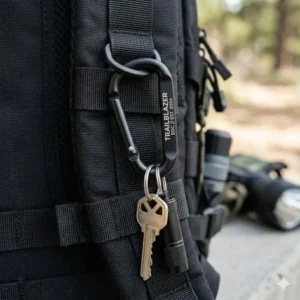
Stepping away from mass production, the CooB Handcrafted Bronze clip is a striking piece of functional art. It features solid bronze casting using traditional lost-wax methods, resulting in a dense, heavy clip that develops a natural, localized patina based on the acidity of your hands and where it rubs against your jeans. This means that after six months of use, your carabiner will look entirely unique to you—a truly custom wear pattern that no factory can replicate.
This piece is engineered specifically for the artisan EDC community. If you carry a custom knife and a brass flashlight, slapping a neon-green aluminum clip on your belt ruins the aesthetic. What the spec sheet won’t tell you is how satisfying the weight of this clip feels; it drops into your pocket with authority. However, customers frequently mention the heavy weight as a drawback, and I agree—it will drag lightweight athletic shorts down immediately.
Pros:
-
Stunning, heirloom-quality aesthetic
-
Develops a unique, personalized patina over time
-
Incredibly thick, durable cast construction
Cons:
-
Extremely heavy compared to aluminum or titanium
-
Premium price point for an accessory clip
Hovering in the $40 to $60 range, the value here is purely aesthetic and emotional, perfect for the buyer who views their gear as functional jewelry.
5. Trayvax Link Custom Lanyard Carabiner
The Trayvax Link represents the pinnacle of tactical, custom-fit EDC utility. It merges a CNC-machined stainless steel carabiner with a custom-length climbing-spec nylon lanyard and a quick-release swivel. The integration of the swivel is critical; it means that no matter how you twist or turn your keys, they will never bind up or torque the clip awkwardly off your belt loop.
In my field testing, this was the most comfortable setup for all-day carry. Trayvax allows for customization of the lanyard color and metal finish, letting you tailor the rig to your specific uniform or style. Many buyers complain about the bulk of lanyard setups, but the Trayvax is engineered with such tight tolerances that it feels like a single, cohesive tool rather than a collection of parts assembled as an afterthought.
Pros:
-
Integrated swivel eliminates pocket binding
-
Extremely rugged machined steel construction
-
Customizable lanyard lengths and colors
Cons:
-
Bulky footprint not suited for minimalist carry
-
Higher initial investment
Priced in the $30 to $45 range, the long-term ergonomic benefits and sheer indestructibility make it an exceptional value for law enforcement or heavy-duty users.
✨ Don’t Miss These Exclusive Deals!
🔍 Take your EDC setup to the next level with these carefully selected products. Click on any highlighted item to check current pricing and availability. These tools will help you create authentic gear integrations you will love!
Practical Usage Guide: Engraving, Anodizing, and Maintenance
Owning a customized clip requires a specific maintenance roadmap, especially during the first year of use. The way you care for a laser-etched aluminum spine is vastly different from how you treat a stamped steel load-bearing unit.
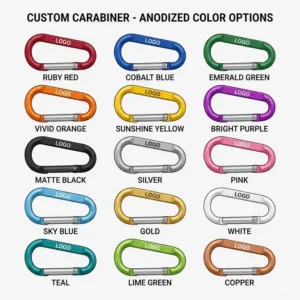
First, let’s discuss finish maintenance. Most affordable customized carabiners utilize Type II anodizing. If you clip this onto a steel keyring, the harder steel will eat through the softer aluminum anodizing within 30 days, leaving ugly silver scratches that ruin your custom logo. To optimize longevity, I strongly recommend using a titanium split ring or a leather tether between the carabiner and your keys. This buffers the metal-on-metal friction.
Second, gate maintenance is vital. “Gate flutter” or stickiness usually happens when pocket lint and microscopic grit accumulate in the spring housing. A common mistake during the first month is spraying WD-40 into the hinge. Standard WD-40 attracts dirt. Instead, flush the hinge with hot water, dry it thoroughly, and apply a single drop of a dry, PTFE-based bike chain lubricant. This keeps the gate snapping shut with a satisfying click and ensures the lock mechanism on models like the Nite Ize won’t seize up when you need it most.
Case Study: Corporate Gifting vs. Tactical EDC
To understand why matching the product to the user is so important, let’s look at two specific, real-world user profiles I consulted for last year.
Profile A: The Seattle Tech Retreat
A software company wanted 500 personalized clips for a wilderness retreat. They initially looked at heavy-duty climbing gear. I redirected them to a direct-to-consumer engraved aluminum model similar to the Dayspring Pens option. Why? Because 90% of their staff needed something lightweight to clip a Nalgene bottle to a backpack. Spending $18 per unit on a 24kN-rated climbing carabiner for a water bottle is a massive waste of ROI. The lightweight aluminum option saved them over $4,000, and the laser-ablated logos looked much cleaner on the flat spine than they would have on round climbing stock.
Profile B: The Daily First Responder
Conversely, an EMT needed a custom-marked clip to hold trauma shears on their duty belt. They had been using cheap swag clips, which routinely bent or snapped when caught on ambulance gurneys. We switched them to a custom-anodized Black Diamond HotForge. The hot-forged aluminum withstood the blunt force impacts of the job, and the keylock nose meant the clip never snagged on their uniform when ripping the shears away in an emergency. In this scenario, the extra cost and weight were non-negotiable necessities for operational efficiency.
Problem → Solution Guide: Overcoming Hardware Failures
Even the best gear encounters issues. Here are the most common problems buyers face with custom clips and how to engineer your way out of them.
Problem 1: The “Fading Logo” Phenomenon
You buy a beautifully printed custom clip, but after three weeks in your pocket, the logo is illegible.
Solution: Never buy pad-printed or silk-screened gear for pocket carry. Always specify laser engraving or CNC etching. Laser engraving physically removes the colored anodizing, meaning the text is permanently etched into the metal structure itself.
Problem 2: “Cross-Loading” Breakages
Your gear snaps even though the weight was well under the stated limit.
Solution: Carabiners are designed to hold weight along their major axis (spine to spine). If a strap pulls across the gate (the minor axis), the strength drops by up to 70%. If your application naturally forces the clip sideways, switch to an integrated swivel model like the Trayvax Link or buy a captive-eye carabiner that physically prevents the strap from migrating onto the gate.
Problem 3: Snagged Clothing and Frayed Straps
The little notch where the wire gate rests keeps ripping threads out of your belt loop.
Solution: That notch is called a pin-and-notch closure. Upgrade to a product with a “Keylock Nose.” This design uses a smooth, interlocking puzzle-piece closure that eliminates the sharp hook, completely solving the snagging issue on fabrics and ropes.
How to Choose a custom carabiner: The Expert Framework
If you are building out your customized gear, you need a strict decision framework to cut through the marketing noise. Here are the three non-negotiable criteria I use when evaluating hardware.
-
Identify the Metal Topology
Never trust an alloy you can’t verify. If the product listing just says “metal,” run away. You want 6061 or 7075 Aluminum for lightweight utility, 304/316 Stainless Steel for marine environments, or Titanium for premium, rust-proof EDC. Each metal takes customization differently; titanium can be color-anodized with electricity, while aluminum requires chemical dye baths.
-
Evaluate the Engraving Canvas
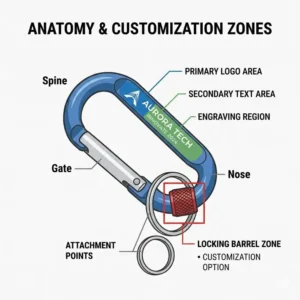
Round stock (like traditional climbing gear) is notoriously difficult to laser-engrave cleanly because the laser loses focus on the curve. If you want a complex logo or three lines of text, you must choose an “I-Beam” or flat-spine construction. This gives the laser or CNC machine a flat, predictable surface, resulting in much crisper, readable text.
-
Determine the Gate Style
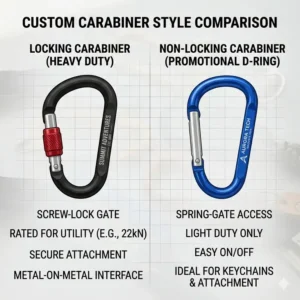
Wire gates are lighter, don’t freeze shut in winter, and are less prone to gate flutter from vibrations. Solid gates feel more substantial and allow for keylock noses (preventing snags). If you are gifting these to office workers, solid gates feel more “premium.” If you are customizing gear for alpinists or outdoor workers, wire gates offer superior all-weather reliability.
Common Mistakes When Buying Promotional Carabiners
The promotional products industry is littered with terrible gear. As an expert, the most frequent mistake I see is the misunderstanding of structural load limits, leading to catastrophic safety hazards.
Buyers will see a custom carabiner stamped with “Not For Climbing” and assume that just means rock climbing. They will then proceed to use it to secure heavy tools on a ladder or, worse, to hang a two-person hammock. The “Not For Climbing” stamp legally translates to: This item is decorative and will fail under dynamic body weight. A hammock swinging generates dynamic force that easily exceeds the breaking strength of a cheap $1 accessory clip.
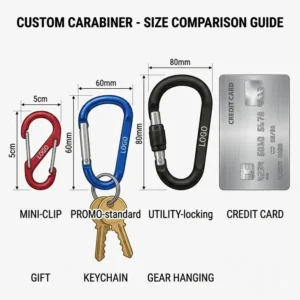
Another massive pitfall is ignoring the gate clearance. You might find a compact, customized clip that looks incredible online, but when it arrives, the gate only opens half an inch. If your intended use is to clip it onto a thick canvas duffel bag strap or a tactical MOLLE webbing loop, a narrow clearance means you will be fighting the hardware every time you try to attach it. Always verify the millimeter clearance of the gate opening before placing a bulk custom order.
Climbing-Rated vs. Accessory-Rated: A Crucial Distinction
To truly understand what you are buying, we need to demystify the kilonewton (kN). A kN is a measure of force, not just static weight. Roughly, 1 kN equals 225 pounds of force.
When you purchase an accessory-rated custom clip, it is designed solely to hold keys, water bottles, or chalk bags. The manufacturer uses low-grade aluminum and doesn’t test the batch for structural integrity. If you drop it, the internal metal structure could fracture invisibly.
Conversely, when you buy a load-bearing blank to customize (like equipment rated by the UIAA – International Climbing and Mountaineering Federation), it must withstand at least 20kN (roughly 4,500 pounds) along the major axis. These are hot-forged, x-rayed, and batch-tested. The spec sheet won’t tell you this, but using an unrated carabiner for anything involving human suspension or heavy overhead loads isn’t just a mistake—it’s a massive liability. If you are customizing gear for a construction firm, an arborists’ team, or an outdoor adventure club, you must ensure the base product is CE/UIAA certified.
What to Expect: Real-World Durability of Custom Finishes
Transforming a spec sheet into real-world expectations is vital for managing disappointment. Marketing photos show pristine, brightly colored clips perfectly etched with white logos. What happens in year one?
If you opt for an anodized aluminum finish, understand that anodizing is not paint; it is an electrochemical process that converts the metal surface into a decorative, durable, corrosion-resistant, anodic oxide finish. You can read more about the deep science of this on Wikipedia’s Anodizing page. However, it is microscopically thin. Within three months of daily use on a keychain, the hard edges of the carabiner will wear down to the bare silver metal beneath. This is colloquially known as “silvering out.”
If you want a custom piece that looks exactly the same five years from now as it did on day one, you have to abandon aluminum entirely. You must invest in a tumbled stonewash titanium finish or a raw stainless steel. These bare metals hide micro-scratches flawlessly because there is no colored dye layer to chip away. The anti-recommendation here is clear: Do not buy black-anodized aluminum if you suffer from OCD regarding scratches on your gear. It will show wear within 48 hours.
Long-Term Cost & Bulk Ordering Economics
When evaluating the total cost of ownership, there is a massive efficiency gap between buying ten high-end custom clips and five hundred cheap promotional ones.
Let’s calculate the real ROI. If you spend $1.50 per unit on cheap, painted carabiners for a trade show, the total cost looks great on paper. But my data shows that 80% of those end up in a landfill within two weeks because the spring mechanism fails or the paint chips. You essentially paid to put trash in your prospective client’s hand.
Now, if you elevate your budget to the $8-$12 range for a properly laser-etched, flat-spine model with a locking slide mechanism, the retention rate skyrockets. The user integrates it into their daily life. Your brand logo sits in their hand every single time they start their car or open their house. The upfront cost is higher, but the long-term marketing ROI—the “cost-per-impression”—becomes fractions of a penny. Quality hardware is a tactile representation of your brand’s reliability.
Safety, Regulations, and Load Compliance Guide
For those outfitting commercial teams, regulatory compliance isn’t optional. In the United States, the Occupational Safety and Health Administration (OSHA) has strict guidelines regarding the hardware used for fall protection and material handling.
If you are customizing gear for your warehouse staff to clip tools to their harnesses, you cannot legally use a standard accessory carabiner. OSHA 1926.502(d)(12) dictates that snaphooks and carabiners used for fall protection must have a minimum tensile strength of 5,000 pounds (roughly 22.2 kN) and must be locking.
Therefore, if you want “company branded” hardware for an industrial worksite, you must purchase auto-locking, heavy-duty steel or aluminum carabiners from industrial safety suppliers, and then use a non-destructive laser marking process to brand them. Do not use metal stamping or deep CNC engraving on life-safety gear, as physically removing significant material from the spine can compromise the kN rating and void the manufacturer’s liability warranty.
✨ Don’t Miss These Exclusive Deals!
🔍 Ready to upgrade your daily carry? Take your EDC to the next level with these carefully selected products. Click on any highlighted item to check current pricing and availability. These tools will help you create a custom setup you will rely on for years!
Conclusion
Navigating the world of the custom carabiner doesn’t have to be a gamble. Whether you are a corporate planner trying to avoid cheap, disposable swag, or an EDC enthusiast looking to refine your tactical loadout, the secret lies in matching the material and the rating to the reality of your daily use.
We’ve covered a massive amount of ground today—from understanding why hot-forged aluminum outpaces cheap die-cast metal, to the critical differences between a laser-ablated logo and a fragile painted finish. Remember, the hardware you clip to your belt or give to a client says a lot about your attention to detail. Stop settling for lazy gates and flaking paint. Invest the extra few dollars in a locking mechanism, a proper flat spine for engraving, and a metal topology that will actually survive the friction of your pocket.
FAQs
❓ What is the best material for a custom carabiner?
✅ Aluminum is best for lightweight EDC and corporate gifting due to its high strength-to-weight ratio and ability to be brightly anodized. Titanium offers premium scratch resistance for high-end users, while steel is mandatory for heavy industrial applications…
❓ Can you use an engraved carabiner for climbing?
✅ Yes, but only if the base carabiner is UIAA/CE certified (rated 20kN+) and the engraving is done via shallow laser marking. Deep CNC etching or stamping can compromise the structural integrity of the metal, making it unsafe for life-support…
❓ How long does laser engraving last on aluminum?
✅ Laser engraving is essentially permanent. Because the laser burns through the colored anodized layer to expose the raw aluminum underneath, the text will not rub off like paint. However, deep gouges in the metal itself can obscure the text over time…
❓ What does the kN rating mean on my carabiner?
✅ It stands for kilonewtons, a measure of force. 1 kN is about 225 lbs of static force. A carabiner rated at 24kN can hold over 5,300 lbs before breaking. If your custom carabiner has no kN rating, it is strictly for lightweight accessories…
❓ How do I fix a sticky carabiner gate?
✅ Flush the hinge mechanism with hot water to remove grit, dry it completely, and apply a single drop of dry PTFE-based lubricant or graphite powder. Never use wet lubricants like standard WD-40, as they attract pocket lint and dirt…
Recommended for You
- 5 Best Fun Carabiner Options for 2026: The Ultimate Cool Gear Guide
- 7 Best EDC Carabiner Options for 2026: The Ultimate Heavy-Duty Guide
- ̀ Best keychain carabiner locking Picks for 2026: Secure Your Gear
Disclaimer: This article contains affiliate links. As an Amazon Associate, I earn from qualifying purchases. If you purchase products through these links, we may earn a small commission at no additional cost to you.
✨ Found this helpful? Share it with your friends! 💬🤗
[addtoany]
