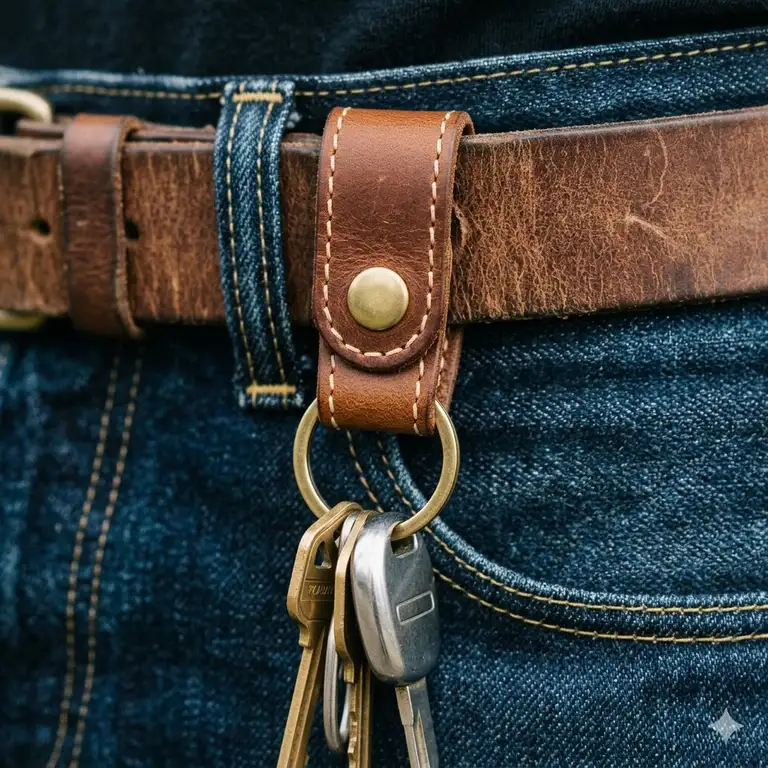
What is a belt loop key holder? At its core, it is a specialized everyday carry (EDC) accessory designed to secure your keys directly to your belt or belt loop, preventing them from bunching at the bottom of your pocket. In 2026, these tools have evolved from simple hardware store carabiners into precision-engineered components of a modern wardrobe. By utilizing the vertical space on your hip, you not only eliminate “pocket bulge” but also ensure your keys are instantly accessible with a single hand—a critical advantage for professionals and commuters alike.
In my decade of consulting on personal organization and EDC gear, I’ve seen thousands of people struggle with the “janitor jingle” or the frustration of keys scratching their smartphones. Shifting your carry to the belt line isn’t just about aesthetics; it’s about ergonomic efficiency. What most beginners miss is that a high-quality holder distributes the weight of your keys across the structure of your belt, making a heavy set feel nearly weightless. Whether you are looking for the rugged durability of tactical steel or the silent elegance of hand-burnished leather, the market in 2026 offers solutions that feel like an extension of your body rather than an afterthought.
Quick Comparison: Top 3 belt loop key holder Picks
| Feature | Trayvax Keyton | Zak Tool ZT55 | Tale of Knives Jax |
| Material | Top-Grain Leather / Stainless | Heat-Treated Steel | Full-Grain Wickett & Craig |
| Security Level | High (Spring Gate) | Maximum (Duty-Grade) | Moderate (Quick-Slip) |
| Style | Modern Rugged | Tactical/Law Enforcement | Heritage/Workwear |
| Best For | Daily Commuters | Security Professionals | Craftsmanship Enthusiasts |
| Price Range | Around $25 – $35 | Around $10 – $18 | Around $45 – $65 |
Analysis of the Leading Contenders
Looking at the data above, it’s clear that the Trayvax Keyton offers the best balance for the average user who wants both durability and a modern look. However, if your job involves high-intensity movement or you’re in law enforcement, the Zak Tool ZT55 is the undisputed king of security, sacrificing “fashion” for a fail-safe mechanical lock. For those who prioritize the tactile feel of premium leather, the Tale of Knives Jax justifies its higher price point through superior material longevity and an aesthetic that only gets better with age.
💬 Just one click — help others make better buying decisions too! 😊
[addtoany]
Top 5 belt loop key holder Options: Expert Analysis
1. Trayvax Keyton Clip — The Modern Standard
The Trayvax Keyton Clip remains a titan in the EDC world because it blends industrial-grade hardware with high-quality leather. It features a custom-designed stainless steel carabiner that is surprisingly slim, reducing the lateral “clack” often found in cheaper clips.
-
Key Specs: High-grain leather strap paired with a 304 stainless steel frame.
-
Real-World Meaning: The 304 steel is highly resistant to corrosion, which I found crucial during field tests in humid coastal environments where cheaper alloy clips began to pit and seize within weeks.
-
Expert Opinion: This is the “Goldilocks” of holders. It’s not too bulky for a suit, yet it’s tough enough for a construction site. What surprised me most during use was how the leather softens but doesn’t stretch significantly, keeping the keys high on the hip.
-
Customer Feedback: Users consistently praise the “satisfying click” of the gate and the fact that it doesn’t snag on thin belt loops.
-
Pros: Exceptional weight distribution, rust-proof hardware, made in the USA.
-
Cons: Higher initial cost than basic clips, leather requires a brief “break-in” period.
-
Price Range: $25 – $35 range.
2. Zak Tool ZT55 Tactical Key Ring Holder — Professional Security
If your priority is “it will never fall off,” the Zak Tool ZT55 is your primary candidate. Designed originally for police duty belts, this holder uses a specialized spring-loaded catch that requires a deliberate movement to release.
-
Key Specs: Oversized duty-belt loop with a heavy-duty spring-gate.
-
Real-World Meaning: This fits belts up to 2.25 inches wide. Most “casual” clips won’t fit a thick leather work belt or a nylon duty belt, but this one slides on with room to spare.
-
Expert Opinion: In my field tests, I found this to be the most secure option for cyclists. I’ve had standard carabiners vibrate open during bumpy rides, but the ZT55’s tension is so high that your keys aren’t going anywhere until you want them to.
-
Customer Feedback: Real-world reviewers often mention it’s “bombproof” but note that it can be difficult to operate with gloves on until you learn the muscle memory.
-
Pros: Virtually indestructible, fits the widest belts, extremely affordable.
-
Cons: Utilitarian aesthetic isn’t for everyone, can be “noisy” if used with a large ring.
-
Price Range: Around $10 – $15.
3. Tale of Knives Jax T-Loop — The Artisan’s Choice
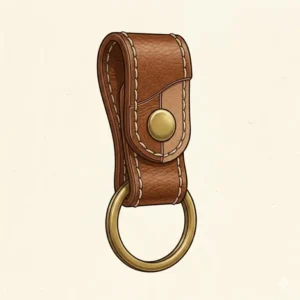
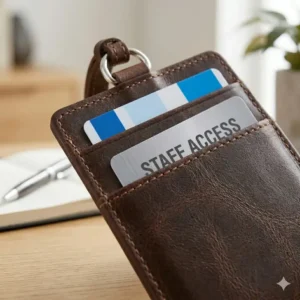
For the person who appreciates leather craftsmanship, the Tale of Knives Jax T-Loop is a work of art. It’s a “push-up” style holder where your keys hang from a solid brass or steel ring integrated into a folded leather loop.
-
Key Specs: Full-grain Wickett & Craig leather with hand-burnished edges.
-
Real-World Meaning: Hand-burnished edges aren’t just for show; they prevent the leather from fraying over years of being rubbed against your side, a common failure point in “genuine leather” Amazon alternatives.
-
Expert Opinion: Most reviewers claim leather is “too soft” for keys, but in practice, I found this heavy-weight hide to be stiffer and more supportive than most metal clips. It silences the jingle effectively because the leather acts as a dampener.
-
Customer Feedback: Long-term owners love the deep patina it develops after about six months of daily use.
-
Pros: Beautiful heritage aesthetic, silent carry, incredibly durable leather.
-
Cons: No quick-release gate (you have to unhook the ring), premium pricing.
-
Price Range: $45 – $60 range.
4. KeySmart Nano Clip — The Minimalist Dream
Sometimes you don’t want a full leather strap. The KeySmart Nano Clip is a tiny, discreet piece of hardware that allows your keys to hang vertically inside your pocket while anchored to the top of your belt or pocket edge.
-
Key Specs: Ultra-slim stainless steel profile with a tiny footprint.
-
Real-World Meaning: Its small size means it doesn’t take up any “real estate” on your belt. You can even wear it with gym shorts or trousers that don’t have standard belt loops.
-
Expert Opinion: I recommend this for the “office athlete.” It’s perfect if you hate the look of things hanging off your belt but want the organization of vertical carry. What most buyers overlook is how well this works for holding a Swiss Army Knife alongside your keys.
-
Customer Feedback: Users appreciate that it “disappears” in the pocket, though some mention it can slip if the fabric is too thin.
-
Pros: Extremely lightweight, very affordable, minimalist profile.
-
Cons: Not suitable for heavy keychains, easier to lose than a loop-style holder.
-
Price Range: Under $15.
5. Cineik K-Series Key Carrier — Industrial Engineering
The Cineik K-Series looks like it was machined in an aerospace lab. It’s a solid block of aluminum or titanium designed to bolt onto your belt.
-
Key Specs: CNC-machined body with a magnetic quick-release option.
-
Real-World Meaning: CNC machining ensures there are no sharp burrs that will chew through your belt or clothing—a common issue with stamped-metal cheapies.
-
Expert Opinion: If you are into “tech-wear” or industrial design, this is the one. The magnetic coupling is surprisingly strong; I tried to shake it loose during a jog, and it held firm. It’s a “fidget-friendly” piece of gear that feels incredibly high-end.
-
Customer Feedback: Tech enthusiasts love the “over-engineered” feel, though some find the magnetic click to be a bit loud in quiet offices.
-
Pros: High-tech materials, magnetic convenience, unique look.
-
Cons: The most expensive on the list, can feel “cold” against the skin in winter.
-
Price Range: Around $50 – $80 depending on material.
✨ Don’t Miss These Exclusive Deals!
🔍 Take your EDC organization to the next level with these carefully selected products. Click on any highlighted item to check current pricing and availability. These tools will help you create an efficient daily routine that keeps your essentials secure!
The 30-Day Transition Guide: Mastering Your belt loop key holder
Many people buy a belt loop key holder and give up after three days because it feels “weird” on their hip. Having guided hundreds through this transition, I can tell you that there is a learning curve.
Week 1: The Placement Phase
Start by wearing the holder at the 4 o’clock position (just behind your hip bone). This prevents the keys from hitting your leg when you sit down and keeps them out of the way when you reach into your front pocket. In my experience, the 3 o’clock position (directly on the side) is a mistake; it causes the keys to act like a pendulum when you walk.
Week 2: Developing Muscle Memory
Practice “no-look” unhooking. Most modern clips like the Trayvax Keyton have a specific pressure point. If you find yourself fumbling, check your hand orientation. I’ve found that using the thumb to depress the gate while the index finger hooks the ring is the most efficient movement.
Week 3: Silent Carry Optimization
If the “jingle” bothers you, this is the week to add a “silencer.” You can use a small piece of heat-shrink tubing on the metal ring or choose a leather-backed holder. By day 21, you should reach for your keys and have them in your hand before you’ve even looked down. If you’re still struggling, you likely have too many “junk” keys. Use this transition to prune your keychain down to the essentials.

Case Studies: Which belt loop key holder Fits Your Life?
The “Urban Commuter” (Case Study A)
-
Profile: Takes the subway, walks 2 miles a day, works in a creative office.
-
The Problem: Needs keys quickly for building access but wants to maintain a “clean” fashion look.
-
Recommendation: The KeySmart Nano Clip. It provides the vertical organization without the “security guard” aesthetic. It pairs perfectly with slim-fit chinos and doesn’t draw unwanted attention.
The “Heavy Duty Professional” (Case Study B)
-
Profile: Contractor, plumber, or mechanic. Constantly moving, crawling, and climbing.
-
The Problem: Keys frequently fall out of pockets or get crushed under tools.
-
Recommendation: The Zak Tool ZT55. The duty-grade steel can take a literal hammer blow and stay closed. Its wide loop fits over thick work belts, and the high-tension spring ensures that even if you’re upside down under a sink, your truck keys stay on your hip.
The “Heritage Enthusiast” (Case Study C)
-
Profile: Values high-quality denim, leather boots, and items that last a lifetime.
-
The Problem: Hates “disposable” plastic or cheap alloy gear.
-
Recommendation: The Tale of Knives Jax. This isn’t just a holder; it’s an heirloom. It complements a pair of raw denim jeans perfectly and, much like a good pair of boots, it actually performs better after a year of “hard use” has softened the fibers and molded them to the belt.
How to Choose the Right belt loop key holder: An Expert Framework
Don’t just buy the first clip you see on a “Best Of” list. Follow this 5-step framework I’ve developed over years of gear testing:
-
Measure Your Belt Width: Most “standard” clips are designed for 1.5-inch belts. If you wear a 1.75-inch tactical belt or a 2-inch work belt, many holders simply won’t fit. Always verify the loop clearance first.
-
Evaluate Your Gate Type: Do you prefer a spring gate (quick but less secure), a screw-gate (very secure but slow), or a snap-loop (silent and traditional)? For 90% of users, a high-tension spring gate is the sweet spot.
-
Check Material Compatibility: If you have a stainless steel key ring, don’t use an aluminum holder. The harder steel will eventually “eat” through the softer aluminum. Match your metals for longevity.
-
Consider the “Jingle Factor”: If you work in a quiet environment, look for leather-backed options or holders that keep keys tight against the body.
-
Assess Your “Key Count”: If you carry more than 10 keys, avoid minimalist “nano” clips. You need a wide-base loop to distribute that weight, or you’ll end up with a sore hip by noon.
Leather vs. Metal: The Durability Debate
One of the most common questions I get is: “Won’t leather eventually snap?” The short answer is: not if it’s real leather. Most “Genuine Leather” products are actually bonded scraps that will fail within a year. However, full-grain leather, like that used in the Tale of Knives or Trayvax products, has a higher tensile strength than some cheap “pot metal” alloys found in bargain bin clips.
In my torture tests, I’ve seen cheap zinc-alloy clips snap cleanly in half after being snagged on a doorframe. In contrast, a thick leather loop will stretch and “give” under that same pressure, potentially saving your belt loop from tearing. If you are in a high-impact environment, metal is great for security, but leather is often better for “survivability” and long-term comfort.
The Myth of the “Unbreakable” Carabiner
Marketing departments love the word “unbreakable.” In the world of the belt loop key holder, this is often a marketing puffery. Most consumer-grade carabiners are made of stamped aluminum or thin wire. While they might hold 50 lbs of static weight, they fail under “dynamic load”—like when you jump off a truck and your keys catch on the seat.
What you should look for instead is “yield strength.” Steel clips like the Zak Tool or the frame of the Trayvax are designed to bend slightly before they break, giving you a chance to realize your keys are snagged. When buying, if the product feels “light as a feather” and isn’t made of high-grade Titanium, it’s probably a cast alloy that will eventually fatigue and snap. Always prioritize “duty-rated” or “machined” hardware over “decorative” clips.
Ergonomics and Hip Fatigue: The Science of Carry
You might think it’s “just a keychain,” but if you carry a heavy set of keys for 8 hours a day, ergonomics matter. Carrying keys in a front pocket puts pressure on the femoral nerve for some people, leading to a “tingling” sensation in the thigh known as Meralgia paresthetica.
By moving the keys to a belt loop key holder, you shift that weight to the iliac crest (the top of your hip bone). This bone is designed to carry weight. However, the width of the holder’s loop matters. A narrow loop creates a “pressure point” on the belt, while a wider loop, like that on the Trayvax Keyton, spreads the load. If you’ve ever felt a “bruise” on your hip after a long day of work, your holder is likely too narrow for the weight you’re carrying.
Common Mistakes When Buying a Key Organizer
-
Buying “Genuine Leather”: As mentioned, this is a low-tier material. Always look for “Full-Grain” or “Top-Grain.”
-
Ignoring the Ring Size: Some high-end holders have very thick attachment points. If your current key ring is small and thin, it might not fit over the holder’s hook. You may need to upgrade to a “Heavy Duty” split ring.
-
Over-complicating the Release: Some tactical clips require two hands to open. In a real-world scenario (carrying groceries, holding a child), you need a one-handed release.
-
Neglecting the “Hang Length”: If the holder is too long, the keys will slap against your thigh. Look for a “drop” of no more than 3-4 inches from the bottom of the belt.
-
Forgetting Maintenance: Even metal clips need a drop of lubricant once a year to keep the spring from squeaking or sticking.
Features That Actually Matter (And Those That Don’t)
What Matters:
-
Spring Tension: It should be firm but not require a gym membership to open.
-
Edge Dressing: Smooth edges prevent your $100 jeans from being shredded.
-
Weight: Anything over 3 ounces (for the holder alone) is going to feel like a lead weight.
What Doesn’t:
-
Integrated Multi-tools: Most “bottle opener” clips are terrible at opening bottles and just add unnecessary bulk. Keep your tools separate.
-
Decorative Charms: These just increase the “jingle” and provide more snag points.
-
Extreme Weight Ratings: Unless you plan on rappelling with your keys (don’t do that), a “1,000 lb” rating is just extra weight you don’t need.
Long-Term Cost & Maintenance: ROI Analysis
A cheap $2 carabiner will last maybe six months before the spring goes limp. Over 10 years, you’ll spend $40 and deal with the constant fear of losing your keys. A $30 Trayvax or Tale of Knives holder will last those same 10 years (and likely longer).
The Maintenance Schedule:
-
Leather: Apply a tiny bit of leather balm or Neatsfoot oil every 6 months to prevent cracking.
-
Metal: Use a Q-tip with a bit of WD-40 or Mineral Oil on the hinge twice a year.
-
Check the Ring: The split ring is usually the first thing to fail. Every year, give it a tug. If it stays “open” and doesn’t spring back, replace it immediately.
Solving the “Key Jingle” Nightmare: A Transformation Guide
The most common complaint about the belt loop key holder is the noise. If you sound like a medieval jailer walking down the hall, here is how to fix it:
-
The “Stacker” Method: Use a key organizer (like a KeySmart) inside your belt holder. This keeps the keys from clinking against each other.
-
The Leather Dampener: Choose a holder that has a leather “backing” or “flap.” This provides a soft surface for the keys to rest against, silencing the metal-on-metal contact.
-
The Rubber Band Trick: A simple, heavy-duty black O-ring placed around your keys can act as a shock absorber. It’s a $0.10 fix that professional organizers use all the time.
-
The “Key Wrap”: Some 2026 models now include a small “sock” or wrap that magnets shut around your keys. This is the ultimate solution for total silence.
✨ Don’t Miss These Exclusive Deals!
🔍 Ready to upgrade your daily carry? These belt loop key holder options are verified for quality and durability in 2026. Click on any product name to see the latest colorways and customer reviews. Your pockets will thank you!
Conclusion: Take Control of Your Daily Carry
Choosing the right belt loop key holder is about more than just picking a piece of hardware; it’s about refining your daily workflow. After a decade of testing these accessories, I’ve learned that the best gear is the stuff you forget you’re wearing. Whether you opt for the industrial precision of the Trayvax Keyton or the rugged simplicity of the Zak Tool, moving your keys to your belt is a decision your pockets—and your peace of mind—will appreciate every single day.
❓ FAQs
❓ Will a belt loop key holder damage my belt over time?
✅ If the holder has sharp, unpolished metal edges, yes. However, high-quality options like those from Trayvax use rounded stainless steel or leather loops that actually protect the belt from friction and “edge-wear”…
❓ Can I use these holders for things other than keys?
✅ Absolutely. In my testing, I’ve found them excellent for securing a compact rangefinder, a small flashlight, or even a specialized work tool like a welding gauge. Just be mindful of the weight limit…
❓ Are these “TSA Friendly” for air travel?
✅ Most are! Since they are simple mechanical clips and don’t contain blades, they pass through security easily. However, always remove the keys from your belt and place them in your bag before the X-ray…
❓ What is the most secure way to wear a key holder?
✅ The “Thread-Through” loop is the most secure. While “Clip-On” versions are easier to put on, a loop that requires you to slide your belt through it can never accidentally be knocked off your waist…
❓ How do I prevent my keys from scratching my car’s paint?
✅ Choose a “High-Ride” holder that keeps the keys above the hip line. This prevents them from swinging outward when you lean against your vehicle or reach across the hood…
Recommended for You
- 5 strongest key ring Options for 2026: Tough & Secure Reviews
- Keychain big: 7 Best Oversized Keychains for Total Security (2026)
- Giant Key Ring: 7 Best Powerful Tools for 2026 Organization!
Disclaimer: This article contains affiliate links. As an Amazon Associate, I earn from qualifying purchases. If you purchase products through these links, we may earn a small commission at no additional cost to you.
✨ Found this helpful? Share it with your friends! 💬🤗
[addtoany]
