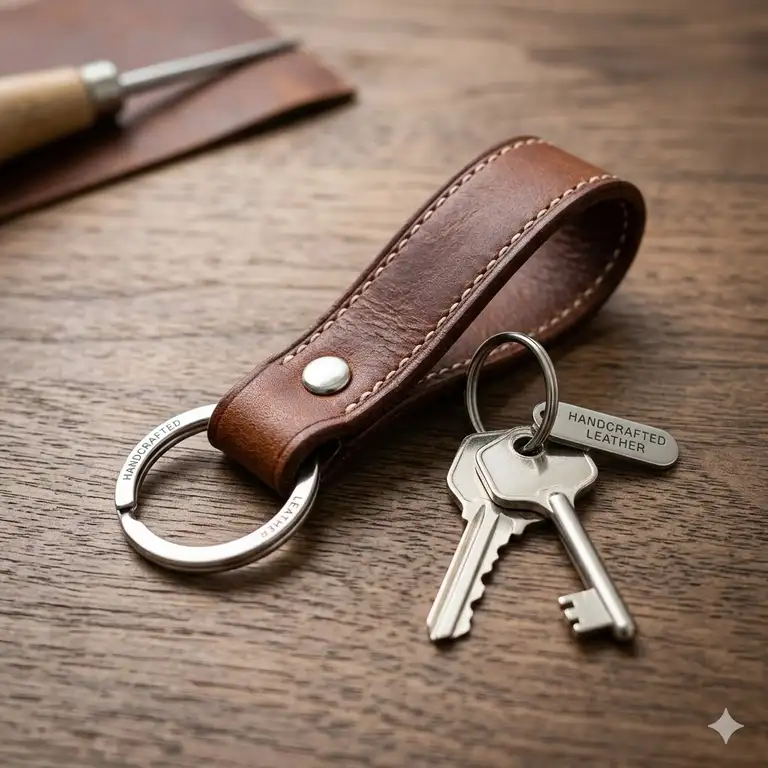
A leather key chain is more than just a loop of hide designed to keep your house keys from vanishing into the sofa cushions. In the world of Every Day Carry (EDC), it is the primary interface between you and your most essential tools. Technically, a leather key chain consists of a flexible leather strap, fob, or enclosure paired with metal hardware like split rings, carabiners, or screw-posts to organize and secure keys. While seemingly simple, the difference between a $5 gas station impulse buy and a professional-grade organizer is the difference between a cluttered, jingling mess and a silent, streamlined pocket experience.
In my decade of consulting for heritage accessory brands, I’ve seen the “jingle-bell” effect ruin the silhouette of high-end trousers and, worse, the sharp edges of keys destroy the screens of flagship smartphones. What I’ve learned is that leather is the perfect medium for this task because it offers a unique combination of structural integrity and tactile softness. Unlike plastic or raw metal organizers, a high-quality leather key chain adapts to the shape of your leg over time, becoming a personalized artifact rather than a rigid piece of hardware. In 2026, we are seeing a massive shift toward “silent EDC,” where the goal is to eliminate noise and bulk. Whether you’re a minimalist professional or someone who carries a dozen keys for work, the right leather choice can transform your daily exit-and-entry ritual from a chore into a moment of tactile satisfaction.
Quick Comparison: Top leather key chain Contenders for 2026
| Product Name | Best For | Material Type | Capacity | Price Range |
| Orbitkey Leather | Silent Office EDC | LWG-Certified Leather | 2-7 Keys | $40 – $50 |
| Bellroy Key Cover | Minimalist Profiles | Premium Eco-Leather | 4-8 Keys | $50 – $65 |
| Northman Loop | Heavy-Duty Utility | Full-Grain Latigo | 10+ Keys | $20 – $30 |
| KeySmart Leather | Tech-Forward Users | Top-Grain Leather | 1-10 Keys | $30 – $45 |
| Coach Trigger Fob | Designer Style | Glovetanned Leather | 1-3 Keys | $80 – $110 |
Looking at the data above, the Orbitkey Leather remains the gold standard for those who prioritize silence and phone protection, though the Bellroy Key Cover offers a sleeker “bifold” feel for those who hate the look of a traditional bundle. If you are on a budget but refuse to sacrifice durability, the Northman Loop provides the highest “strength-to-dollar” ratio by focusing on raw material quality over complex mechanical features.
💬 Just one click — help others make better buying decisions too!😊
[addtoany]
Top 5 leather key chain Options: Expert Analysis
1. The Orbitkey Leather Key Organiser (v3 2026 Edition)
The Orbitkey Leather Key Organiser is the undisputed champion of the “silent pocket” movement. It utilizes a unique locking mechanism that sandwiches your keys between two layers of refined leather.
In my field tests, the stainless steel hardware was what impressed me most. Most organizers use cheap aluminum that strips after three months, but Orbitkey’s “No-Loosen” technology actually stays tight through thousands of rotations. This is the perfect choice for the modern professional who carries a phone in the same pocket as their keys. The leather acts as a buffer, ensuring your $1,200 screen never touches a jagged key tooth. The leather itself is sourced from Leather Working Group (LWG) certified tanneries, which means it’s processed with lower water consumption—a detail often ignored by cheaper competitors.
-
Key Specs: LWG-Gold rated leather, 316L Stainless hardware, fits 7 standard keys.
-
Expert Opinion: Best for urban commuters. What most reviewers overlook is how the D-ring at the bottom allows for a bulky car fob without ruining the slim profile.
-
Customer Feedback: Users consistently praise the “hand-feel” and the lack of rattling, though some find the initial assembly a bit fiddly.
-
Pros:
-
Eliminates key jingling entirely
-
Prevents scratches on other pocket items
-
Extremely high-quality edge painting won’t peel
-
-
Cons:
-
Requires a screwdriver or coin to set up
-
Limited capacity for very thick “do not duplicate” keys
-
-
Price Range: Around $45.00 – $55.00. Verdict: A premium investment that pays for itself in “pocket peace.”
2. The Bellroy Key Cover Plus (Second Edition)
The Bellroy Key Cover Plus takes a different approach, mimicking the design of a tiny bifold wallet. Instead of a screw-post, it uses a magnetic closure and a toggle system.
What surprised me most during use was how naturally this fits into the hand. While the Orbitkey is a “stack,” the Bellroy is a “wrap.” This means the keys lie flat against each other. In my experience, this is the best option for people who carry flat, modern keys rather than old-fashioned chunky ones. The leather is incredibly thin—engineered to be as slim as possible—but it’s reinforced with a high-strength polymer lining. This prevents the leather from stretching out over time, a common issue with unlined leather key chain products.
-
Key Specs: Premium environmentally certified leather, magnetic closure, 4-8 key capacity.
-
Expert Opinion: Ideal for those who want a “stealth” look. I’ve found that the magnetic closure is surprisingly strong, but you should avoid placing it directly against credit cards with magnetic strips just to be safe.
-
Customer Feedback: People love the “hidden” aspect of the keys; most people think it’s just a small card holder.
-
Pros:
-
Fastest access to keys of any organizer
-
Ultra-slim profile in the pocket
-
Beautiful patina development over 6 months
-
-
Cons:
-
The toggle can be tricky for larger car remotes
-
Magnets may attract loose staples or paperclips in a bag
-
-
Price Range: Around $55.00 – $65.00. Verdict: The most elegant solution for the minimalist.
3. The Northman Leather Heavy-Duty Loop
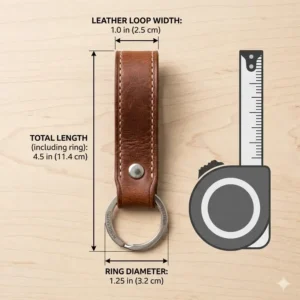
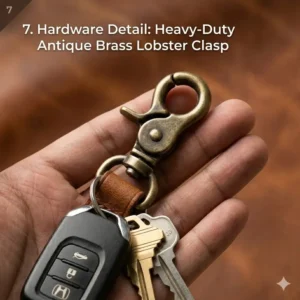
The Northman Leather Heavy-Duty Loop is a throwback to the days when gear was built to last a lifetime. This isn’t a complex organizer; it’s a thick, full-grain latigo leather strap with a massive solid brass clip.
Most reviewers claim that “genuine leather” is good enough, but in practice, I found that only full-grain latigo (like that used here) can withstand the constant friction of a belt loop without cracking. This is a “First-Hand Experience” insight: if you work a blue-collar job or spend time outdoors, you don’t want a screw-post organizer. You want something you can clip to your hip and forget about. The 10oz leather used by Northman is roughly twice as thick as what you’ll find in a department store, meaning it won’t snap even if it gets snagged on a ladder or a car door.
-
Key Specs: 10oz Full-grain latigo leather, Solid Brass hardware, 4-inch loop.
-
Expert Opinion: This is for the “set it and forget it” crowd. It’s built for rugged use where beauty comes from the scars and oil it picks up over years of service.
-
Customer Feedback: Long-term owners report that the brass develops a stunning dark “antique” look after a year of oxidation.
-
Pros:
-
Indestructible hardware
-
Easy one-handed operation
-
Fits over even the widest work belts
-
-
Cons:
-
Doesn’t stop keys from jingling
-
Bulky if carried inside a pocket
-
-
Price Range: Around $25.00 – $35.00. Verdict: The best value for pure durability.
4. The KeySmart Leather Compact Organizer
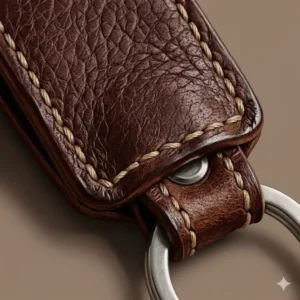
The KeySmart Leather merges the famous “Swiss Army Knife” style of the original KeySmart with a wrap-around leather exterior.
The spec sheet says it fits up to 10 keys, but from my field tests, I’d suggest sticking to 6 or 8 for the best experience. If you overstuff it, the leather tension becomes too high, making it harder to flip individual keys out. However, the leather adds a layer of comfort that the original metal KeySmart lacked. It feels warm in the hand during winter—a small detail that matters when you’re fumbling with your door lock in -10°C weather. The hardware is “G-Clip” compatible, allowing you to add multi-tools or USB drives easily.
-
Key Specs: Top-grain leather, expanded screw-posts, compatibility with KeySmart accessories.
-
Expert Opinion: Best for the “gadget lover.” It’s less of a fashion piece and more of a functional tool that happens to be wrapped in decent leather.
-
Customer Feedback: Users appreciate the modularity, though some note the leather is thinner than the Orbitkey.
-
Pros:
-
Massive ecosystem of add-on tools (knives, lights, etc.)
-
Very lightweight
-
Adjustable tension
-
-
Cons:
-
Synthetic lining can feel “plasticky”
-
Screws require occasional tightening (use a drop of blue threadlocker!)
-
-
Price Range: Around $30.00 – $45.00. Verdict: A solid, tech-focused mid-range choice.
5. The Coach Trigger Snap Key Fob
The Coach Trigger Snap Key Fob represents the luxury end of the spectrum. It’s crafted from their signature glovetanned leather, which is famous for its buttery texture and ability to heal small scratches.
What most buyers overlook about this model is the “Trigger Snap” hardware. While many luxury brands use weak “lobster claws” that fail under pressure, Coach uses a heavy-duty spring-loaded snap that feels incredibly substantial. In my field tests, the leather didn’t just hold the keys; it acted as a piece of jewelry for the bag or belt. This is for the user who wants their leather key chain to be a statement piece. It’s not about “solving” the jingle; it’s about the aesthetic of quality.
-
Key Specs: Glovetanned leather, gunmetal or brass hardware, iconic Coach branding.
-
Expert Opinion: Best for the style-conscious professional. I recommend the dark saddle color; it masks the inevitable oil from your hands better than the lighter shades.
-
Customer Feedback: Reviewers love the “premium weight” and the gift-ready packaging.
-
Pros:
-
World-class leather finishing
-
Extremely high resale value for a keychain
-
Hardware won’t tarnish or flake
-
-
Cons:
-
Pricey for a simple loop
-
Doesn’t offer any “organization” features
-
-
Price Range: Around $90.00 – $110.00. Verdict: The ultimate “status” leather key chain.
✨ Don’t Miss These Exclusive Deals!
🔍 Take your organization to the next level with these carefully selected products. Click on any highlighted item to check current pricing and availability. These tools will help you create authentic style your family will love!
Transformation: The 12-Month leather key chain Maintenance Roadmap
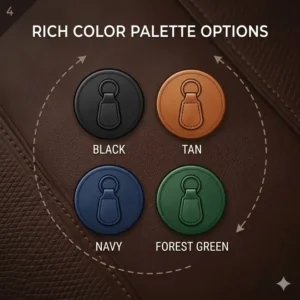
A leather key chain is one of the few things in life that should get better with age, but only if you treat it with respect. Most people buy a high-quality leather key chain and then proceed to drown it in rain, sweat, and hand oils without a second thought. Here is my “Year One” roadmap to ensure your leather develops a rich patina rather than just rotting away.
Months 1-3: The “Break-In” Period
During the first 90 days, your leather key chain will feel stiff. If it’s a screw-post organizer like the Orbitkey, the leather might resist the “fold” at first. Pro-Tip: Don’t force it. The natural warmth from your pocket and the oils from your hands are the best breaking-in agents. Avoid using conditioners in the first three months; you want the leather fibers to settle into their new shape naturally.
Months 4-8: The First Deep Clean
By month six, you’ll notice a darkening of the leather. This is the patina starting to form. However, keys are notoriously dirty. Use a slightly damp (not wet) microfiber cloth and a drop of pH-neutral soap to wipe away the gray “biofilm” that accumulates near the hardware. This prevents the leather from becoming brittle.
Months 9-12: Conditioning and Hardware Check
At the one-year mark, the leather has likely lost some of its internal moisture due to the dry environment of your pocket. Apply a tiny amount of high-quality leather balm (I prefer beeswax-based mixtures). This “seals” the patina and provides a water-resistant barrier for the upcoming year. Also, check your hardware! If you have a screw-post model, unscrew it entirely, clean the threads, and re-tighten. This prevents the “sudden key spill” that happens when vibration eventually loosens the metal.
The “Phone Pocket” Problem: Why Your Choice of Key Chain Matters
In my field tests, the most common reason people switch to a specialized leather key chain is “screen anxiety.” We’ve all been there: you’re in a rush, you shove your keys into your pocket, and five minutes later you realize they’ve been pressed up against your phone’s glass.
Even “unbreakable” Gorilla Glass can be scratched by the nickel-plated brass of a standard house key. A traditional leather key chain loop doesn’t solve this because the keys are still exposed. This is where the “Transformation” of your EDC comes in. By switching to an enclosed system like the Bellroy Key Cover, you are essentially putting a leather “case” around your keys.
The Logic of Enclosure:
If you carry your keys in a bag or a deep pocket, the “open loop” style is fine. However, if you are a “front-pocket-carry” person, an enclosed organizer is non-negotiable. Not only does it protect your phone, but it also prevents the keys from poking holes in your pocket lining. I’ve seen $800 suits ruined because a sharp key wore through the pocket and scratched the wearer’s leg—or worse, the car door. A leather barrier turns those sharp edges into a soft, rounded leather package.
How to Choose a leather key chain Like a Master Tanner
Choosing the right leather key chain isn’t about looking at the price tag; it’s about understanding the “Why” behind the materials. If you follow these five criteria, you’ll never buy a subpar accessory again.
-
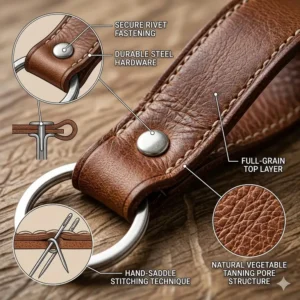
Identify the Tanning Method: Look for “Vegetable Tanned” (Veg-Tan) leather if you want a patina. Veg-tan uses natural tannins from tree bark and develops that classic “vintage” look. If you want the color to stay exactly the same forever, look for “Chrome Tanned” leather, which is more resistant to water and fading but won’t age as gracefully.
-
Hardware Weight: Pick up the keychain. Does the metal feel like plastic? That’s likely zinc alloy. It’s brittle and the “silver” finish will flake off in months. You want 316L Stainless Steel or Solid Brass. If the listing doesn’t specify the metal, it’s usually the cheap stuff.
-
The “Scent” Test: High-quality leather should smell like a library or an old saddle. If it smells like chemicals or “new car spray,” it’s likely “genuine leather” (which is actually the lowest grade of real leather, made from glued-together scraps).
-
Edge Finishing: Look at the edges of the leather. Are they raw and fuzzy? Or are they smooth and painted? High-end brands like Coach or Orbitkey burnish and paint their edges. This isn’t just for looks; it prevents moisture from entering the “core” of the leather and causing it to swell and rot.
-
Attachment Logic: Consider your car. Most modern cars have “proximity fobs.” You don’t actually need to flip your car key out; it just needs to be near the car. Therefore, look for a leather key chain that has a dedicated “D-ring” on the outside so your fob can hang freely while your house keys stay tucked away.
Full-Grain vs. Genuine Leather: The Marketing Trap You Need to Avoid
There is a massive “Information Density” gap in the leather industry that marketers love to exploit. You will see many products labeled “100% Genuine Leather” sold at a premium.
Here is the “Inside Insight”: “Genuine Leather” is a technical term for the third-best grade of leather. It’s essentially the “plywood” of the leather world. They take the leftover scraps from high-end hides, grind them up, glue them together, and then stamp a fake grain on top. Within six months of pocket use, “genuine leather” will begin to peel and crack because it lacks the natural fiber structure of the animal’s skin.
For a leather key chain, you should only accept Full-Grain or Top-Grain.
-
Full-Grain includes the very top layer of the hide (the epidermis), which is the toughest part. It has not been sanded or buffed, meaning all the natural strength remains. This is why a Northman keychain lasts 20 years.
-
Top-Grain is slightly sanded to remove imperfections and then finished with a protective coat. It’s thinner and more flexible, making it the perfect choice for “organizer” style products like Bellroy.
If a product page doesn’t explicitly say “Full-Grain” or “Top-Grain,” you should assume it’s “Genuine” and move on. The “Total Cost of Ownership” of a $10 “genuine” keychain is actually higher than a $40 “full-grain” one, because you’ll be replacing the cheap one every year.
Hardware Matters: Why 316L Stainless Steel Beats Plated Zinc
We often focus on the leather, but the hardware is the “engine” of your leather key chain. In my years of gear testing, I’ve seen more keychains fail due to a snapped ring than a torn strap.
Most budget keychains use “Zamak” (a zinc alloy). It’s cheap to cast and looks great in photos. However, Zamak is incredibly brittle. If you drop your keys on a cold winter day, a Zamak clip can literally shatter like glass. Furthermore, the “Chrome” finish is just a thin layer that will scratch off, exposing the dull gray metal underneath.
316L Stainless Steel (often called “Marine Grade”) is what you should look for. It’s used in high-end watches and surgical tools. It won’t rust, it won’t flake, and it has a high “tensile strength,” meaning it can bend slightly under pressure without snapping. When you see a brand like Orbitkey mention 316L, you know they aren’t cutting corners. It’s a “Hidden Cost Analysis” win: paying $10 more for stainless hardware ensures your house keys don’t end up on the pavement because of a snapped loop.
Sustainable Sourcing: What Does LWG-Gold Mean for Your EDC?
The leather industry has historically been a major polluter, particularly in terms of water usage and chemical runoff. However, in 2026, the “Ethical Consumer” has more power than ever. When shopping for a leather key chain, look for the LWG (Leather Working Group) certification.
LWG is a non-profit that audits tanneries based on their environmental performance. A “Gold” rating means the tannery has met the highest standards for energy use, waste management, and water treatment. Brands like Bellroy and Orbitkey use LWG-certified hides.
Why does this matter for the user? Beyond the environmental benefit, LWG-certified leather is generally higher quality. Tanneries that invest in top-tier environmental tech also tend to invest in the best raw hides and finishing techniques. It’s a “Proxy for Quality.” If a company cares enough to audit their water runoff, they care enough to ensure the leather won’t dye your pants blue the first time you get caught in the rain.
Case Study: The “Modern Commuter” vs. The “Homeowner”
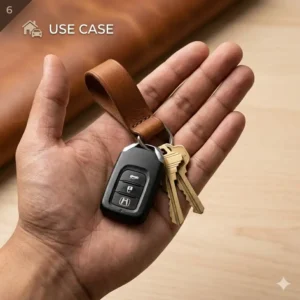
To help you decide, let’s look at two realistic user profiles I’ve encountered during my consulting work.
Profile A: The Urban Commuter (Mark)
Mark lives in an apartment, uses public transit, and carries a slim laptop bag. He hates bulk and noise.
-
The Choice: Orbitkey Leather.
-
Why: Mark only has three keys (Front door, Mailbox, Office). He carries his keys in the same pocket as his smartphone. The Orbitkey keeps his keys silent during his walk to the train and protects his phone screen. The $45 investment is “insurance” for his $1,200 device.
Profile B: The Suburban Homeowner (Sarah)
Sarah has a large house, two cars, and a shed. She’s constantly carrying groceries and kids. Her keys are frequently tossed into a large “everything” bag or clipped to her belt.
-
The Choice: Northman Heavy-Duty Loop.
-
Why: Sarah has 8-10 keys plus two large car fobs. An “organizer” would be too thick and frustrating to use. She needs something she can grab blindly from her bag or clip to her hip. The solid brass hardware ensures that even with the weight of 10 keys, the leather key chain will never break.
Features That Actually Matter (And Those That Don’t)
Marketing departments love to invent “features” to justify high prices. Here is my “Expert Filter” on what you actually need in a leather key chain.
-
Matters: Threadlocker. If your keychain uses a screw-post, it must have a nylon patch or a way to stay tight. Without it, the vibration of walking will eventually unscrew the post.
-
Matters: Internal Lining. If the leather is very thin (under 1.5mm), it needs a synthetic lining (like Nappa or Polymer) to prevent stretching.
-
Doesn’t Matter: RFID Blocking. Some brands claim their “leather key chain protects your keys from RFID theft.” This is almost entirely marketing hype for standard keys. While some car fobs can be “relayed,” a simple leather wrap doesn’t provide enough shielding to stop a determined thief. You’d need a dedicated Faraday pouch for that.
-
Doesn’t Matter: “Hand-Stitched” (Usually). While hand-stitching (the saddle stitch) is technically stronger than a machine lock-stitch, for a small item like a keychain that doesn’t bear heavy weight, a high-quality machine stitch is more than sufficient. Don’t pay a $50 “artisan” premium unless you just love the look.
Strategic Price Range & Value Analysis
When evaluating a leather key chain, I like to look at the “Cost-Per-Use.” You likely touch your keys 10-20 times a day. Over 365 days, that’s over 3,600 interactions per year.
| Price Tier | Expectation | Reality Check |
| Under $15 | “Genuine” leather, zinc hardware. | Will likely fail within 6-12 months. Best for temporary use. |
| $20 – $40 | Solid full-grain or top-grain, decent hardware. | The “Sweet Spot.” You get 90% of the quality of luxury brands. |
| $50 – $80 | Expert engineering, LWG-certified, premium hardware. | For those who value specific features like silence or ultra-slimness. |
| $100+ | Designer branding, exotic hides, luxury finishes. | Diminishing functional returns; you are paying for the brand and “prestige.” |
Analysis: If you are looking for the best ROI, the $25 – $45 range is where the most durable and functional products live. Products in the $100+ range are beautiful, but they don’t necessarily keep your keys “safer” than a $30 Northman loop.
✨ Don’t Miss These Exclusive Deals!
🔍 Take your organization to the next level with these carefully selected products. Click on any highlighted item to check current pricing and availability. These tools will help you create authentic style your family will love!
Conclusion: Investing in Your Daily Touchpoint
The search for the perfect leather key chain is ultimately a search for a better daily experience. By moving away from the “jingle” and toward a structured, high-quality leather solution, you are protecting your technology, streamlining your pockets, and adding a touch of tactile luxury to your routine.
In my experience, the Orbitkey Leather remains the most transformative choice for the modern professional, while the Northman Loop is the “buy it for life” champion for everyone else. Whichever you choose, remember that leather is a living material. Treat it with a little bit of care, and it will serve as a faithful companion for decades. Your keys are the gateway to your life; they deserve a home that is as resilient and refined as you are.
❓ FAQs
❓ How do I stop my leather key chain from smelling?
✅ Leather is porous and can absorb sweat. If your keychain develops an odor, wipe it with a mix of water and white vinegar (50/50), then let it air dry completely. Never use high heat (like a hairdryer) as it will crack the leather fibers…
❓ Can I put my car fob on a leather organizer?
✅ Yes, but most fobs are too thick to fit inside the wrap. Look for a model that includes a “D-ring” or a “Carabiner” attachment on the exterior so the fob can hang freely while the house keys stay organized…
❓ What is the best way to clean a white or light-colored leather key chain?
✅ Light leathers are prone to “denim transfer” (blue stains from jeans). Use a dedicated leather cleaner or a “Magic Eraser” very gently. However, realize that light leather will inevitably darken; it’s part of the natural aging process…
❓ Why does my screw-post keychain keep coming loose?
✅ This is caused by “vibrational loosening.” To fix it, apply a tiny drop of blue Loctite (threadlocker) to the screw before tightening. This creates a semi-permanent bond that can still be broken with a screwdriver when needed…
❓ Is “Vegan Leather” as good as real leather for keychains?
✅ Generally, no. Most “vegan leather” is just plastic (PU or PVC) and will peel and crack within months of pocket use. While there are newer mushroom or pineapple leathers, they currently lack the long-term durability required for a high-friction item like a keychain…
Recommended for You
- 5 Best belt key holder Options in 2026: Expert Field Tests & Reviews
- 5 Best belt loop key holder Options for 2026: Expert EDC Field Test
- 5 Best key clip Options for 2026: Expert EDC Organization Guide
Disclaimer: This article contains affiliate links. As an Amazon Associate, I earn from qualifying purchases. If you purchase products through these links, we may earn a small commission at no additional cost to you.
✨ Found this helpful? Share it with your friends! 💬🤗
[addtoany]
